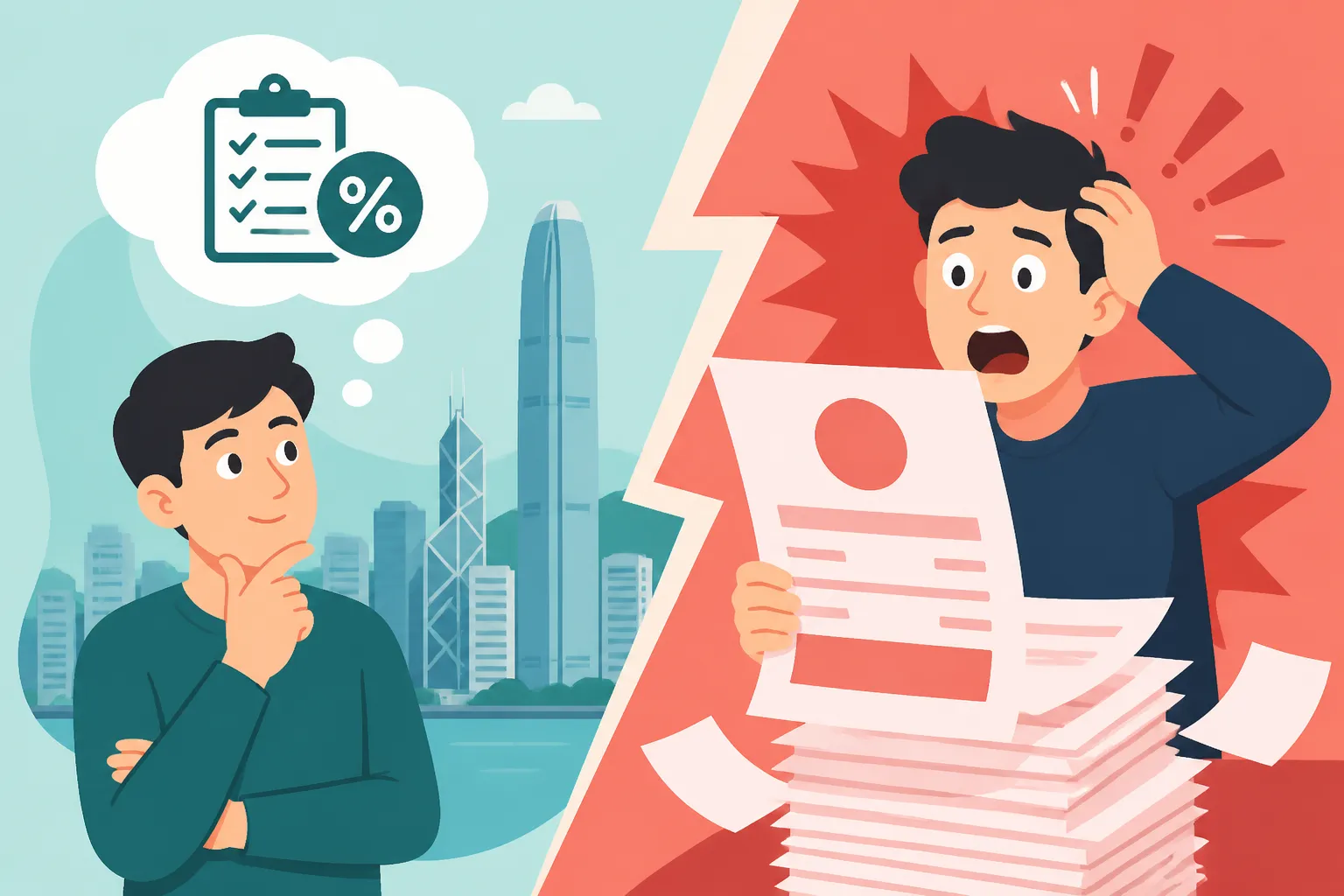
What is Provisional Tax and Why is My First Tax Bill So High?
Ah, the infamous Hong Kong tax bill! If you've just received your first one and found yourself staring at a figure that feels inexplicably high, trust me, you are not alone. It’s a rite of passage for many expats here, a moment of utter confusion followed by a frantic Google search asking, "What on earth is Provisional Tax, and why am I paying so much?" This guide is here to demystify that hefty first bill, explain exactly what Provisional Tax is, and arm you with strategies to manage it without breaking the bank.
The Hong Kong Tax System: A Primer on Salaries Tax
Before we dive into the beast that is Provisional Tax, let's quickly touch on how Hong Kong’s Salaries Tax generally works. It's often praised for its simplicity and low rates, and for good reason, but there are nuances that can catch newcomers off guard.
Hong Kong's Unique "Pay-as-You-Earn" (or Not Quite) System
Unlike many Western countries that operate on a true "pay-as-you-earn" (PAYE) system where tax is deducted from your salary each month, Hong Kong's Salaries Tax operates on an annual assessment basis. Your employer doesn't actually withhold your final tax liability from your monthly paycheque. Instead, they provide the Inland Revenue Department (IRD) with your earnings information, and you are responsible for settling your tax bill once it's issued. This can feel strange and often leads to a false sense of financial security throughout the year, only to be hit with a large bill at the end.
Imagine you've just arrived in Hong Kong, landed a great job, and you're seeing a fantastic gross salary hit your bank account. You might assume your employer is handling everything, or that the taxes are just that low. But then, the dreaded green envelope arrives, typically between May and August after the end of the tax year (which runs from April 1st to March 31st), and it's a shocker. This initial bill covers not just the tax for the year that just ended, but also a prepayment for the next year – that's the Provisional Tax component.
Salaries Tax Fundamentals: How it’s Calculated
Hong Kong's Salaries Tax is calculated on your net assessable income (your total income minus approved deductions and allowances). You'll pay either at a progressive rate on your net assessable income, ranging from 2% to 17% for 2026/27, or at a standard rate of 15% on your net assessable income before allowances, whichever is lower. This low standard rate is one of the biggest draws for professionals relocating here. There are also various allowances you can claim, such as basic personal allowances, married person's allowance, child allowance, and dependent parent allowance, which can significantly reduce your taxable income. For a deep dive into these, check out our guide on Claiming Tax Deductions: Domestic Rent, Elderly Care, and Donations and Personal vs Married Person's Tax Allowances Explained.
However, the calculation for your first tax bill often includes a surprise. The IRD is essentially playing catch-up, and they want to ensure they receive tax revenue consistently, even from new residents. This is where Provisional Tax steps in, transforming your seemingly simple tax calculation into a double whammy for newcomers.
Unpacking Provisional Tax: Why Your First Bill Stings
This is it – the core of the mystery behind that unexpectedly high tax statement. Provisional Tax is probably the single most common cause of financial distress for expats during their first year or two in Hong Kong.
The Concept of Provisional Tax Explained
In simplest terms, Provisional Tax is an advance payment of your Salaries Tax for the current tax year. When the IRD assesses your tax liability for a particular year (let’s call it Year 1), they will simultaneously estimate your tax liability for the next year (Year 2) and demand that you pay both at the same time. The idea is that your income isn't likely to change drastically from one year to the next, so they're asking you to pay Year 2's tax in advance, based on Year 1's figures.
Think of it like this: The IRD issues a "Notice of Assessment" for Year 1. On that same notice, they also issue a "Notice of Provisional Assessment" for Year 2. So, your bill for Year 1 will essentially be: Actual Tax for Year 1 + Provisional Tax for Year 2.
This system ensures a steady stream of revenue for the government and helps prevent a situation where taxpayers accumulate a massive bill over several years. For established residents, it often feels like you're just paying "last year's tax" because you've already paid the provisional amount for the current year. But for someone new, or someone with a sudden jump in income, it can be a significant financial burden.
How Provisional Tax is Calculated
The calculation for Provisional Tax is usually based on your net assessable income for the immediate preceding year. So, if your first tax bill is for the 2024/25 tax year (which you receive around mid-2025), the Provisional Tax component on that same bill will be an estimate for your 2025/26 tax year, and that estimate will be based on your actual 2024/25 income.
For example:
- You earned HKD 800,000 in the 2024/25 tax year.
- Your assessed Salaries Tax for 2024/25 might be, say, HKD 90,000 after deductions and allowances.
- The IRD will then estimate your income for 2025/26 to be the same HKD 800,000, and thus estimate your Provisional Tax for 2025/26 to be another HKD 90,000.
- Your total bill, issued in mid-2025, will be HKD 90,000 (actual for 2024/25) + HKD 90,000 (provisional for 2025/26) = HKD 180,000.
This is the "double payment" scenario that catches so many off guard. You're effectively paying nearly two years' worth of tax in one go, often within a few months, and usually split into two installments.
Why Your First Bill Feels Like a Punch to the Gut
The reason this system feels particularly harsh on your first bill is precisely because you haven't built up that "credit" of provisional payments yet. For long-term residents, the provisional tax paid last year covers this year's liability, so when the new bill arrives, it's just a top-up or a small adjustment, plus the next year's provisional amount. They’re used to the cycle.
But as a newcomer, you’re essentially starting from zero. You have to pay the full actual tax for the first year you were assessed and the full provisional tax for the subsequent year, all at once. This can represent a substantial portion of your annual income, especially if you have a high-earning job. Many expats simply aren't prepared for this large outgoing, having assumed Hong Kong's low tax rates meant a negligible annual bill.
The IRD typically splits this large payment into two installments. For a tax year ending March 31st, the first installment is often due in January or February of the following calendar year, and the second in April. So, for a 2024/25 tax year assessment received in August 2025, your first payment might be due in January 2026, and the second in April 2026. These dates can feel very close together, adding to the pressure.
Strategies for Managing Your Provisional Tax Bill
Don't panic! While the bill can be intimidating, there are avenues to manage it. Understanding your options is key to navigating this unique aspect of Hong Kong taxation.
Checking Your Assessment for Accuracy
Before anything else, carefully review your "Notice of Assessment" (Form BIR60) as soon as you receive it. Errors can happen.
- Income Details: Does the assessable income match what you actually earned for that tax year? Check against your employment income statement.
- Deductions: Have all your eligible deductions been applied? This could include approved charitable donations, home loan interest, or even mandatory provident fund (MPF) contributions beyond what your employer contributes, up to the maximum allowable. Our guide on Mandatory Provident Fund (MPF): Contribution Rules and Options might be helpful here.
- Allowances: Are all your personal allowances correctly reflected? If you got married, had a child, or started supporting a dependent parent in the last tax year, ensure these are included. If not, you may need to file an objection or request an amendment.
It's common for expats to miss out on claiming certain allowances or deductions simply because they aren't aware of them or the forms can be a bit daunting. Services like Taxes for Expats can often help you review your assessment for potential omissions.
Applying for a Holdover of Provisional Tax
This is often the most critical strategy for expats facing a high first Provisional Tax bill. If you anticipate that your actual tax liability for the current year (the year the provisional tax is for) will be significantly lower than the amount the IRD has estimated, you can apply for a "holdover" of your Provisional Tax. This effectively defers or reduces the provisional amount you have to pay.
Common reasons for applying for a holdover include:
- Reduced Income: Your income for the current year is, or is likely to be, at least 10% less than the income for the year of assessment on which the Provisional Tax was based. This could happen if you've changed jobs with a lower salary, taken unpaid leave, or if your employment ceased during the year.
- Cessation of Employment: You ceased employment during the year for which Provisional Tax was charged and will not be earning any further assessable income.
- Increased Allowances: You become eligible for new personal allowances (e.g., marriage, birth of a child, supporting elderly parents) that were not taken into account when the Provisional Tax was calculated.
- Property Tax: If you're paying property tax on rental income and your rental income has significantly decreased.
The process involves completing a specific form (Form IR1121) and submitting it to the IRD. Crucially, you must submit this application no later than 28 days before the due date for payment of the Provisional Tax, or 14 days after the issue date of the Notice of Assessment, whichever is later. Miss these deadlines, and it becomes much harder to argue your case. Our article on Understanding the "Holdover of Provisional Tax" Application delves into this in much greater detail.
It's important to provide clear, accurate, and verifiable reasons for your holdover application. If you've just arrived and started work partway through the tax year, your actual income for that initial year might be lower than a full year's salary, and the IRD might have based your provisional tax on a full-year projection. This is a perfect scenario for a holdover application.
Payment Options and Installments
If a holdover isn't applicable or is denied, you'll need to pay the bill. The good news is that the IRD generally splits the Provisional Tax bill into two installments.
- First Installment: Usually around 75% of the total amount, due typically in January or February.
- Second Installment: The remaining 25%, usually due in April.
You have several ways to pay your tax bill in Hong Kong. You can pay by EPS, by telephone, via the eTAX portal (using credit cards, PPS, or internet banking), or even by cheque. For more options, check out our guide on How to Pay Tax by Telephone, eTAX, or ATM in Hong Kong. Some expats, especially those sending money internationally, find services like Wise useful for managing their finances and ensuring funds are ready for these payments without excessive exchange fees.
It's tempting to ignore the bill or delay payment, but this is a dangerous game. The IRD can impose surcharges for late payments and even take legal action. If you genuinely cannot afford to pay, contact the IRD before the due date to explain your situation and explore options for installment plans. They are generally more lenient if you communicate proactively.
Forward Planning: Preparing for Future Tax Assessments
Once you've navigated your first Provisional Tax bill, you'll be much wiser! Planning ahead can save you a lot of stress (and potentially money) in subsequent years.
Budgeting and Saving for Future Bills
Now that you know the drill, incorporate your annual tax liability into your financial planning. Many expats find it helpful to set aside a portion of their monthly salary into a separate savings account, specifically for their tax bill. Consider it a mandatory saving, just like rent or utility bills.
- Estimate Your Liability: After your first assessment, you'll have a much better idea of your annual tax. Divide that by 12 and try to put that amount aside monthly.
- Review Allowances Annually: Keep track of any changes in your personal circumstances that might affect your allowances or deductions for the next tax year. Did you have another child? Are you now supporting a dependent parent? These can reduce your taxable income.
- Consider a "Tax Buffer": Hong Kong's economy can be dynamic. Having a small buffer in your tax savings can help if your income unexpectedly increases or if there are changes to tax policies.
For a broader understanding of managing your finances in Hong Kong, our article on Everyday Budgeting in HK: Cost of Living Benchmarks (2026) can provide valuable insights.
When to Seek Professional Advice
While Hong Kong's tax system is relatively straightforward compared to some other jurisdictions, it can still be complex, especially for those with unique financial situations, such as:
- Share Options or Equity Compensation: The taxation of these can be tricky.
- Overseas Income: If you have income from outside Hong Kong, how it's treated for tax purposes depends on various factors.
- Business Income: If you're a freelancer or run your own business, the Profits Tax rules apply, which are different from Salaries Tax.
- Leaving Hong Kong: There are specific tax clearance procedures you need to follow, including obtaining a Tax Clearance Letter (IR56G): What You Need Before Leaving HK.
This is where professional tax advisors, like those at Taxes for Expats, can be invaluable. They can help ensure you're claiming all eligible deductions and allowances, advise on complex income scenarios, and assist with holdover applications or objections if needed. Their expertise can potentially save you more than their fees in the long run.
Understanding Your Financial Year and Income Fluctuations
Your Provisional Tax is based on your previous year's income. It's an estimate. If your income for the current year is expected to be substantially different from the previous year, this needs to be addressed.
- Promotions or Raises: If you received a significant pay raise or promotion, your Provisional Tax might be an underestimation. This is a "good problem," but be prepared for a larger bill next year.
- Demotions or Pay Cuts: If your income drops by more than 10%, you have strong grounds for a holdover application.
- Change of Employment: Switching jobs, especially if it involves a period of unemployment or a different salary structure, will impact your actual income and should be factored into your Provisional Tax planning. If your new employer offers a substantial housing allowance, remember to account for How Employer Housing Allowances Reduce Your Salaries Tax.
It’s crucial to keep good records of your income, expenses, and any changes in personal circumstances. The more organized you are, the easier it will be to accurately assess your tax situation and apply for adjustments when necessary.
Scenarios Where Provisional Tax Might Be Reduced or Waived
The IRD understands that life happens, and income isn't always perfectly stable. There are specific circumstances under which you can apply for a reduction or even a waiver of your Provisional Tax.
Income Reduction
As mentioned, if your income for the current year is expected to be at least 10% lower than the basis of assessment for your Provisional Tax, you can apply for a holdover. This isn't just for job loss; it can also be due to:
- Reduced working hours: Perhaps you've switched to part-time, or your employer has cut hours.
- Lower bonus: If your bonus structure changed, or you anticipate a significantly smaller bonus than the previous year.
- Unpaid leave: Taking extended unpaid leave will reduce your annual income.
When making this application, you'll need to provide evidence, such as a letter from your employer, new employment contracts, or a clear explanation of your circumstances.
Changes in Personal Circumstances
Life events can have a significant impact on your tax liability, and the IRD provides allowances for these. If, after your Provisional Tax was assessed, you experienced changes that entitle you to new or increased allowances, you can apply for a holdover. These include:
- Marriage: Entitling you to a married person's allowance.
- Birth of a child: Entitling you to child allowance.
- New dependent parent/grandparent: If you start maintaining a dependent parent or grandparent, you can claim the dependent parent/grandparent allowance.
- New dependent sibling: If you start maintaining a dependent sibling.
- Becoming a single parent: Eligibility for single parent allowance.
It's vital to report these changes to the IRD, ideally when you file your next tax return (BIR60), but for Provisional Tax purposes, an immediate holdover application could be beneficial.
Leaving Hong Kong
If you are planning to leave Hong Kong permanently, your Provisional Tax liability for the current year may be affected. The IRD requires you to undergo tax clearance before your departure. As part of this process, your final tax assessment will be calculated, and any Provisional Tax you've paid that exceeds your actual final liability will be refunded. Conversely, if you still owe tax, you'll need to settle it before you leave.
This is a critical step, and rushing it can cause headaches down the line. It's often best to plan your departure with enough time to complete your tax clearance properly. This also ties into managing your financial exit strategy from Hong Kong, including things like closing bank accounts and managing your MPF, as covered in our guide Leaving Hong Kong Financially Prepared: Taxes, Banks, and MPF. You can also use services like Wise to facilitate any international transfers you might need to make once your finances are in order.
A holdover application due to cessation of employment and departure from Hong Kong requires specific documentation, usually including your flight itinerary or new visa if you're moving to another country.
Provisional Tax vs. Actual Tax: A Quick Comparison
Here's a simplified look at how your tax bill components typically appear:
| Component | First Year (e.g., 2024/25) | Subsequent Years (e.g., 2026/27) |
|---|---|---|
| Salaries Tax for Year 1 | Full amount for 2024/25. | Adjustment for 2025/26 (actual vs. provisional paid). |
| Provisional Tax for Year 2 | Full amount for 2025/26, based on 2024/25 income. | Full amount for 2027/28, based on 2026/27 income. |
| Total Bill Impact | Feels like paying two years of tax at once. | Feels like paying "last year's tax" plus a prepayment for the next. |
| Shock Factor for Expats | High, often unexpected. | Generally lower, more predictable. |
| Installments | Usually two large installments. | Usually two installments. |
| Holdover Applicability | High likelihood of eligibility due to partial year income. | Applicable if income or allowances change significantly. |
Navigating Hong Kong's Provisional Tax system can feel like a steep learning curve, especially if you're used to different tax regimes. But by understanding its purpose, how it's calculated, and the options available for managing it, you can turn that initial shock into a well-managed part of your annual financial routine. Don't be afraid to seek professional advice when needed, and always review your assessments carefully.
Disclaimer
The information provided in this guide is for general informational purposes only and does not constitute financial, tax, or legal advice. Tax laws and regulations in Hong Kong can change, and individual circumstances vary. It is highly recommended to consult with a qualified tax advisor or the Hong Kong Inland Revenue Department for personalized advice regarding your specific tax situation.