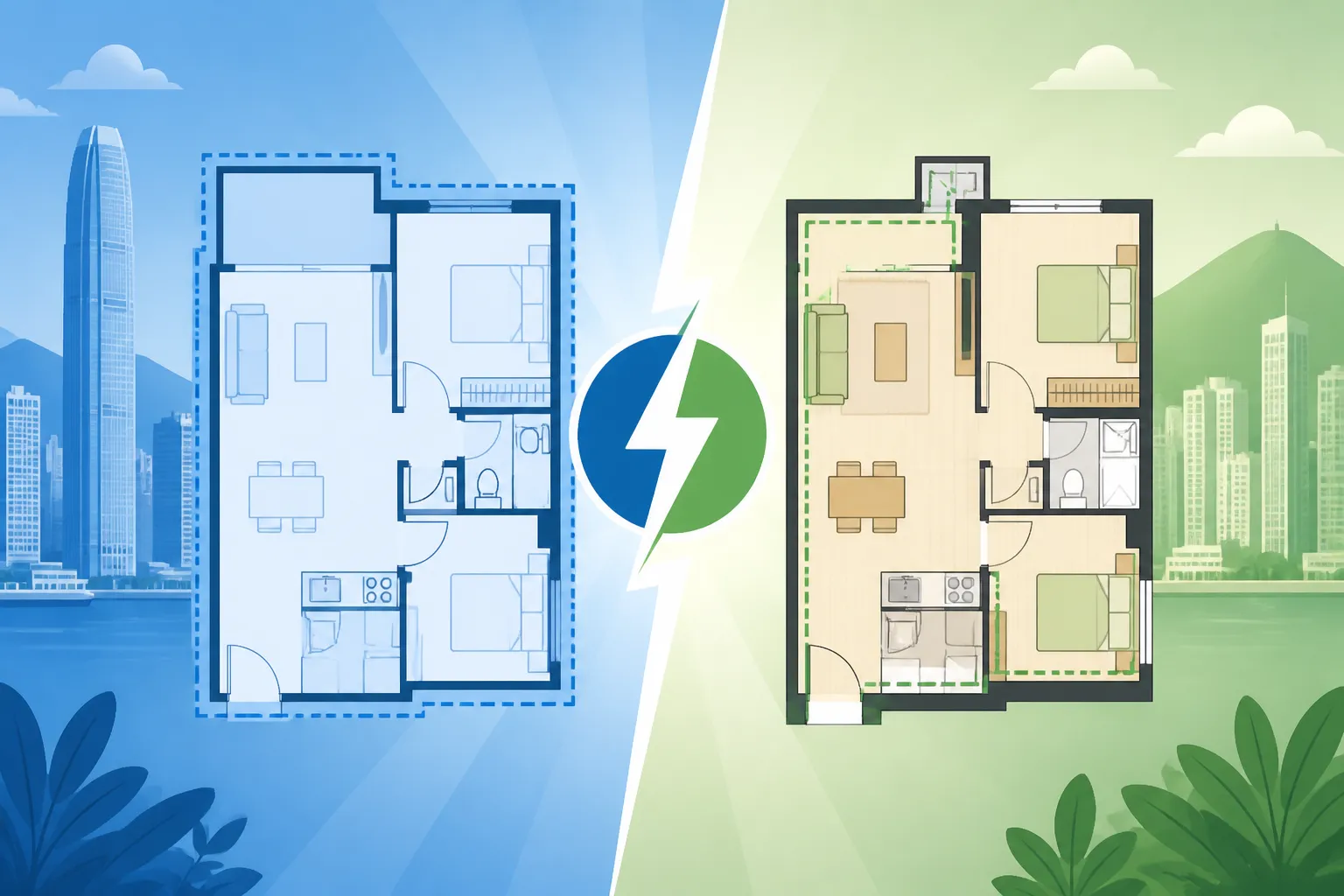
Understanding “Gross Area” vs “Saleable Area” in HK Apartments
One of the first bewildering things you'll encounter when searching for a home in Hong Kong is the sheer discrepancy between the advertised size of an apartment and what it feels like when you step inside. This often comes down to the confusing difference between "Gross Area" and "Saleable Area." As an expat, understanding these terms isn't just about semantics; it's crucial for managing expectations, budgeting, and ensuring you get what you pay for. This guide will meticulously break down these two key measurements, help you navigate apartment listings with confidence, and empower you to make informed decisions in Hong Kong's unique property market.
The Tale of Two Sizes: Unpacking Gross Area
When you first see a property listing in Hong Kong boasting a generous 800 square feet, your heart might skip a beat, picturing ample space. Then you visit the apartment and wonder if you've walked into a funhouse mirror. More often than not, that initial large number refers to the "Gross Area." It's a figure that includes much more than just the space you'll actually inhabit, which can be a real shock if you're not prepared.
What Exactly is Gross Area?
Think of Gross Area as the developer's way of telling you how much total space they've allocated to your unit and its share of the building's common areas. This measurement includes the internal floor area of your apartment, but critically, it also encompasses a proportionate share of the common parts of the building. We're talking about things like elevator shafts, stairwells, lobbies, shared corridors on your floor, communal clubhouses, and even the thickness of external walls and some shared internal walls of the building itself. It's essentially the entire footprint, including all the structural elements and shared amenities that serve your unit. Historically, this was the primary way property sizes were marketed, as it allowed developers to present a more impressive number to potential buyers and tenants.
For example, imagine a building with a stunning lobby, a huge gym, and sprawling outdoor terraces. While these amenities are fantastic, a portion of their square footage will be factored into your apartment's Gross Area. This means that a significant chunk of that "800 square feet" might be dedicated to the lift lobby on your floor or the communal swimming pool, rather than your actual living room. It's a metric that can paint a very misleading picture of the usable space, leading to considerable frustration if you're expecting a cavernous apartment based purely on the advertised number.
The Practical Implications for Expats
The most immediate implication of Gross Area is how it inflates the perceived size of your potential home. You might view a 600 sq ft (gross) apartment and then a 450 sq ft (saleable) apartment, and while the numbers look vastly different, the actual living space could be quite similar. This can be particularly frustrating when you're trying to compare properties, as an agent might lead with the gross area to make a unit seem more appealing. It's like buying a pizza based on the size of the box, not the pizza itself!
Beyond just perception, Gross Area can also impact your wallet. In many Hong Kong buildings, especially older ones, the service charges or management fees are calculated based on the Gross Area of your unit, not the Saleable Area. This means you could be paying maintenance fees for space you don't even step foot in – stairwells, common hallways, or even parts of the building's exterior. This is a crucial detail to clarify when looking at a property, as those management fees can add a significant amount to your monthly expenditure. When you're trying to budget your Everyday Budgeting in HK: Cost of Living Benchmarks (2026), these hidden costs can really add up, making a seemingly affordable place less so.
The Reality Check: Understanding Saleable Area
Thankfully, in recent years, Hong Kong has made strides to provide more transparency in property listings. This is where "Saleable Area" comes into play, offering a much more realistic and honest representation of the space you're actually paying for and living in. It’s the number you should always prioritize when evaluating a property.
Defining Saleable Area (The Real Living Space)
Saleable Area is, simply put, the internal floor area of the property, including any balconies, utility platforms, or verandahs that are exclusively for the use of that unit. The key here is "internal" and "exclusive use." It specifically excludes common areas like lobbies, staircases, and communal facilities, as well as the thickness of external walls or shared internal walls. It's the space where you can actually put your furniture, walk around, and live your daily life without bumping into shared walls or paying for the square footage of the building's fire escape.
Since the implementation of the Residential Properties (First-hand Sales) Ordinance in 2013, developers are legally required to state the Saleable Area prominently when selling new properties. While this law primarily targets first-hand sales, the push for transparency has influenced the broader rental market as well. You'll find that many reputable agents and property portals now specify both gross and saleable areas, or at least have the information readily available. This regulatory change was a huge win for consumers, especially for foreigners who found the previous system completely baffling. When you look at the floor plan, the Saleable Area is essentially the sum of all the rooms within your apartment, plus your private balcony if you have one.
Why Saleable Area Matters Most to You
For an expat settling into Hong Kong, the Saleable Area is the metric that truly matters. This is the tangible space where you'll be placing your sofa, setting up your bed, and determining if your dining table will actually fit. When you're planning your move, unpacking your boxes, and trying to make a compact Hong Kong apartment feel like home, the Saleable Area dictates your reality. It's the critical number for understanding the true value for money you're getting, particularly in a city where every square foot comes at a premium.
Think about it: if you're comparing two apartments, one listed as 700 sq ft (gross) and another as 500 sq ft (saleable), without knowing the saleable area of the first, you're not comparing apples to apples. The 700 sq ft (gross) unit might only have 450 sq ft of saleable area, making the 500 sq ft (saleable) unit actually larger in terms of usable space. This crucial distinction affects everything from how much furniture you can realistically bring to whether you feel comfortable or cramped in your new home. Many expat-focused rental platforms and services like Sirelo, Blueground, and Habyt often highlight saleable area to give a clearer picture, which can be incredibly helpful when you're initially browsing.
The Hong Kong Apartment Paradox: Why the Confusion Persists
Despite the increased transparency, the dual measurement system of gross and saleable area can still be a source of confusion, especially for newcomers. This paradox is rooted in historical practices and the unique dynamics of the Hong Kong property market. It's a quirk that, like many things in Hong Kong, requires a bit of local insight to navigate effectively.
Historical Context and Developer Practices
Before the 2013 ordinance, marketing properties solely by gross area was the norm. Developers found it advantageous to quote larger numbers, as it naturally made units seem more spacious and therefore more appealing, especially in a city where space is such a luxury. This practice became ingrained in the industry, and even now, while new developments are more transparent, older buildings (which constitute a significant portion of the rental and sales market) might still primarily be referred to by their gross area. You'll often hear agents confidently rattle off the gross area first, sometimes requiring you to specifically ask for the saleable figure.
The psychological impact of these numbers is powerful. A "750 sq ft apartment" sounds much grander than a "550 sq ft apartment with an additional 200 sq ft of common area allocation." This legacy of marketing means that even with better regulations, the old habits and expectations linger, contributing to the initial bewilderment many foreigners experience. It takes a conscious effort to re-calibrate your understanding of size in the Hong Kong context. When you're looking for a Short-Term Serviced Apartments for Your First Month in HK, the gross area might be quoted, but always dig for the saleable area to understand your actual space.
Navigating the Market as a Foreigner
As a foreigner, this dual system adds an extra layer of complexity to an already challenging rental market. It means you can't simply rely on online listings' headline figures. When you're engaging with an agent to find a place, whether in bustling Living in Mid-Levels and Central: Pros, Cons, and Commutes or the more suburban Family-Friendly Discovery Bay (DB) and Lantau Island, always be prepared to ask pointed questions. Don't be shy to inquire about both the gross and saleable area for every property you consider.
Another critical step is to always request floor plans with dimensions. These are invaluable tools for visualizing the space and understanding how you might arrange your furniture. Even better, nothing beats an actual site visit. During a viewing, take a mental (or actual) measuring tape with you. Pay attention to how the space feels, where the walls are, and what areas are truly functional for your living needs. If you're comparing an older building that might only list gross area with a newer one that prominently features saleable area, remember to factor in that the older unit's gross area will likely have a much larger common area component, making its actual living space even smaller relative to the headline figure. This diligence will help you avoid disappointment and ensure you're making a truly informed choice. Reputable rental platforms, including those like Habyt, often provide clear floor plans that distinguish usable space, helping bridge this information gap.
Practical Tips for Measuring and Comparing Apartments
Navigating the Hong Kong property market requires a bit of strategic thinking and a proactive approach, especially when it comes to understanding apartment sizes. Don't let the numbers intimidate you; with a few simple tips, you can become a pro at discerning true living space.
Essential Questions for Your Agent
When you're embarking on your Step-by-Step Guide to Renting an Apartment in Hong Kong, the agent is your primary source of information, but you need to ask the right questions. First and foremost, for every property, clearly ask for both the Gross Area and the Saleable Area. If they only provide one, politely insist on the other. This immediately tells you the "efficiency" of the apartment – how much of the gross area is actually usable.
Secondly, if the property includes balconies, utility platforms, or verandahs, ask if these spaces are included in the stated Saleable Area, and if so, what their individual dimensions are. Sometimes these outdoor or semi-outdoor spaces are indeed part of the Saleable Area, but knowing their exact size helps you visualize what you can do with them – a small balcony for a plant versus one large enough for a small table and chairs. Finally, always request a detailed floor plan, ideally one that includes measurements. This plan should clearly delineate internal walls, external walls, and any shared spaces. Don't just look at the overall shape; mentally (or physically) plot out where your furniture would go.
Making Sense of Your Options
Once you start gathering data on multiple properties, it can be easy to get overwhelmed. A great strategy is to create a simple comparison table like the one below. This allows you to standardize the information and compare properties on an even playing field. When discussing budgets and potential How to Negotiate Rent with a Hong Kong Landlord, having these figures clearly laid out can give you leverage.
| Feature | Apartment A (e.g., Older Building) | Apartment B (e.g., Newer Development) |
|---|---|---|
| Advertised Size | 800 sq ft (Gross) | 600 sq ft (Saleable) |
| Stated Gross Area | 800 sq ft | ~800 sq ft (if available) |
| Stated Saleable Area | ~600 sq ft (if provided, else estimate) | 600 sq ft |
| Difference (Gross-Saleable) | ~200 sq ft | ~200 sq ft |
| Approx. Efficiency | 75% | 75% |
| Monthly Rent | HKD 35,000 | HKD 38,000 |
| Rent per Saleable Sq Ft | HKD 58.33 | HKD 63.33 |
| Management Fees | HKD 3,000 (based on Gross) | HKD 2,500 (based on Saleable) |
| Total Monthly Cost | HKD 38,000 | HKD 40,500 |
(Note: Efficiency is a rough percentage of saleable area to gross area. This is a crucial metric for comparison.)
When you're physically viewing apartments, consider bringing a small measuring tape. This isn't just for fun; it allows you to quickly check if a crucial wall is wide enough for your bed, or if the living room really can accommodate your sofa. It's also an excellent way to gauge whether the actual space aligns with the stated Saleable Area on the floor plan. Ultimately, when calculating the real cost of your rent, always divide the rent by the Saleable Area to get a true "per square foot" value. This provides the most accurate basis for comparison across different properties and helps you understand the true value you're receiving for your money. Remember to also understand the nuances of your Understanding the HK Tenancy Agreement: Fixed vs Flexible Terms to ensure you're aware of all clauses related to the property.
Disclaimer
The information provided in this guide is for general informational purposes only and does not constitute legal, financial, or real estate advice. While every effort has been made to ensure accuracy, the Hong Kong property market and its regulations can change. It is strongly recommended to consult with a qualified real estate agent, lawyer, or financial advisor for personalized advice regarding your specific situation in Hong Kong.