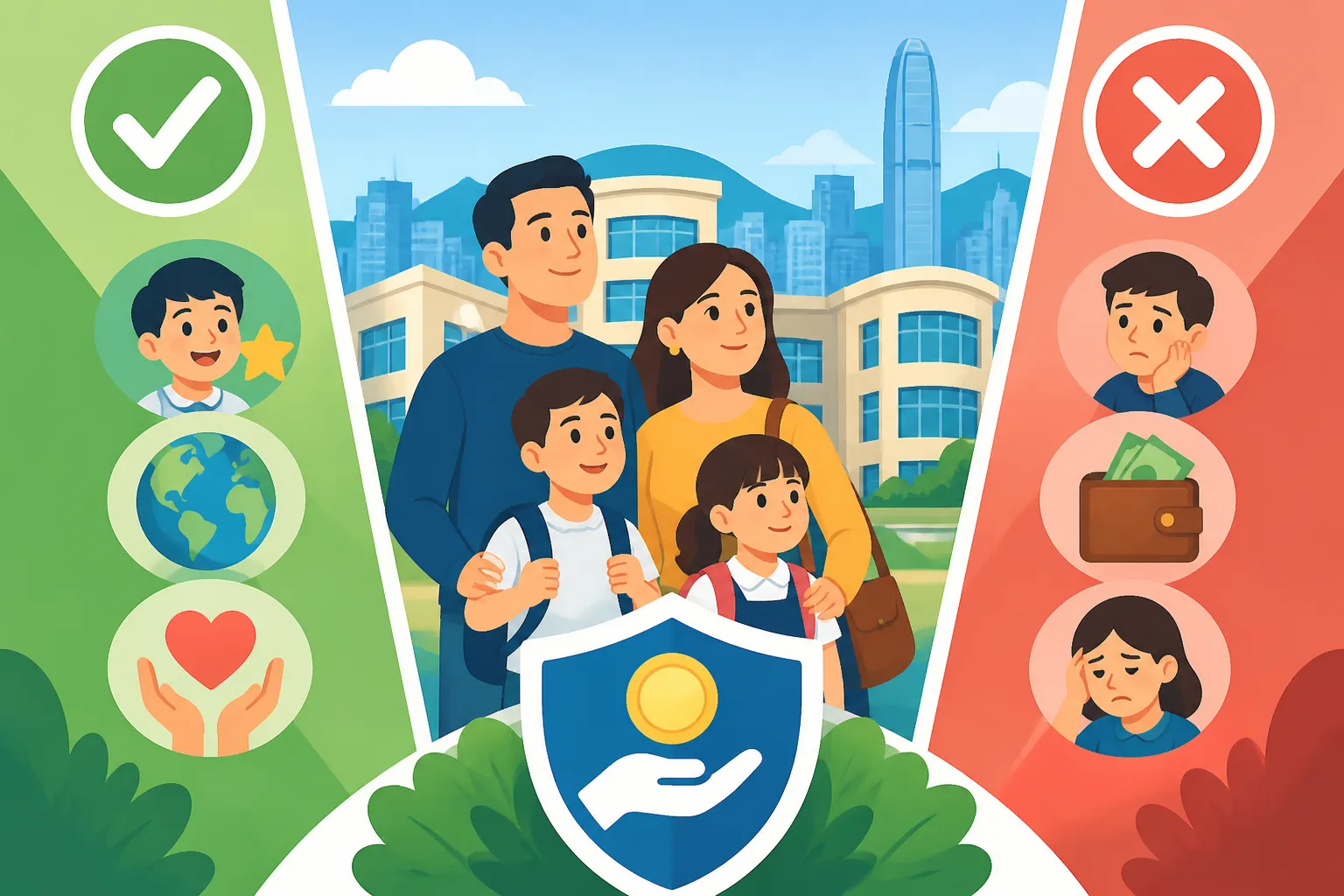
Local HK Schools for Expat Kids: Pros, Cons, and EDB Subsidies
Deciding whether to plunge your child into the local school system or shell out for an international one is the ultimate expat crossroads. I remember standing outside a local primary school in Mong Kok, watching kids in crisp uniforms, wondering if my daughter would sink or swim in a sea of Cantonese. This guide breaks down the local school reality to help you decide.
Understanding the Local Hong Kong School System
The local education system in Hong Kong is a sprawling, complex beast that can feel incredibly opaque if you did not grow up within it. Unlike many Western systems where you simply "enroll at the nearest school," Hong Kong utilizes a centralized, points-based allocation system that often feels like a high-stakes lottery. For many expats, the first hurdle is simply deciphering the terminology used by the Education Bureau (EDB) and understanding that not all "local" schools are created equal.
Primary One Admission and Secondary School Place Allocation
The process of getting into a local school is divided into two main stages: the Discretionary Places stage and the Central Allocation stage. During the discretionary phase, parents can apply to one school of their choice regardless of where they live. Schools use a point system based on factors like whether a sibling already attends or if a parent is an alumnus. If you are a first-generation expat with no local ties, you will likely find yourself relying on the Central Allocation stage, which is essentially a "big shuffle" based on your residential district.
Navigating How the EDB School Allocation System Works for Local Schools is essential because the district you live in dictates your "school net." Some nets, like those in Kowloon Tong or Central and Western District, are incredibly competitive because they house the "elite" traditional schools. If you are aiming for these, you need to understand that the competition starts early, often beginning with Interview Tips for HK Kindergartens: Preparing Your Toddler to ensure they get into a "feeder" preschool that helps them climb the ladder.
Secondary school admission is even more rigorous, involving a banding system (Band 1, 2, and 3) based on academic performance. Your child’s primary school grades and the results of Internal Assessments for the Purpose of Secondary School Places Allocation (Pre-S1 exams) will determine which band they fall into. This dictates which secondary schools they are eligible for, creating a pressure-cooker environment that starts as early as Primary 4.
Government Schools vs Aided Schools vs Direct Subsidy Scheme
There are three primary categories of schools within the local system, and the differences in autonomy and cost are significant. Government schools are fully funded and managed by the EDB; they follow the national curriculum strictly and are entirely free. Aided schools are also free and follow the curriculum but are managed by voluntary bodies, often religious organizations like the Catholic Diocese or the Anglican Church (Sheng Kung Hui). Most local schools fall into the "Aided" category.
The third category, Direct Subsidy Scheme (DSS) schools, is often the "sweet spot" for expat families. These schools receive government subsidies but are allowed to charge tuition fees and have more flexibility in their curriculum and admissions. Many DSS schools offer a mix of the local HKDSE curriculum and international options like the IB or IGCSE. If you find International Schools in HK: Curriculums, Debentures, and Applications too expensive, a DSS school provides a middle ground with better facilities and often a more diverse student body than a standard government school.
Choosing between these requires a hard look at your family’s long-term goals. If you plan to stay in Hong Kong forever, a traditional Aided school offers deep local integration. If you might move in three years, a DSS school with an international stream might be a safer bet for your child’s transition.
The Pros of Sending Expat Children to Local Schools
While the local system has a reputation for being intense, the benefits for a foreign child can be life-changing. Beyond the obvious financial savings, the "local experience" provides a level of cultural and linguistic immersion that no international school can truly replicate. It forces a child to view the world through a different lens, building a type of resilience and adaptability that is highly valued in the global job market.
Radical Language Immersion and Cultural Fluency
The most immediate benefit is the acquisition of Cantonese and, increasingly, Mandarin. In a local school, your child isn't just "learning" the language; they are living it. They hear it in the hallways, on the playground, and during school assemblies. While Learning Cantonese vs Mandarin for Career Growth in HK is a common goal for adult expats, children who attend local schools often reach a level of native-like fluency that allows them to navigate Hong Kong society with ease.
Beyond the language, there is the "cultural shorthand" that children pick up. They learn the nuances of Chinese etiquette, the importance of filial piety, and the collective spirit of the Hong Kong people. This deep cultural fluency is something that cannot be taught in a textbook. Your child will grow up feeling like a part of the city rather than a temporary observer. They will understand the significance of the Lunar New Year or why certain Weather Warnings and School Closures: T8 and Red Rainstorm Rules are treated with such seriousness by the local community.
This immersion extends to the social circle of the parents as well. By joining the local PTA, you will meet Hong Kong families from all walks of life. It breaks the "expat bubble" and provides a much more authentic experience of living in the territory. You will learn about the best local tutors, the hidden gems in wet markets, and the real-world concerns of your neighbors.
Financial Relief and the Role of EDB Subsidies
Let’s be honest: the cost of international education in Hong Kong is eye-watering. Between tuition, mandatory debentures, and capital levies, you can easily spend HKD 250,000 per year, per child. In contrast, local government and aided schools are free. This financial freedom allows expat families to allocate funds toward better housing, travel, or retirement savings. Even DSS schools, which do charge fees, are significantly cheaper, often ranging from HKD 20,000 to HKD 60,000 per year.
The EDB also provides various subsidies that help reduce the "hidden costs" of education. For example, the Student Grant provides a flat rate (usually around HKD 2,500) per year to every student in Hong Kong to help with school-related expenses. There are also textbook allowances and transport subsidies for families who meet certain income criteria. When you compare this to the "hidden costs" found in Maternity Packages at Private Hospitals: What to Budget in 2026, the local school system represents a massive financial relief for the average family.
Furthermore, the government’s "Free Quality Kindergarten Education Scheme" means that even the early years can be heavily subsidized if you choose a participating local kindergarten. This allows you to start the immersion process early without the financial burden that usually accompanies high-quality childcare in other global cities.
Academic Rigor and STEM Focus
Hong Kong’s local schools are consistently ranked among the best in the world for mathematics and science. The curriculum is incredibly rigorous, emphasizing rote learning, mental math, and disciplined study habits. While this "drill and kill" method is often criticized, it produces students with a formidable work ethic and a solid foundation in core subjects. If your child is naturally inclined toward STEM, they may find the local curriculum challenging and rewarding.
The competition within the system pushes students to excel. While this can be stressful, it also fosters a sense of achievement. Students learn to handle high-pressure exams from a young age, which can be an advantage when they eventually apply for universities. Many local students transition seamlessly into top-tier global universities because their academic "floor" is so much higher than that of their peers in more relaxed systems.
Additionally, the discipline enforced in local schools is legendary. From School Uniform Rules and Where to Buy Them in HK to the strict punctuality and respect for teachers, the environment is very structured. For some children, this structure is exactly what they need to thrive. They know what is expected of them, and the clear boundaries of the local school system can provide a sense of security and purpose.
The Cons and Reality Checks for Foreign Families
It isn’t all easy transitions and free tuition. The local system is a shock to the system for most Westerners, and the "culture clash" can be a significant source of stress for both the child and the parents. You have to be prepared for a fundamental shift in how you view education, moving away from a "child-centered" holistic approach toward an "achievement-centered" competitive model.
The Homework Mountain and Tiger Mom Culture
The sheer volume of homework in the local system is often the biggest deal-breaker for expat families. It is not uncommon for a Primary 1 student to have two hours of homework every night, plus multiple "dictations" (spelling and memory tests) and quizzes every week. The weekends are often consumed by "supplementary exercises" and preparation for the next week’s assessments. This can leave very little time for the "free play" or extracurricular activities that many Western parents prioritize.
The "Tiger Mom" culture is a real phenomenon. You will find that many of your child’s classmates are enrolled in "cram schools" or have private tutors for every subject. If you aren't prepared to play that game, your child may struggle to keep up. The pressure to perform is intense, and the "banding" system creates a hierarchy where a few marks can feel like the difference between success and failure. This environment can be particularly grueling for children with learning differences or those who are naturally more creative and less "academic."
Managing this stress requires a proactive approach. Many expat parents find they need to hire their own tutors just to help the child (and the parents) understand the homework instructions. This is where platforms like Preply or iTalki become lifesavers. Using Preply to find a local Cantonese speaker who can sit with your child and explain the nuances of their Chinese homework can make the difference between a peaceful evening and a tear-filled one.
The Language Barrier for Parents
While your child might become fluent in Cantonese, you probably won't—at least not at the level required to navigate the school’s administrative maze. Most communication from government and aided schools, including newsletters, permission slips, and WhatsApp group chats among parents, will be in Chinese. While translation apps have improved, they often fail to capture the nuance of school requirements.
Parent-teacher conferences can also be a challenge. While most teachers in Hong Kong speak English, their comfort level varies, and the "official" language of the school is Cantonese. You may feel sidelined in your child’s education because you cannot fully participate in the school community or understand the "unspoken rules" that local parents seem to know instinctively. This can be isolating and can lead to misunderstandings regarding your child’s progress or school events.
To bridge this gap, some parents use iTalki to take intensive "Parenting Cantonese" lessons, focusing specifically on the vocabulary needed for school interactions. Even learning how to say "My child is sick today" or "Can you explain this homework?" in Cantonese can go a long way in building a rapport with the school staff. Without this effort, you may find yourself perpetually "out of the loop."
Strict Discipline and Lack of Creative Flexibility
The local system prioritizes conformity and obedience over individual expression. This can be a jarring change if your child is coming from a progressive Western preschool. In a local classroom, students are expected to sit still, stay quiet, and follow instructions to the letter. There is very little room for "thinking outside the box" or questioning the teacher’s authority. Art and music are often treated as secondary subjects, sometimes even sacrificed to make more room for "core" subjects like Chinese or Math during exam periods.
This rigidity extends to the physical environment as well. Many local schools are housed in older buildings with limited green space or "creative zones." The focus is on functionality and exam preparation. If you value a "well-rounded" education that includes drama, competitive sports, and emotional intelligence training, you might find the local system lacking. While some Bilingual Schools in HK (Mandarin/English) for Expat Children try to balance these aspects, the traditional local school remains very much a "results factory."
For a child who is spirited or unconventional, this environment can feel stifling. We often see expat children who were "stars" in their home country become withdrawn or anxious in the local system because they feel they can never quite "fit" the mold of the perfect, quiet Hong Kong student.
Navigating Education Bureau Subsidies and Costs
One of the most compelling reasons to go local is the financial support provided by the Hong Kong government. The "subsidy" isn't just a single check; it is a layered system of grants and schemes designed to make education accessible to all residents, including expats holding valid visas. Understanding how to claim these can save you thousands of dollars every year.
Free Quality Kindergarten Education Scheme
The government's commitment to education begins at the kindergarten level. Under the "Free Quality Kindergarten Education Scheme," the EDB provides subsidies to eligible non-profit kindergartens. If you choose a school that participates in this scheme, a large portion (or sometimes all) of the tuition is covered by the government. To benefit from this, you must apply for a "Registration Certificate for Kindergarten Admission" from the EDB well before the school year starts.
This scheme is a game-changer for expat families who want to start language immersion early. By choosing a local "scheme" kindergarten, you ensure your child gets a solid foundation in Cantonese while keeping your costs near zero. However, be aware that these schools usually follow a very "local" curriculum, which might involve more writing and structured learning than you are used to for a three-year-old.
Financial Assistance and Textbook Allowances
Beyond tuition, the EDB offers several "Student Financial Assistance" schemes. While these are means-tested, even families who don't qualify for full assistance can often benefit from the "School Textbook Assistance Scheme" or the "Student Travel Subsidy Scheme." The textbook allowance helps cover the cost of the many workbooks and texts required in the local system, which can add up to several thousand dollars a year.
The "Student Grant" is perhaps the most famous. In recent years, the government has provided a non-means-tested grant of HKD 2,500 to all students (from kindergarten through secondary school) to alleviate the burden of educational expenses. This is usually distributed through the school in the middle of the first term. It is a simple, no-strings-attached way the city supports every child's education.
| Feature | Government / Aided School | DSS School | International School |
|---|---|---|---|
| Tuition Cost | Free | HKD 2,000 – 6,000 / month | HKD 15,000 – 25,000+ / month |
| Curriculum | Local (HKDSE) | Local + IB / IGCSE options | International (IB, UK, US, etc.) |
| Language of Instruction | Mostly Cantonese (CMI) | Mixed (EMI / CMI) | Mostly English (EMI) |
| Diversity | Low (Mostly local) | Medium (Mixed) | High (International) |
| Facilities | Basic to Standard | Good | Excellent / Luxury |
| Admissions | Central Allocation / Points | Independent / Interviews | Independent / Very Competitive |
Practical Tips for a Successful Transition
If you decide to take the leap, you need a strategy. You cannot simply drop a non-Cantonese-speaking child into a local school and hope for the best. It requires a "support scaffolding" that you, as the parent, must build. This involves both academic support and a shift in your family's daily rhythm.
Supplemental Language Support with Preply and iTalki
The biggest hurdle is the language gap. Even "English Medium of Instruction" (EMI) schools in the local system often use Cantonese for social interaction and certain subjects. To prevent your child from feeling isolated, start language lessons at least six months before enrollment. This isn't about achieving fluency; it's about giving them the "survival Cantonese" they need to make friends and ask for help.
Using Preply is an excellent way to find a tutor who specializes in children's Cantonese. You can schedule short, engaging sessions that focus on the vocabulary of the classroom. Similarly, iTalki allows you to connect with teachers who can help your child practice their "Dictation" or read through their Chinese textbooks. Having a "cool" older tutor to talk to can make the language feel less like a chore and more like a secret code they are learning to crack.
Don't forget the parents! You should also be using these platforms. Use Preply to find a tutor who can help you translate school notices or practice the basic phrases you'll need for "Parents' Day." The school will appreciate your effort to bridge the cultural gap, and it will set a great example for your child.
Choosing Non-Chinese Speaking (NCS) Friendly Schools
The EDB designates certain local schools as "NCS-friendly." These schools receive extra funding to provide specialized support for students whose mother tongue is not Chinese. This support might include "pull-out" Chinese lessons where the curriculum is simplified, or having teaching assistants who speak English or other languages to help the children settle in.
When researching schools, look for those with a high percentage of NCS students. These schools are much more accustomed to the "expat experience" and are less likely to be overwhelmed by a child who doesn't speak the language. They often have more experience in helping parents navigate the system and may even provide translated versions of important documents.
You can check the EDB's website for a list of these schools. However, be aware that "NCS-friendly" does not mean "International." The academic expectations and the "local" feel will still be very present. It is simply a way to ensure your child has a "soft landing" while they begin their journey into the local culture. If your child is younger, you might also consider ESF Primary and Secondary Schools: Catchment Areas and Zones as a slightly more expensive but highly supportive alternative that still feels "local-adjacent."
Final Thoughts on Making the Choice
The decision to go local is a brave one. It is a choice to trade the comfort and familiarity of the international system for a deep, sometimes difficult, but incredibly rewarding immersion into the heart of Hong Kong. For some families, the "homework mountain" and the language barrier are simply too high. For others, the financial freedom and the gift of a second language are worth every stressful "Dictation Day."
If you are on the fence, I recommend visiting a few DSS schools first. They offer a "middle path" that can feel less intimidating than a pure government school. Talk to other expat parents who have made the leap; you will find a small but passionate community of "local school expats" who wouldn't have it any other way. Whatever you choose, remember that Hong Kong is a city of transitions—and children are often much more resilient than we give them credit for.
Disclaimer
This guide is for informational purposes only and does not constitute official educational or legal advice. School policies, EDB subsidy rates, and admission criteria in Hong Kong are subject to frequent change. Always verify specific details directly with the Education Bureau of Hong Kong or the individual school's admissions office before making enrollment decisions.