Bilingual Schools in HK (Mandarin/English) for Expat Children
Deciding whether to place your child in a purely international environment or a rigorous local one is the first major headache most expat parents face when landing in the Fragrant Harbour. I remember sitting in a coffee shop in Mid-Levels, clutching a stack of brochures and feeling like I was failing my three-year-old before she’d even started K1. This guide breaks down the complex world of Mandarin-English bilingual schools to help you find that elusive middle ground.
The Landscape of Bilingual Education in Hong Kong
The educational ecosystem in Hong Kong has shifted dramatically over the last decade. While the "English Schools Foundation" (ESF) was once the default for many, a new breed of private independent and international schools has risen to prominence, focusing specifically on high-level Mandarin and English biliteracy. For expat families, the choice isn't just about the language—it's about the pedagogical philosophy behind the "bilingual" label.
Understanding the Dual-Language Immersion Models
In Hong Kong, "bilingual" can mean many things. Some schools follow a 50/50 model where subjects are split evenly between English and Mandarin. Others use a "Dual Language Immersion" (DLI) approach, where two teachers are present in the classroom simultaneously—one speaking only English and the other only Mandarin. This "one teacher, one language" method is often preferred by experts because it prevents children from "lazy-switching" and forces them to build neural pathways in both languages.
When you are researching International Schools in HK: Curriculums, Debentures, and Applications, you will find that the immersion model varies by grade level. In early years (EY), many bilingual schools lean more heavily on Mandarin (sometimes 70/30) to build a solid foundation before English becomes the dominant academic language in secondary school. This can be jarring for a child who only speaks English at home, but from my experience, kids are like sponges in those first few years of primary school.
Traditional vs Simplified Characters
This is the "great debate" among expat parents in Hong Kong. Local schools and many prestigious private schools use Traditional Chinese characters, which are more complex and culturally significant to Hong Kong and Taiwan. Conversely, some international schools use Simplified characters, which are used in Mainland China and Singapore.
Choosing between them is a matter of long-term intent. If you plan on staying in Hong Kong for the long haul or want your child to appreciate the historical depth of the language, Traditional is the way to go. However, if your career might take you to Shanghai or Singapore next, Simplified characters might be more practical. Many of the top bilingual schools, like the Independent Schools Foundation Academy (ISF), focus on Traditional characters first, as it is easier to "simplify" later than it is to learn the complex strokes of Traditional after years of writing Simplified.
The Cantonese Factor in a Mandarin World
It is a common misconception that every "bilingual" school in Hong Kong incorporates Cantonese. In reality, most expat-focused bilingual schools focus exclusively on Mandarin (Putonghua) and English. If you live in a neighborhood like Sai Kung or Kowloon City, your child will hear Cantonese everywhere, but they won't necessarily learn it in the classroom.
If you are interested in a trilingual approach, you may need to look at Local HK Schools for Expat Kids: Pros, Cons, and EDB Subsidies. These schools provide a much deeper dive into Cantonese but can be an overwhelming cultural shock for families who don't have a native speaker at home to help with the mountainous amounts of homework.
Top Bilingual Schools for Expat Families
Hong Kong is home to some of the most expensive and prestigious bilingual schools in the world. These institutions aren't just schools; they are communities where your child will build a network that spans the globe. However, getting in is often described as a competitive sport.
The Heavyweights: CIS and VSA
Chinese International School (CIS) on Braemar Hill is arguably the gold standard for bilingual education in the region. It’s famous for its rigorous 50/50 curriculum and its unique Year 10 program in Hangzhou, where students spend a year living in Mainland China. I’ve known families who have moved their entire lives to North Point just to be closer to the CIS campus.
Victoria Shanghai Academy (VSA) in Wong Chuk Hang is another major player, offering the International Baccalaureate (IB) program in a truly bilingual setting. Because it is a Private Independent School (PIS), it has a higher requirement for local student intake compared to pure international schools, which creates a very diverse and locally-integrated student body. This is a great option if you want your child to have local friends while still following an international curriculum like those found in American vs British Curriculum Schools in Hong Kong.
Newer Contenders and Specialized Curriculums
Schools like St. Stephen’s College Preparatory School or the Singapore International School (SIS) offer different flavors of bilingualism. SIS, located in Aberdeen, is known for its incredible academic rigor and its focus on the Singaporean curriculum, which is world-renowned for its math and science standards. It's a high-pressure environment, but for the right child, the results are undeniable.
Then there is the Independent Schools Foundation (ISF) Academy in Pok Fu Lam. ISF is deeply rooted in Chinese culture and philosophy, offering a "Shuyuan" program that blends classical Chinese learning with modern inquiry-based education. When I toured the campus, I was struck by how the students moved seamlessly between languages during lunch—it wasn't forced; it was just who they were.
Comparing Key Bilingual Schools in Hong Kong
| School Name | Location | Primary Curriculum | Character Type | Notable Feature |
|---|---|---|---|---|
| Chinese International School (CIS) | Braemar Hill | IB / School-based | Traditional | Hangzhou immersion year |
| ISF Academy | Pok Fu Lam | IB / School-based | Traditional | Focus on Chinese philosophy |
| Victoria Shanghai Academy (VSA) | Wong Chuk Hang | IB | Traditional | Strong local integration |
| Singapore International School (SIS) | Aberdeen | Singaporean / IB | Simplified | World-class Math/Science |
| Hong Kong Academy (HKA) | Sai Kung | IB | Simplified | Inclusive, community feel |
| Dalton School Hong Kong | West Kowloon | US / School-based | Traditional | Child-led Dalton Plan |
Navigating the Admissions and Interview Process
The application process for these schools can feel like applying for a C-suite executive position. Between the "Parent Statement," the child observation sessions, and the financial commitment of debentures, it is a marathon, not a sprint.
Preparing Your Child and Yourself for Assessment
For primary and secondary entry, your child will be assessed on their proficiency in both languages. If your child is entering from a non-Mandarin speaking home, the school will be looking for "potential" and "linguistic aptitude" rather than perfect fluency in the early years. However, for older grades, the requirements are much stricter.
The "Parent Interview" is equally important. Schools want to see that you are committed to the bilingual journey. They will ask how you plan to support Mandarin learning at home if you don't speak it yourself. This is where honesty is key. Mentioning that you are looking for external support through platforms like Preply or iTalki shows you have a concrete plan. Schools don't expect you to become fluent overnight, but they do want to see that you value the language as much as they do. You can find more specific advice in our guide on Preparing for an ESF School Admissions Interview, as many of the techniques are transferable to the private bilingual sector.
The Role of Debentures and Capital Levies
Let's talk about the elephant in the room: the cost. Most top-tier bilingual schools in Hong Kong require either a corporate debenture, an individual debenture, or a non-refundable capital levy. These can range from a few hundred thousand HKD to several million.
A debenture essentially buys you a spot in the "priority queue," but it does not guarantee admission. Some parents have reportedly spent five million HKD on a secondary market debenture only for their child to fail the academic assessment. It is vital to understand the terms—some are refundable when the child leaves, others depreciated over time. For a deeper dive into the financial mechanics, check out International School Debentures in HK: Capital Levies and Waitlists.
Managing the Waitlist Stress
It is common to be "waitpooled" in Hong Kong. This is different from a traditional waitlist; it means your child has passed the assessment but there simply isn't a seat available. Don't lose hope. The expat population in Hong Kong is transient, and seats often open up unexpectedly in January or right before the summer break. Staying in polite contact with the admissions office—perhaps sending an updated school report or a new achievement—can keep your child top-of-mind.
Supplementing Language Learning at Home
One of the biggest hurdles for expat families in bilingual schools is the "language gap" that forms when the school day ends. If the household is 100% English-speaking, the child's Mandarin can often stagnate or become purely academic, lacking the "slang" and natural flow of a native speaker.
Beyond the Classroom: Tutors and Language Apps
To bridge this gap, many families turn to external tutors. While there are hundreds of tutoring centers in Tsim Sha Tsui and Central, many parents find it more convenient to use online platforms. Using Preply allows you to find tutors who can help with specific school curriculums or even provide a relaxed environment for conversation. Similarly, iTalki is fantastic for finding native Mandarin speakers who can engage your child in hobby-based discussions—like talking about Minecraft or sports—to make the language feel "real" rather than just a school subject.
I personally found that having a tutor from iTalki spend 30 minutes a day just chatting with my daughter helped her confidence more than any textbook ever could. It took the pressure off the "academic" side of Mandarin and turned it into a tool for connection.
Creating a Chinese-Friendly Environment in a Non-Native Household
You don't need to be fluent to help your child. Simple changes in the home can make a massive difference. Switch their favorite Netflix shows to the Mandarin dub (most Disney movies have excellent Mandarin voice acting). Play Chinese pop music in the car on the way to school.
For parents, Learning Cantonese vs Mandarin for Career Growth in HK can also be a bonding experience with your child. When they see you struggling to learn tones or memorize characters, it normalizes the difficulty. It turns a "homework chore" into a family challenge. I used to have a whiteboard in the kitchen where we would write one new character a day, and my daughter took great joy in correcting my stroke order.
The "Helper" Advantage
Many expat families in Hong Kong employ a domestic helper. If you are fortunate enough to have a helper who speaks Mandarin, encourage them to speak it with your children. However, keep in mind that many helpers in HK are from the Philippines or Indonesia and may not be fluent. If you are in the process of hiring, you might consider someone with experience in a Mandarin-speaking household. For more on the legalities of this, see our guide on Hiring a Foreign Domestic Helper in HK: Legal Rules and Costs.
Cultural Integration and Long-Term Benefits
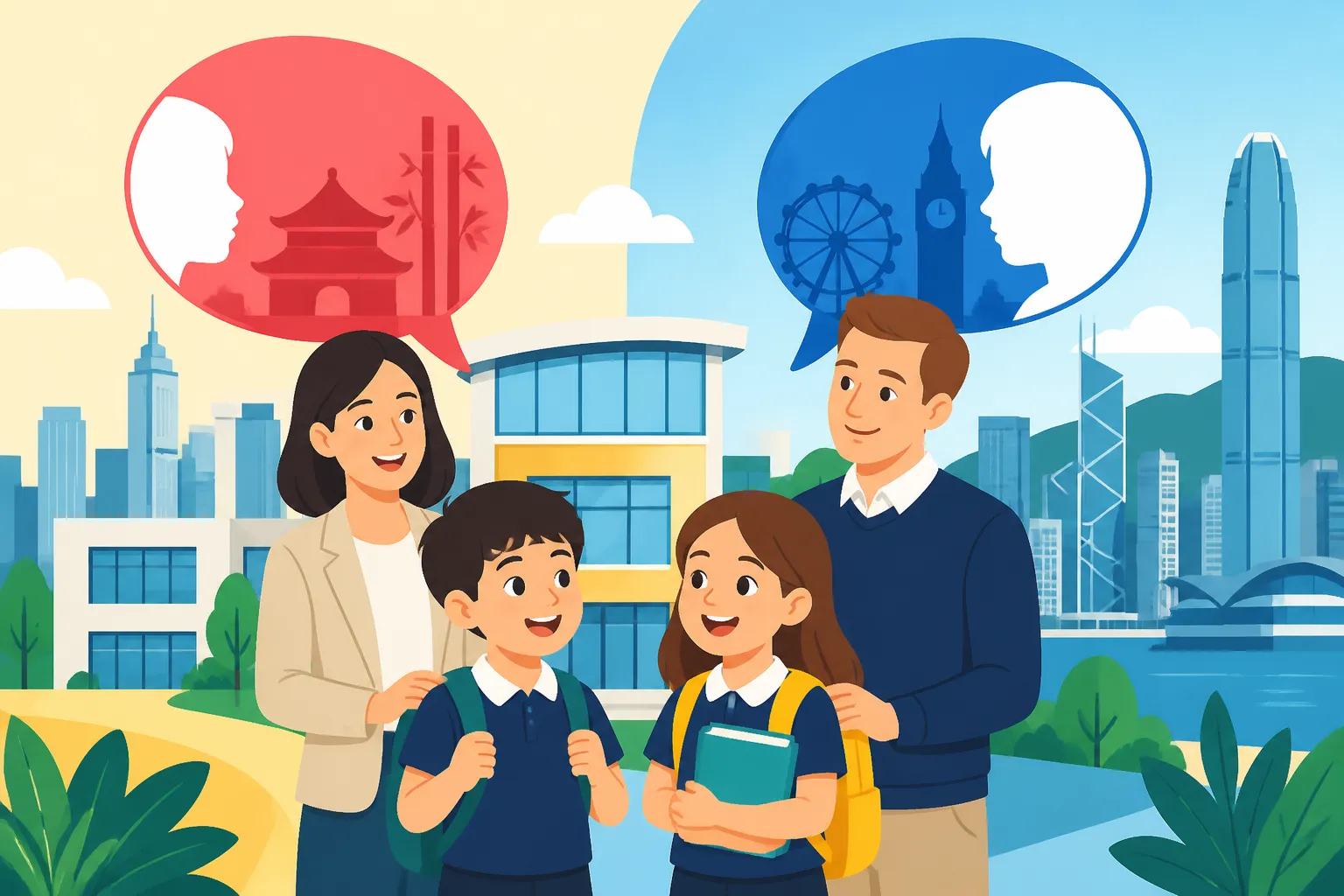
Bilingual education isn't just about the ability to translate words; it’s about "Biculturalism." In a city like Hong Kong, where East meets West in every alleyway, giving your child the keys to both cultures is an extraordinary gift.
Developing Cultural Intelligence in the Heart of Asia
Students in bilingual schools are often more adaptable. They learn to navigate different social cues, humor, and thought patterns. In a Mandarin-English environment, they are exposed to Chinese literature, history, and values like filial piety and collective responsibility, while simultaneously engaging with Western concepts of critical thinking and individual expression.
This "Cultural Intelligence" (CQ) is what will set them apart in the future. Children who are now in university often move from a high-level discussion in English to a nuanced negotiation in Mandarin without skipping a beat. They don't just speak the language; they "understand" the people.
Future-Proofing Careers through Biliteracy
By the time your child enters the workforce, the global economy will likely be even more Asia-centric. Being biliterate in the two most spoken languages on Earth is the ultimate "insurance policy." Whether they end up in finance in Central, tech in Shenzhen, or arts in London, the ability to read a Chinese contract or build a relationship with a mainland partner is invaluable.
If you are looking at long-term paths, consider how this affects university. Many bilingual students in HK go on to study at top universities in the UK, US, or even stay local, as seen in the Student Visa Document Checklist for HKU, CUHK, and HKUST. The IB Diploma, offered by many of these schools, is highly recognized globally, and having a "Bilingual Diploma" (where the student completes two languages at a high level) is a significant feather in their cap.
The Social Life of a Bilingual Student
One thing parents often worry about is whether their child will "fit in." The truth is, the bilingual school community in Hong Kong is incredibly welcoming. Because everyone is in the same boat—juggling two languages and often living between cultures—the kids tend to be very open-minded.
The social circle extends beyond the classroom. From weekend soccer in Happy Valley to birthday parties in Discovery Bay, these kids form a "Third Culture" identity. They might celebrate Mid-Autumn Festival with as much enthusiasm as Christmas. It’s a unique, vibrant way to grow up that you simply can't find anywhere else in the world.
Practical Steps for Choosing the Right School
If you’re feeling overwhelmed, take a breath. No choice is permanent, and Hong Kong’s school system is more flexible than it first appears.
- Attend Open Days: Seeing the "vibe" of the school is crucial. Do the kids look stressed or engaged? Are the teachers actually using both languages in the hallways?
- Check the "Exit Results": Look at where the students go after graduation. If a school’s graduates almost exclusively go to US universities, the curriculum might lean more "Western" than the "Bilingual" label suggests.
- Calculate the Commute: Hong Kong is small, but traffic is real. A 45-minute bus ride each way is a lot for a five-year-old. Check ESF Primary and Secondary Schools: Catchment Areas and Zones to see how location affects school choice.
- Review the Fees: Don't just look at tuition. Factor in the capital levy, bus fees, uniforms, and the inevitable "lunch box" costs. You can get a sense of the scale in ESF School Fees 2026: Tuition, Capital Levy, and Application Fees.
- Trust Your Instinct: Every child is different. Some thrive in the high-pressure environment of a Singaporean-style school, while others need the creative freedom of a Dalton or a Montessori-based bilingual program.
Disclaimer
This guide is intended for informational purposes only. School policies, admission requirements, and fees in Hong Kong are subject to frequent changes by individual institutions and the Education Bureau (EDB). Always verify the latest details directly with the school’s admissions office before making financial or relocation decisions.