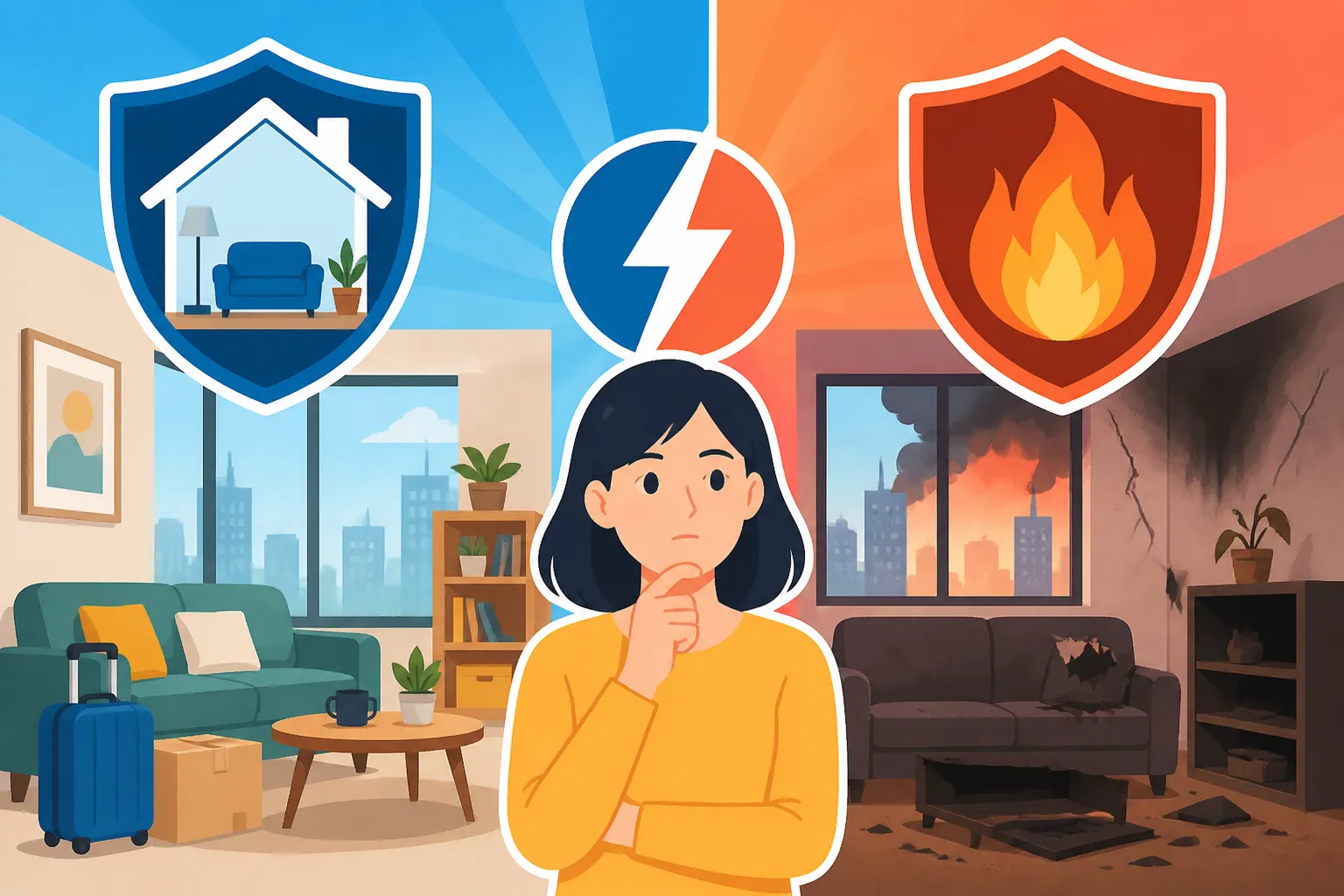
Renters Insurance vs Fire Insurance in HK Apartments
Many expats arrive in Hong Kong and assume their landlord’s insurance covers their belongings, only to face a massive bill when a typhoon-shattered window leads to water damage. I learned this the hard way during my second year in a Mid-Levels flat when a burst pipe turned my living room into a wading pool. This guide clarifies the critical differences between fire and renters insurance so you can protect your assets properly.
The Fundamental Divide Between Structure and Contents
In the high-density world of Hong Kong real estate, insurance is rarely a "one size fits all" product. Most newcomers find themselves staring at a pile of documents from their bank or landlord, wondering why they are being asked to pay for something called Fire Insurance when they don't even own the building. To navigate this, you have to understand that Hong Kong insurers split the world into two distinct categories: the physical "shell" of the apartment and everything that lives inside that shell.
Fire insurance, which is more accurately described as "Building" or "Structural" insurance, is designed to protect the bricks and mortar. If the building were to burn down or be structurally compromised by a landslide—a very real concern in certain parts of Hong Kong Island—the fire insurance policy is what pays to rebuild the walls, floors, and ceilings. It is fundamentally concerned with the asset value of the property itself. For a tenant, this often feels distant, yet it is frequently a non-negotiable part of the rental process.
Renters insurance, often marketed as "Home Contents Insurance" in the local market, is the policy that actually protects your life as an expat. It covers your furniture, your expensive MacBook, your designer handbags, and even the contents of your fridge if the power goes out. More importantly, it covers your legal liability. If you are following a Step-by-Step Guide to Renting an Apartment in Hong Kong, you might see these terms tossed around, but rarely is the distinction made clear: fire insurance protects the landlord’s investment, while renters insurance protects your bank account and your sanity.
Why the Misconception Persists
The confusion often stems from the fact that banks require fire insurance for mortgages. If you are renting from a landlord who still has a mortgage on the property, the bank insists that a fire insurance policy be in place to protect their collateral. Sometimes, the landlord will try to pass this cost on to the tenant, or it might be bundled into the management fees. Because the word "Fire" is used, tenants often think, "Great, I'm covered if there's a fire."
However, if a fire starts in your kitchen and destroys your laptop and your collection of vintage records, the fire insurance policy will pay for the blackened walls to be repainted, but it won't give you a cent for your belongings. This is why understanding the Everyday Budgeting in HK: Cost of Living Benchmarks (2026) is so important; you need to factor in the cost of a separate home contents policy to ensure you aren't left starting from scratch after an accident.
The Overlap in Perils
While the "what" they cover is different, the "how" is often similar. Both policies usually cover what insurers call "perils," which in Hong Kong almost always includes fire, lightning, explosions, and the big one: typhoons. When a T10 signal is hoisted and the wind is rattling your windows, both the structural insurer and the contents insurer are on high alert. One is worried about the window frame blowing out; the other is worried about the rain ruining your silk rugs once that window is gone.
Fire Insurance The Structural Requirement for Landlords and Owners
If you are an expat who has decided to move from renting to buying, fire insurance becomes an immediate, mandatory hurdle. Banks in Hong Kong will not release mortgage funds without proof of a fire insurance policy. The logic is simple: the apartment is the bank’s security. If the building collapses, the bank needs to know there is money available to recover the value of the loan.
For tenants, you may encounter fire insurance when reviewing your lease. Some landlords include a clause requiring the tenant to reimburse them for the fire insurance premium. While this is negotiable, it is common practice in some older buildings or with specific corporate landlords. When you are Understanding the HK Tenancy Agreement: Fixed vs Flexible Terms, keep an eye out for who is responsible for "Building Insurance." If it's you, realize that this is a cost you are paying solely to keep the landlord’s bank happy.
What is Actually Covered Under Fire Insurance
Fire insurance in Hong Kong is relatively narrow. It typically covers the "reinstatement value" of the property. This includes the building's foundation, the external walls, the roof, and the common areas if it’s a master policy for the whole block. Inside your specific unit, it covers the "original" fixtures and fittings. This is a tricky area for many expats. If your landlord has done a massive renovation with Italian marble floors and custom cabinetry, the basic fire insurance might only cover the cost of the original, basic tiling that was there when the building was first built.
Most fire policies cover:
- Fire and lightning damage.
- Explosions (such as a gas leak).
- Landslips and subsidences (crucial for hillside properties in Pok Fu Lam or Mid-Levels).
- Impact by vehicles or aircraft.
- Water damage from bursting pipes (but only for the structural repairs).
The Master Policy vs. Individual Policy
Many large housing estates, like Taikoo Shing or those managed by the MTR, have a "Master Policy" that covers the entire building. In these cases, the cost is usually wrapped into your monthly management fees. You don’t need to go out and buy a separate fire insurance policy because the Owners' Corporation has already done it. However, if you are living in a "Tong Lau" (an older walk-up building) or a stand-alone house in Sai Kung, you might be responsible for securing your own individual policy.
When managing these payments, especially if you are coordinating with a landlord while your funds are still in a home-country account, using Wise can be a lifesaver. Using Wise allows you to pay these local premiums or reimburse your landlord without getting crushed by the hidden exchange rate markups that traditional banks often charge. It's one of those small Money & Finance tips that adds up over a multi-year stint in the city.
Saleable Area and Reinstatement Costs
In Hong Kong, insurance premiums for fire insurance are often calculated based on the "Saleable Area" of the flat and the estimated cost to rebuild. This is not the same as the market value. Your flat might be worth HKD 15 million on the open market, but the fire insurance might only be for HKD 3 million, because that is what it would cost to actually rebuild the structure. Don't be alarmed if the insured sum looks low; it doesn't reflect what you could sell the flat for, only the cost of the concrete and labor.
Renters Insurance Protecting Your Expat Lifestyle
If fire insurance is for the landlord, renters insurance is for you. This is the policy that covers the things that make your apartment a home. In a city where humidity is a constant battle, insurance can even sometimes assist with the aftermath of environmental damage, though you should always check the fine print regarding Dealing with Humidity and Mold in Your Apartment.
Renters insurance in Hong Kong is surprisingly affordable, often starting at less than HKD 1,000 per year for a standard one-bedroom flat. For that price, you get coverage for "all risks" to your contents. This means if you are robbed, if there is a fire, or if a typhoon causes water to leak through your AC unit and fry your television, you can file a claim for the replacement cost of those items.
The Contents Component
"Contents" refers to anything that isn't part of the building's structure. If you could turn your apartment upside down and shake it, everything that falls out is considered "contents." This includes:
- Electronics (PCs, cameras, gaming consoles).
- Furniture and home decor.
- Clothing and jewelry (though high-value items often need to be "scheduled" or declared separately).
- Kitchen appliances.
- Food in your freezer (most policies have a small sub-limit for "spoilage of frozen food" due to power failure).
I always tell new arrivals to take a video of their apartment once they’ve moved in. If you ever need to claim, having a visual record of your belongings makes the process with the adjuster much smoother. This is particularly helpful if you have issues with Air Conditioner Maintenance: Cleaning Schedules and Landlord Disputes; if a poorly maintained AC unit leaks and ruins your expensive sofa, your renters insurance will likely pay for the sofa and then "subrogate" (go after) the landlord's insurance or the landlord themselves for the cost.
Unusual Benefits of HK Renters Insurance
One of the best things about Hong Kong home insurance is the "Global Personal Effects" cover. Many policies will cover your belongings—like your mobile phone or laptop—even when you are outside the house. If you are sitting in a coffee shop in Central and someone swipes your phone, a good renters insurance policy will cover the loss, subject to a deductible.
Additionally, many policies include a "Temporary Accommodation" benefit. If a fire or major leak makes your apartment uninhabitable, the insurance company will pay for you to stay in a hotel or a serviced apartment for a few weeks while repairs are made. Given the Cost of Living in Central vs New Territories: A Practical Comparison, having an insurance company foot a HKD 2,000-per-night hotel bill can prevent a bad situation from becoming a financial disaster.
The Role of Financial Planning
When you are setting up your life here, it's easy to focus only on the big numbers, like rent and school fees. However, a holistic view of your finances is essential. For many expats, this includes consulting with experts like Taxes for Expats to ensure that their global financial footprint is optimized. While insurance premiums themselves aren't usually tax-deductible in Hong Kong, the peace of mind they provide allows you to focus on your career and long-term wealth building without worrying about a single "Black Rainstorm" wiping out your savings.
Third-Party Liability The Hidden Essential
If there is one reason and one reason only to get renters insurance in Hong Kong, it is Third-Party Liability. This is the section of the policy that protects you if you accidentally cause damage to someone else’s property or if someone is injured in your home. In a city where people live on top of each other, the potential for causing damage to a neighbor is incredibly high.
The most common scenario is water damage. Imagine you leave a tap running, or your washing machine has a catastrophic hose failure while you are at work. The water seeps through your floor and into the ceiling of the neighbor below. In Hong Kong, you are legally liable for the repairs to their flat, their ruined furniture, and even their temporary relocation costs. Reports indicate "minor" leaks result in liability claims of over HKD 100,000. Without insurance, that comes directly out of your pocket.
Tenant’s Liability to the Landlord
Renters insurance also includes "Tenant’s Liability." This protects you if you accidentally damage the landlord’s property—specifically the fixtures and fittings they provided. If you drop a heavy pot and crack the expensive marble kitchen counter, your tenant’s liability coverage will pay for the repair. This is vital for Recovering Your Security Deposit: Wear and Tear vs Damage. Instead of fighting with your landlord over a HKD 20,000 repair bill at the end of your lease, you can simply have your insurance company handle it.
Personal Liability Beyond the Home
Many Hong Kong policies extend this liability coverage to your "private capacity" anywhere in the city. If you are out cycling in Tai Po and you accidentally collide with a pedestrian, or if your dog bites someone in the park, the liability portion of your home insurance often steps in to cover the legal costs and any damages awarded. For a few hundred Hong Kong dollars a year, this is arguably the most valuable financial protection an expat can have.
| Feature | Fire Insurance (Building) | Renters Insurance (Home Contents) |
|---|---|---|
| Primary Target | The physical structure/walls | Your personal belongings/liability |
| Mandatory For | Mortgage holders | Highly recommended for all tenants |
| Who Usually Pays | Landlord (sometimes tenant reimburses) | The Tenant |
| Covers Laptop/TV? | No | Yes |
| Covers Neighbors? | No (only structural damage) | Yes (Third-Party Liability) |
| Key Risk | Landslides, Major Fire | Burst pipes, Theft, Typhoons |
| Cost Basis | Reinstatement value of structure | Total value of your belongings |
Navigating the Claims Process in Hong Kong
Filing an insurance claim in Hong Kong can be a bureaucratic exercise, but it is manageable if you are prepared. The most important rule is: Do not throw anything away. If a typhoon smashes your window and water ruins your TV, take photos of the broken window, the puddle, and the non-functioning TV. Keep the ruined items until an insurance adjuster has had a chance to inspect them or has given you written permission to dispose of them.
You will typically need to provide:
- A completed claim form.
- Photos of the damage.
- Original purchase receipts (if you have them) or photos of the items in the house before the damage.
- A repair quote or a "beyond economical repair" statement from a technician.
- For theft claims, a police report (you must report thefts to the HK Police within 24 hours).
Managing Deductibles and Excess
Every policy in Hong Kong has an "excess" (known as a deductible in the US). This is the amount you have to pay out of your own pocket before the insurance kicks in. For example, a policy might have a HKD 1,000 excess for "All Other Claims" but a HKD 3,000 excess for "Water Damage." If your repair bill is HKD 5,000 and the excess is HKD 1,000, the insurance company will send you a check for HKD 4,000.
When you are Setting up FPS Auto-Debit for Your Rent and Credit Card Bills, it’s worth keeping a small "emergency fund" specifically to cover these insurance excesses. It ensures that even in a crisis, you aren't scrambling for cash to start the repair process.
The Role of an Insurance Broker
While you can buy insurance directly from banks like HSBC or BOC, many expats prefer using a broker. A broker doesn't cost you extra (they are paid by the insurance company), and they can compare five or six different providers to find the best coverage for your specific building. If you are living in an older building with a history of pipe issues, a broker can help you find a policy with a lower water damage excess.
When the claim time comes, a good broker acts as your advocate. They know the language the insurance companies use and can help speed up the process. If you are receiving a settlement in a foreign currency or need to send funds abroad after a claim, Wise remains a top choice for ensuring you get the real exchange rate without the bank's typical "handling fees."
Choosing the Right Policy for Your Apartment
Not all apartments in Hong Kong have the same risk profile. A ground-floor village house in Mui Wo has very different needs than a 50th-floor penthouse in West Kowloon. When selecting your coverage, consider the specific environmental risks of your neighborhood. If you are in a low-lying area, flood coverage and high liability limits are essential. If you are in a high-rise, you want to ensure your "window breakage" coverage is robust, as the wind pressure at high altitudes during a T8 or T10 typhoon can be immense.
Questions to Ask Before Signing
Before you commit to a policy, ask the following:
- Is the "Third-Party Liability" at least HKD 5,000,000? (This is the standard minimum I recommend for HK).
- Does it cover "Tenant's Liability" for the landlord's fixtures?
- What is the excess for water damage? (This is the most common claim in HK).
- Does it cover my phone and laptop when I’m outside the house?
- Is there a "New for Old" replacement clause, or do they deduct for depreciation?
By taking the time to answer these questions, you move from being a "target" for agents to an informed consumer. You can then integrate these costs into your Hong Kong Tax Guide for Expats: Salaries Tax and Filing (2026) preparation—not as a deduction, but as part of your overall financial health check. Being an expat is about adventure, but that adventure is much more enjoyable when you know that a burst pipe or a stolen bag won't derail your financial future in this vibrant city.
Disclaimer Regarding Financial and Insurance Advice
This guide is intended for informational purposes only and does not constitute professional financial, legal, or insurance advice. Insurance regulations and policy terms in Hong Kong can change frequently. You should always read the specific terms and conditions of any insurance policy before purchasing and consult with a licensed insurance professional or broker to ensure the coverage meets your individual needs. The mention of specific brands or services does not imply a legal guarantee of their performance.