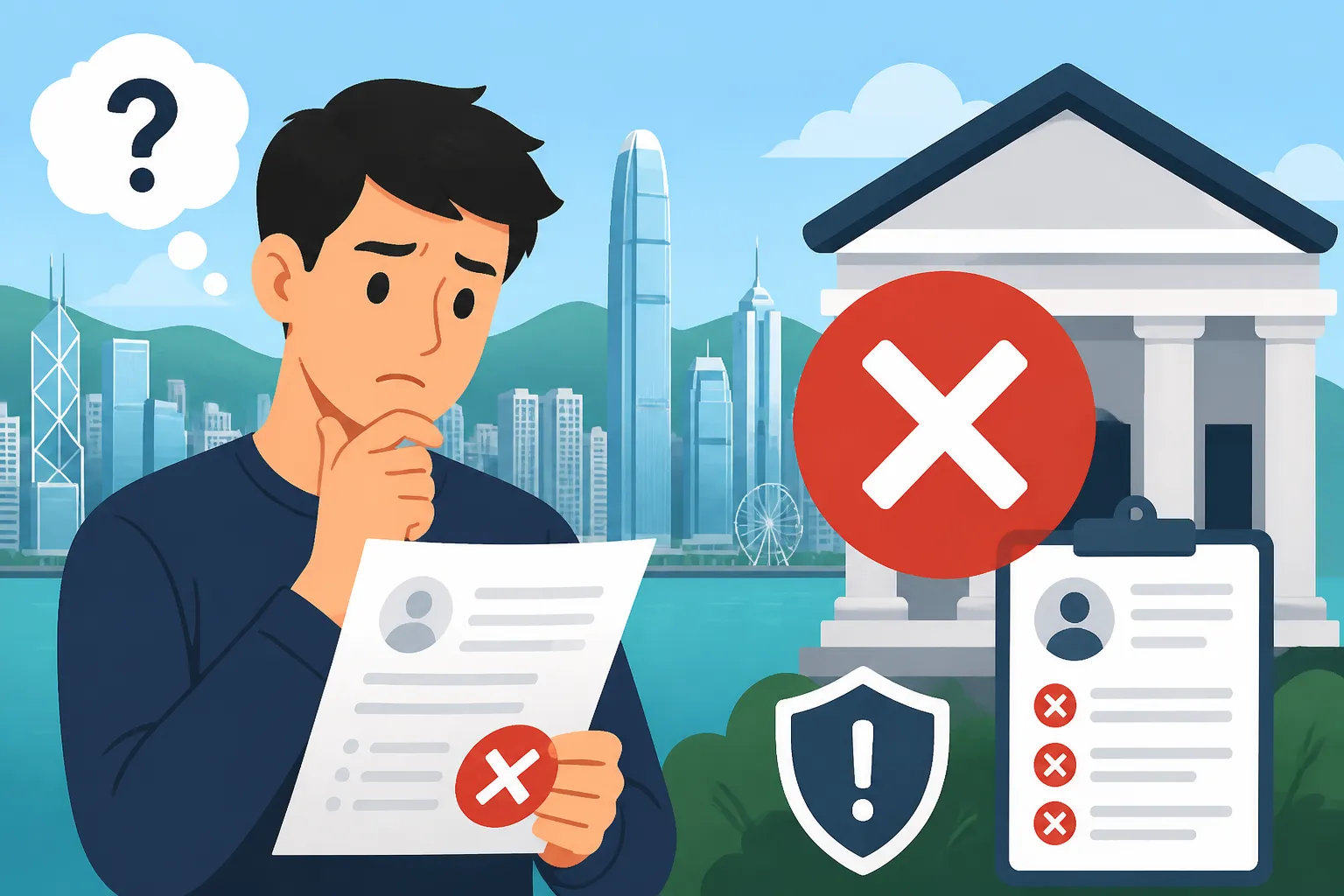
Why Was My Bank Account Application Rejected in HK?
Moving to a vibrant, international city like Hong Kong, you probably expect things like opening a bank account to be straightforward, a quick check-the-box item. But oh, how quickly that illusion shatters when your application gets rejected, leaving you wondering what went wrong! Believe me, I've seen countless expats, myself included, grapple with the baffling intricacies of Hong Kong's banking system. This guide is here to demystify those frustrating rejections and arm you with the knowledge to successfully open an account.
The KYC Gauntlet: Understanding Hong Kong's Strict Due Diligence
Hong Kong's banking sector is renowned for its stability, but this also means it operates under extremely stringent regulatory frameworks, particularly when it comes to "Know Your Customer" (KYC) and Anti-Money Laundering (AML) directives. These aren't just polite requests; they are legally mandated requirements that banks must adhere to, making them exceptionally cautious, especially with new foreign residents. What might seem like an over-the-top request for documents is simply the bank ticking every single box to ensure compliance and mitigate risk. For an expat trying to settle in, it can feel like a bureaucratic brick wall.
Who You Are and Where Your Money Comes From: Source of Funds and Wealth
One of the biggest hurdles expats face is demonstrating their source of funds and source of wealth. It's not enough to simply state you have money; the bank needs to understand how you acquired it and where it's coming from. This can be particularly invasive and confusing if you're used to less scrutinizing systems in your home country. They want to see the audit trail, the history.
For example, if you've recently sold property, they'll want to see sale agreements, transfer documents, and bank statements showing the proceeds entering your account. If it's from salary, they'll ask for employment contracts, payslips, and income tax returns (which you'll also need when dealing with your Hong Kong Tax Guide for Expats: Salaries Tax and Filing (2026) later on). Perhaps you received a significant inheritance; in that case, expect to provide wills, probate documents, and corresponding bank statements. The intent is to prove that the funds are legitimate and not linked to illicit activities. Banks like HSBC, Standard Chartered, and Bank of China (BOC) are particularly diligent in this area, often requesting several months or even years of bank statements from your previous country of residence to show consistent income and savings.
The level of detail required can vary, but generally, the larger the amount of money you intend to deposit or transact, the more questions you'll face. They are essentially trying to build a financial narrative for you, ensuring that your declared profession and background align with your financial activity. Without this clear narrative, even if everything is perfectly legitimate, a bank may deem the risk too high and reject your application. It’s a tedious but unavoidable part of the process in Hong Kong, and it often catches newcomers off guard.
The Address Predicament: Proof of Residence
You've landed in Hong Kong, found a flat, and signed a lease. Great! But then the bank asks for proof of your Hong Kong address, and your freshly signed tenancy agreement might not cut it, or perhaps you haven't received your first utility bill yet. This is a classic expat Catch-22. Banks typically require a recent (usually within the last three months) utility bill (electricity, water, or gas), a bank statement from another established Hong Kong bank (which you're trying to open!), or a government-issued letter.
If you're staying in serviced apartments or temporary accommodation, getting official proof can be even tougher. While a serviced apartment contract might be accepted by some banks, it's not a guarantee. Often, a letter from your employer confirming your residential address in Hong Kong can sometimes serve as interim proof, but this is at the bank's discretion. The challenge here is that many new expats don't have these documents immediately upon arrival, leading to delays and potential rejections. It's a frustrating loop, especially when you need a bank account to pay those very utility bills. Remember that when you're Setting Up Utilities: Electricity, Water, Gas, and Broadband in HK, getting those bills in your name promptly is crucial.
This is a key area where even seasoned expats can stumble. If you've just arrived and haven't had a chance to get formal bills, consider asking your HR department for an official letter confirming your employment and residential address, explicitly stating the start date of your residency. It might not work for every bank, but it's a good alternative to have on hand. The more official-looking and third-party verified your address proof is, the better your chances.
Ties to Hong Kong: Proving Your Connection
Beyond just having a local address, banks are increasingly looking for demonstrable ties to Hong Kong. This isn't usually a formal checklist item, but it heavily influences the risk assessment. Essentially, they want to be sure you're genuinely relocating and not just using Hong Kong as a temporary transit point for your finances. This can be a subtle but significant factor in their decision-making process.
What counts as a "tie"? An employment visa is a strong indicator, as it shows you have a legitimate reason to be working and residing here. A local employment contract further reinforces this. If you’re a student, your student visa and university enrollment letter serve the same purpose. Having a Hong Kong ID (HKID) is almost a prerequisite and signals your official residency. If you're coming on a Dependent Visa, showing your spouse's employment details and HKID will also help establish your family's connection to the city. The longer your visa validity, the better, as it suggests a more long-term commitment. You can learn more about Hong Kong Visas and Immigration: The Complete 2027 Guide to understand the types of visas that strengthen your case.
If you're an entrepreneur or self-employed, this can be trickier. Without a traditional employment contract, you might need to provide a robust business plan, company registration documents, and evidence of local business activities. The banks are trying to ascertain your legitimate presence and purpose in Hong Kong. They're not just offering a service; they're also acting as gatekeepers against financial crime, and "ties" help them justify that you're a legitimate customer for their jurisdiction.
Common Reasons for Rejection Beyond KYC
Even when you feel you've got your KYC documents in order, rejections can still happen. It's often due to subtle nuances in the application process or a bank's internal risk appetite that isn't immediately obvious to an applicant. These factors can vary significantly between banks, which is why a rejection from one doesn't necessarily mean you'll be rejected by all.
Incomplete or Inconsistent Documentation
This might seem obvious, but it's astonishing how often applications get stalled or rejected due to minor discrepancies or missing information. A common mistake is providing documents that are outdated, such as a proof of address older than three months, or a passport that's about to expire. Another frequent issue is inconsistencies between documents – for instance, your name appearing slightly differently on your passport versus your employment contract, or a discrepancy in your birth date or address format.
Banks operate on strict protocols, and even a minor inconsistency can trigger a red flag, leading to further delays or outright rejection. Imagine if your local phone number is listed as '852 1234 5678' on one document, but '00852-12345678' on another – simple formatting, but it can cause issues. Ensure every document is legible, officially translated if not in English or Chinese, and that all details match exactly. I cannot stress enough the importance of triple-checking everything before submission. It's also worth noting that many banks require certified copies of certain documents, not just photocopies. Knowing What to Bring to Your HKID Appointment (Checklist) can give you a good idea of the level of detail Hong Kong authorities expect.
It’s an administrative nightmare, but the clearer and more uniform your documents are, the smoother your application will be. This is where attention to detail really pays off, preventing unnecessary back-and-forth with the bank’s compliance department.
Nationality or Residency Risks
Unfortunately, some nationalities or previous countries of residence can inherently be classified as higher risk by banks in Hong Kong. This is not personal, but rather a reflection of international financial regulations and geopolitical factors that label certain jurisdictions as having higher risks for money laundering or terrorism financing. If you hail from a country on a financial blacklist or one with known political instability, you might face additional scrutiny or even outright rejection, regardless of your personal financial integrity.
This is a harsh reality for some expats. Banks have internal algorithms and country lists that dictate their risk appetite. For instance, individuals from certain nations might find it exceptionally challenging to open accounts at traditional banks, while others might sail through. This isn't discrimination in the traditional sense, but a compliance measure designed to protect the bank from regulatory penalties. In these cases, even if you have a perfectly valid visa and employment, the bank might simply decide the compliance burden is too high for them to take you on as a customer.
This is also where virtual banks in HK might offer a sliver of hope, as their digital onboarding processes can sometimes be less rigid, though they too must adhere to stringent KYC/AML laws. You can explore options like Mox, ZA Bank, or Livi Bank, but be prepared for robust digital verification. For managing your money across borders, services like Wise (formerly TransferWise) offer excellent alternatives for international transfers, but they don't replace a full-fledged local bank account for everyday use. Wise can be a lifesaver for Wise vs Bank SWIFT Transfers: Cheapest Ways to Send Money, but not for local utility payments requiring a HK bank account.
Perceived High-Risk Profile
Beyond your nationality, certain professions or financial activities can also elevate your risk profile in the eyes of a bank. If your profession involves handling large sums of cash, dealing with high-value goods (like art or luxury items), or operating in politically sensitive sectors, you might be deemed a higher risk. Freelancers, self-employed individuals, or those with complex income streams can also face greater scrutiny because their financial flows are less predictable or standardized compared to a salaried employee.
The bank's concern isn't just about the source of your funds, but also the nature of your ongoing financial activities. If your job involves frequent international transactions to high-risk jurisdictions, or if your projected account activity doesn't align with a typical expat profile for your declared profession, it can raise questions. Banks have a legal obligation to monitor transactions for suspicious activity, and they prefer customers whose financial patterns are relatively easy to understand and justify. For example, if you declare yourself a teacher but anticipate making large, frequent international transfers to a business in a jurisdiction known for tax havens, the bank will certainly flag that as high risk.
This is particularly true for those looking to open business accounts. Opening a Business Bank Account: Challenges for Startups is an entirely different beast, involving even deeper scrutiny of your business activities, shareholders, and projected financial volumes. The key is to be transparent and, where possible, simplify your financial narrative for the bank.
Navigating the Rejection: What to Do Next
A bank account rejection can feel incredibly disheartening, almost like a personal slight. But it's crucial to remember that it's rarely personal. It's a bureaucratic process, and understanding the system is your best defense. Don't throw in the towel after the first "no."
Seeking Clarity and Understanding the Feedback If Any
Unfortunately, Hong Kong banks are not always forthcoming with the exact reasons for a rejection. Due to compliance and data privacy regulations, they often issue a generic refusal without detailed explanations. This is maddening, I know. You're left guessing. However, it’s still worth politely asking if there's any specific feedback they can provide. Sometimes, a branch manager or a relationship officer might offer a tiny hint, perhaps indicating that a particular document was unclear or that a specific piece of information was missing.
If you have a contact at the bank, like someone from your company’s HR or a personal reference who banks there, they might be able to subtly inquire on your behalf. However, do not expect a full breakdown of their internal risk assessment. They simply won't provide it. The best you can hope for is an indication of an area to improve for your next application. Use this feedback, no matter how vague, to refine your documentation and approach for future applications. Keep meticulous records of all documents submitted and any communication with the bank.
Alternative Banking Solutions
While traditional banks like HSBC, Standard Chartered, and BOC are often the first choice for expats due to their established presence, they are also often the most stringent. If you've hit a wall with them, it's time to explore alternatives.
Virtual Banks: Hong Kong's financial landscape has evolved rapidly, with several virtual banks entering the market. These include ZA Bank, Mox, Livi, and Ant Bank. They operate entirely online, often have simpler onboarding processes for individuals, and may be more amenable to certain expat profiles. They still adhere to strict KYC/AML, but their digital-first approach can sometimes make the process smoother, especially for straightforward personal accounts. Many offer multi-currency accounts and competitive exchange rates, making them useful for those who also use services like Wise for international transfers. For example, you might find that Mox vs ZA Bank: Which Virtual Bank is Better for Everyday Spending? offers valuable insights. However, be aware that some virtual banks might have lower transaction limits or less comprehensive services compared to traditional banks, and not all companies accept them for payroll deposits.
Smaller Traditional Banks: Don't overlook smaller or local banks like Citibank (which has a strong expat focus in some regions) or Bank of East Asia. Their branch staff might have more discretion or a different risk appetite for certain profiles. The key is to do your research, check their specific requirements, and perhaps visit a branch in person rather than just relying on online applications. Sometimes a face-to-face interaction can help build rapport and clarify any potential red flags the bank might have.
Money Service Operators (MSOs): For very basic remittance needs, MSOs are licensed entities that can facilitate money transfers, but they are not banks and do not offer full banking services like current accounts or credit cards. Use these sparingly and only if absolutely necessary for specific, limited purposes.
Preparing for a Reapplication or Trying Another Bank
A rejection from one bank isn't the end of the road. It's often a learning experience. Gather all your documents again, ensure they are current, consistent, and impeccably organized. If you received any feedback, address it directly. If not, try to anticipate potential issues based on common rejection reasons.
Consider making a physical appointment at a bank branch, rather than just applying online. This allows you to present your case in person, ask questions, and clarify anything on the spot. Bring more documents than you think you need: original passport, HKID, valid visa, employment contract, salary slips, proof of previous address, Hong Kong tenancy agreement, utility bills (even if not in your name, you can explain your situation), and a letter from your employer. Having a local Hong Kong phone number is also generally essential for the application process, so make sure you have one setup.
Here's a quick checklist of documents often required:
| Document Type | Purpose | Key Details to Ensure |
|---|---|---|
| Identity Proof | Verify who you are | Original Passport, HKID (front & back), valid visa. Ensure consistent name. |
| Address Proof (HK) | Confirm your residential address in Hong Kong | Utility bill (electricity, water, gas) <3 months old, tenancy agreement. |
| Address Proof (Overseas) | Validate previous residence (for source of funds) | Utility bill or bank statement from home country. |
| Employment Proof | Establish income source and ties to HK | Employment contract, recent payslips (3-6 months), employer letter. |
| Source of Funds/Wealth | Prove legitimacy of your money | Bank statements (local & overseas), tax returns, sale agreements, etc. |
| Tax Residency Form | Comply with international tax reporting standards | Self-declaration of tax residency for CRS/FATCA. (Helpful for Taxes for Expats) |
| HK Phone Number | Essential for contact and often for digital banking setup | Active local SIM card, registered in your name if possible. |
When reapplying or trying a new bank, clearly articulate your purpose for the account. Are you primarily using it for salary deposits? To pay local bills? For savings? Being transparent about your anticipated account activity can help the bank understand and assess your risk profile more accurately. Remember, patience and persistence are key when dealing with Hong Kong's banking system.
Disclaimer
The information provided in this guide is for general informational purposes only and does not constitute financial, legal, or immigration advice. Banking policies and regulations in Hong Kong can change frequently. While we strive to keep the information up-to-date, it may not reflect the very latest developments. Always consult with the specific bank or relevant professional advisors for personalized guidance regarding your individual situation.