Do Taxis in Hong Kong Accept Credit Cards or Only Cash?
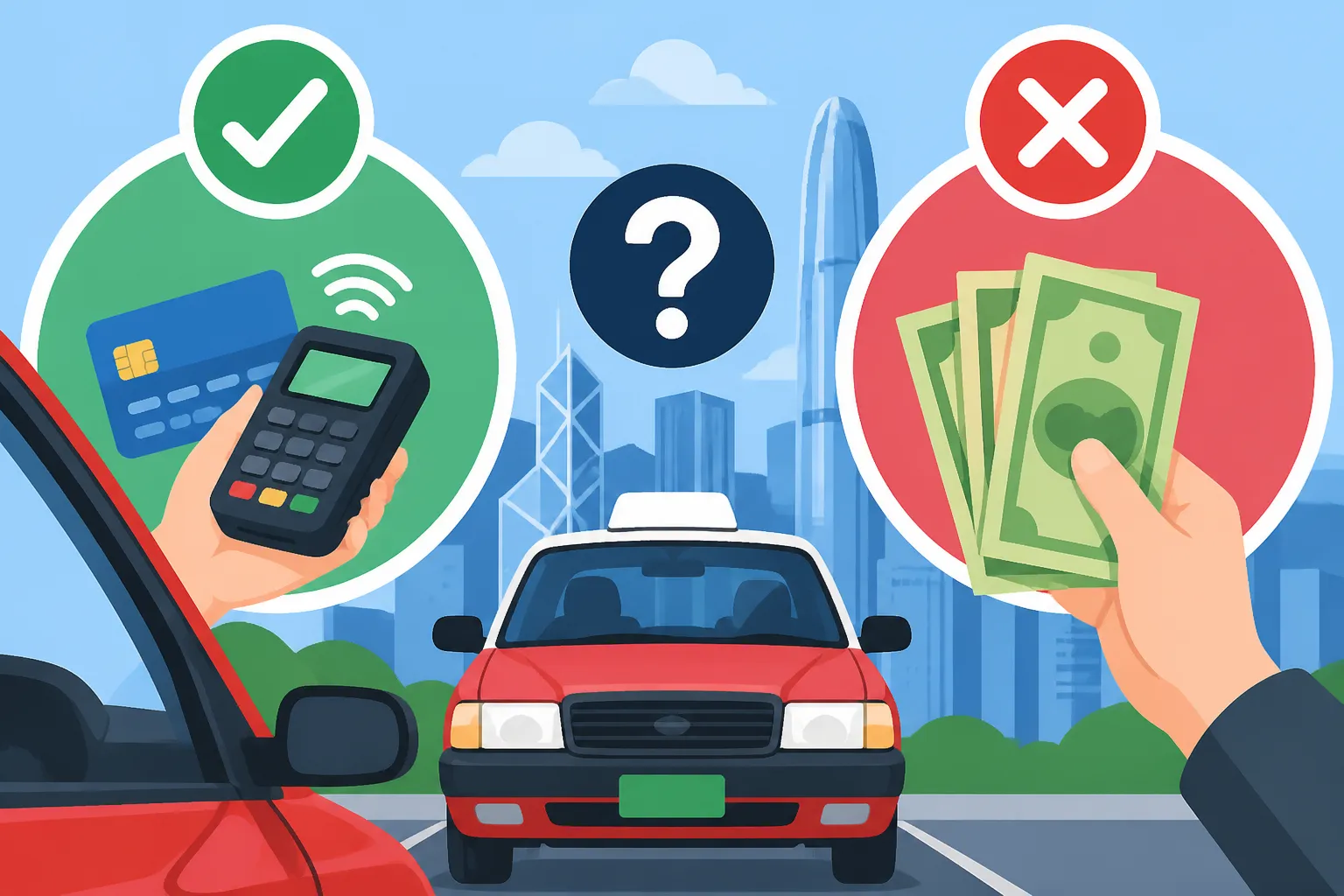
Navigating the bustling streets of Hong Kong often means hopping into one of our iconic red, green, or blue taxis. While incredibly convenient, many newcomers (and even some seasoned expats!) quickly hit a snag when it comes to payment: the vast majority of Hong Kong taxis operate firmly in the cash-only realm. This can be a real headache when you've just arrived from a credit card-centric world, clutching a large denomination note, only to find your driver sighing at the prospect of breaking it. This guide will meticulously break down the payment landscape for taxis, saving you from awkward fumbles and ensuring smoother journeys around our vibrant city.
The Undisputed Reign of Cash in Hong Kong Taxis
It's a reality that hits almost every expat in Hong Kong at some point: you hail a taxi, enjoy the ride, and then reach for your credit card only to be met with a shake of the head or a direct, "Cash only, la." Yes, despite Hong Kong being a global financial hub, its taxi industry largely remains loyal to physical currency. This isn't just a quirk; it's deeply embedded in the local culture and operational preferences of the drivers.
Why Cash is King for Most Drivers
For many taxi drivers in Hong Kong, cash offers unparalleled simplicity and immediate liquidity. They don't have to worry about transaction fees that eat into their daily earnings, nor do they face delays in receiving funds. Every credit card or digital payment transaction typically incurs a small fee, which, when accumulated over dozens of rides a day, can add up significantly. For a profession where every dollar counts, avoiding these charges is a priority. Additionally, processing digital payments can sometimes be slower or require specific equipment that not all drivers possess or are willing to invest in. Imagine trying to explain a card reader issue to a passenger when neither of you speaks the same primary language – it's a hassle they'd rather avoid.
The city also has a robust network of ATMs and convenience stores that allow for easy cash access, reinforcing this preference. Many expats, coming from places where everything from a coffee to a taxi ride is paid by card, find this a jarring shift. You might be accustomed to merely tapping your phone or card, but here, it's about being prepared with crisp Hong Kong dollar notes. It's a key part of Everyday Budgeting in HK: Cost of Living Benchmarks (2026), where cash plays a more significant role in daily transactions than you might expect.
The Frustration of the "No Change" Scenario
Another common scenario that can try the patience of even the most zen expat is the "no change" trick. You hand over a HKD 500 note for a HKD 52 ride, and the driver might genuinely not have change, or, perhaps, will imply it. While some drivers are genuinely short on smaller bills, it's also an unspoken tactic to encourage customers to pay with closer to the exact fare. This is why always carrying smaller denominations – HKD 20s, HKD 50s, and HKD 100s – is crucial. Arriving at the airport with only HKD 1,000 notes after exchanging foreign currency can quickly turn your first taxi ride into a mini-crisis, especially when facing tunnel tolls and luggage charges on top of the base fare. It's not uncommon to see new arrivals scrambling for change at convenience stores right outside the airport terminal, a situation easily avoided with a bit of foresight.
Beyond Physical Cash: Exploring Digital and Card Alternatives
While cash dominates, Hong Kong is a city that embraces innovation, and the landscape is slowly but surely shifting. However, it’s a patchwork of options rather than a universal standard, meaning you can't rely on cashless options for every taxi ride.
Credit Cards: The Rare Sight
Let's be blunt: attempting to pay a street-hailed Hong Kong taxi with a credit card is usually an exercise in futility. It's exceptionally rare for traditional taxis to have credit card terminals. While there might be a handful of premium taxi services or specific arrangements made via hotels that do accept cards, these are not your typical red, green, or blue cabs you hail off the street. Don't factor credit card payment into your taxi plans unless you've specifically pre-booked a luxury service or confirmed it with the driver upfront, which is practically impossible for a spontaneous street hail.
This might be a stark contrast to what you're used to, particularly if you're managing international finances with services like Wise, where digital transactions are the norm. It highlights how important it is to adapt your payment habits when living in Hong Kong.
The Octopus Card: Not a Universal Solution (Yet!)
The Octopus Card is undoubtedly Hong Kong's most essential payment tool, used for everything from the MTR to convenience stores. You might think it'd be a natural fit for taxis, right? For years, the answer was a resounding no. Traditional taxis historically did not accept Octopus. However, this has started to change, albeit slowly and not universally. Some individual taxi drivers or fleets have begun to install Octopus readers, but it's still far from the norm. You'll often see a small sticker on the passenger window indicating acceptance, but assume cash first. Don't count on being able to use your The Octopus Card: Hong Kong's Essential Transport & Payment Tool for every taxi ride; you'll likely be disappointed. Always have a backup plan with cash.
Mobile Payment Apps: A Growing, But Inconsistent, Trend
The most promising shift away from pure cash for taxis comes from mobile payment applications. Platforms like AlipayHK, WeChat Pay, and even local services like PayMe are gaining traction. Many drivers, particularly younger ones, are increasingly displaying QR codes in their cabs for these specific apps.
- AlipayHK and WeChat Pay: These are widely used in Hong Kong, especially among the local population. If you have an account linked to a Hong Kong bank account, you can often scan a driver's QR code to pay. However, acceptance is still driver-dependent. Some drivers might accept one but not the other, or neither.
- PayMe: Developed by HSBC, PayMe is a popular peer-to-peer payment app. Some taxi drivers have started accepting PayMe, especially if they are already using it for personal transactions. It’s convenient if both you and the driver have it set up.
The key takeaway here is inconsistency. While you might encounter a taxi that accepts one of these mobile payment methods, it's not guaranteed. Always confirm with the driver before you start the journey, or at the very least, before you reach your destination. Look for the QR code stickers prominently displayed. If you're someone who uses services like Wise for international transfers, you're likely comfortable with digital payments, but remember that even with these apps, a local bank linkage or HKID is often required for full functionality, something you'll definitely want to sort out when Opening a Traditional Bank Account: HSBC, Standard Chartered, and BOC.
Taxi-Hailing Apps: The Safest Bet for Digital Payments
If you absolutely must pay digitally and want to avoid the cash dilemma, your best bet is to use a dedicated taxi-hailing app. Apps like HKTaxi (which connects you to local cabs) or international ride-sharing services like Uber often allow you to link your credit card directly to the app. When you book a ride through these platforms, the payment is processed electronically once the trip concludes, eliminating the need for cash.
This approach offers convenience and transparency, as the fare is often estimated upfront, and you avoid any potential "no change" issues. It's a different service model from hailing a taxi off the street, but it's a reliable way to ensure a cashless transaction. Remember, these apps might also include booking fees or surge pricing, so always check the final fare before confirming. For those focused on managing their finances carefully, perhaps even consulting a service like Taxes for Expats for overall financial planning, knowing your transport costs upfront can be quite beneficial.
Hong Kong Taxi Fare Structure and Charges
Understanding the fare structure helps manage your expectations for payment and ensures you have sufficient cash. Hong Kong taxis operate on a metered system, but there are additional charges to be aware of.
Metered Fares and Additional Surcharges
The base fare for a Hong Kong taxi varies slightly depending on whether it's a red (urban), green (New Territories), or blue (Lantau Island) taxi. All operate on a tiered system: an initial flag-down fare covers the first few kilometers, and then the fare increases incrementally per unit distance.
- Initial Charge: A fixed amount for the first 2 kilometers or so.
- Incremental Fare: The meter ticks up by a small amount for every subsequent 200 meters or every minute of waiting time. The increment is higher for the initial part of the journey and then drops slightly for longer distances.
- Luggage Charge: There's usually a small per-piece charge for luggage placed in the boot (trunk) or large items carried inside the passenger compartment. This often applies to bags exceeding a certain size.
- Tunnel and Bridge Tolls: If your journey involves crossing any of Hong Kong's tunnels (e.g., Cross-Harbour Tunnel, Western Harbour Tunnel, Eastern Harbour Tunnel) or bridges, the toll amount will be added to your fare. You're typically expected to pay both ways for the tunnel, meaning the return toll for the driver.
- Pet Surcharge: A small fee applies if you're traveling with a pet, though rules on pet transport in taxis can be a bit ambiguous, so it's always best to ask permission first.
These additional charges are typically added manually by the driver at the end of the trip, so don't be surprised if the final amount is higher than what the meter initially shows.
Cross-Harbour and Airport Journeys
For journeys involving cross-harbour tunnels, especially from Hong Kong Island to Kowloon or vice-versa, factor in the tunnel tolls. These can add a significant amount to your fare, sometimes more than the metered fare itself depending on the tunnel used. For example, the Western Harbour Tunnel is considerably more expensive than the Cross-Harbour Tunnel. When traveling from the airport, the fare will include an airport service charge, usually a small fixed amount, on top of the metered fare and any tunnel tolls. It's always a good idea to have a rough estimate of the total cost by checking online resources or asking a local if it's a common route.
Here’s a simplified breakdown of typical taxi payment scenarios:
| Payment Method | Street-Hailed Taxis (Red/Green/Blue) | Taxi-Hailing Apps (HKTaxi, Uber, DiDi) | Notes |
|---|---|---|---|
| Cash (HKD) | Yes (Highly Recommended) | Optional (if paying driver directly) | The most reliable method. Always carry small denominations (HKD 20, 50, 100). Be prepared for potential "no change" situations, especially with large bills. |
| Credit Card | Extremely Rare | Yes (Linked to app) | Almost non-existent for street hails. Only an option for pre-booked luxury services or via apps. |
| Octopus Card | Slowly Increasing (check sticker) | No | Some individual taxis have readers, but it's not universal. Don't rely on it. |
| AlipayHK/WeChat Pay/PayMe | Growing (check QR code) | No (unless driver accepts direct app transfer) | Acceptance is driver-dependent. Look for QR codes. Requires local setup and often an HKID. Good for those who have embraced Digital Payments in HK: Octopus, AlipayHK, PayMe, and WeChat Pay. |
Pro Tips for Expats to Ensure a Smooth Taxi Ride
Having lived here for a while, I've picked up a few tricks to make taxi rides stress-free, even with the payment nuances.
Always Carry Small Bills
This is hands down the most important piece of advice. Before you step out, especially if you know you'll be taking a taxi, ensure you have a good stash of HKD 20, 50, and 100 notes. Break those larger HKD 500 or 1,000 notes at convenience stores like 7-Eleven or Mannings, or when making smaller purchases. If you're running low on cash, a quick stop at an ATM is a must. These are readily available almost everywhere in Hong Kong. Think of it as part of your Essential Health Checklist for Your First 30 Days in Hong Kong – alongside getting your HKID and a local SIM, mastering cash management is crucial.
Confirm Payment Method if Unsure
If you absolutely need to pay digitally, or want to try your luck with Octopus or a mobile payment app, ask the driver before you get in. A simple "Octopus?" or "Alipay?" while pointing to the relevant logo (if you see one) can save you a lot of hassle later. If they shake their head, you know it's cash only. It's often easier to find another taxi than to argue about payment at your destination.
Keep a Digital Payment App Ready, But Don't Rely on It
Having AlipayHK or WeChat Pay set up on your phone is a good idea for overall living in Hong Kong, and it might just save you on a taxi ride. But, as mentioned, don't rely solely on it for taxis. Use it as a convenient bonus when available. If you're a heavy user of digital financial services, you'll appreciate providers like Wise that make international money management seamless, but local taxi payments are a different beast entirely.
Know Your Destination and How to Communicate It
While not directly payment-related, knowing your destination's exact address (preferably written in Chinese for local drivers) or a clear landmark helps avoid miscommunications, which can compound stress at payment time. An unexpected detour due to a misunderstanding can lead to a higher fare, making the payment more complicated if you're already short on cash. You can use mapping apps that display Chinese characters, or simply ask a local to write it down for you before you leave.
Consider Pre-Booking for Peace of Mind
For important appointments, airport runs, or late-night trips when you're tired, consider booking a taxi through an app that guarantees digital payment. This provides transparency on the fare (including tolls) and removes the stress of cash availability. While often slightly more expensive, the peace of mind can be well worth it. Many local apps, like HKTaxi, allow you to specify payment by credit card in the booking.
Don't Expect Tipping
In Hong Kong, tipping is not customary for taxi drivers. The fare is the fare. Any small change you let them keep is generally seen as a bonus, but it's not expected as it might be in other parts of the world. So, don't feel obligated to add extra, although rounding up to the nearest convenient denomination is common practice if you don't have exact change. Understanding Expat Guide to Tipping Etiquette in Hong Kong Restaurants helps set the right expectations for service industries across the city.
In essence, while Hong Kong is technologically advanced, its taxi payment system retains a charming, old-school reliance on cash. Embrace it, prepare for it, and you'll find getting around by taxi to be one of the easiest and most enjoyable parts of your Hong Kong experience.
Disclaimer
The information provided in this guide is for general informational purposes only and does not constitute financial, legal, or professional advice. While we strive to keep the content up-to-date and accurate, taxi payment policies and technological adoption can change rapidly. Always verify current practices and charges.