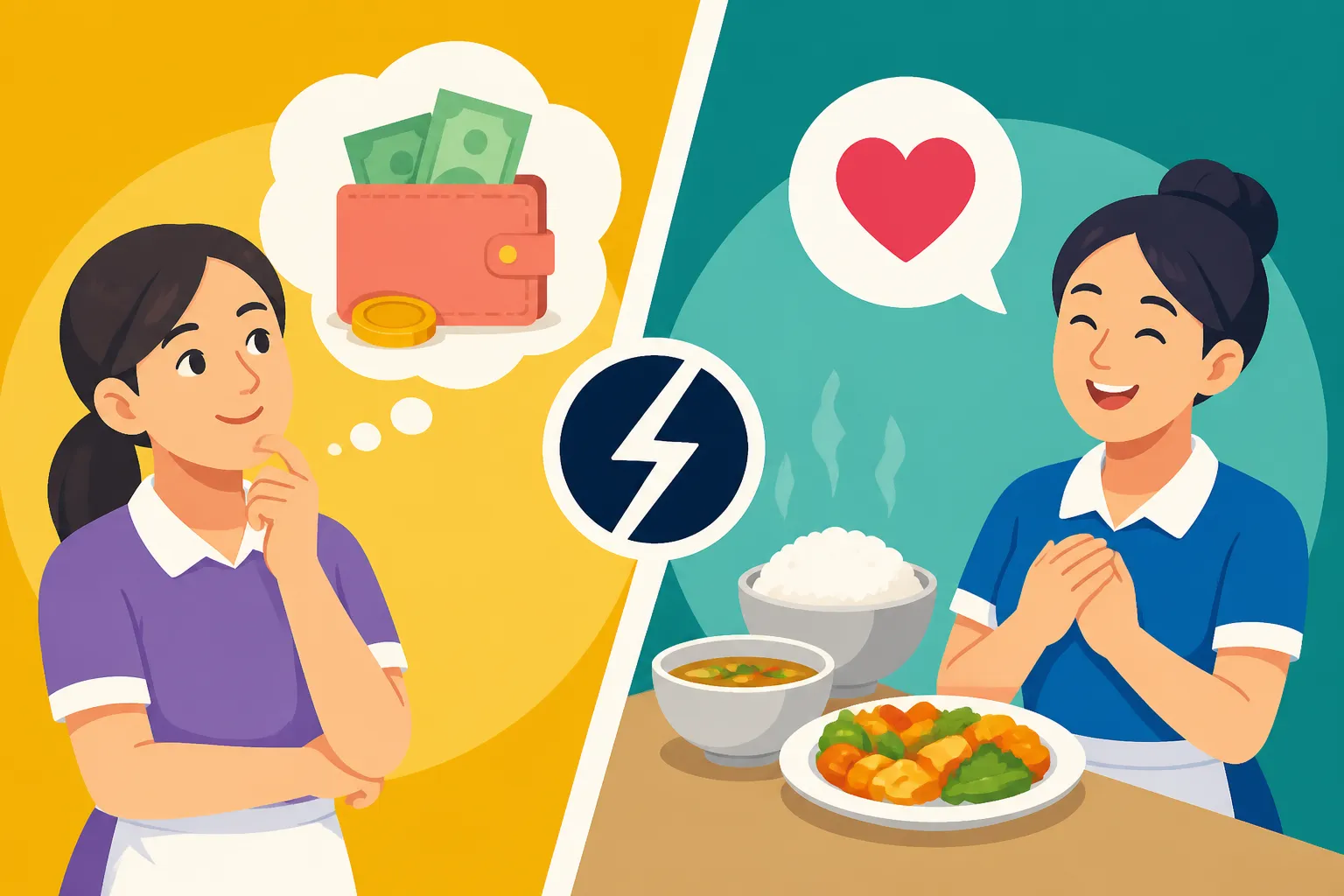
Domestic Helper Food Allowance vs Providing Free Food
Navigating the specific clauses of a domestic helper contract for the first time can feel like deciphering ancient script while under immense pressure to get it right. I remember sitting in a cramped agency office in Wan Chai, sweating over Clause 6 of the ID 407, wondering if "free food" meant I had to cook for my helper or just provide a bag of rice. This guide solves that exact dilemma by breaking down the legal, financial, and personal implications of choosing between a food allowance and providing free food.
The Legal Foundation of the Standard Employment Contract
The relationship between an employer and a foreign domestic helper in Hong Kong is strictly governed by the Labor Department and the Immigration Department. When you are Hiring a Foreign Domestic Helper in HK: Legal Rules and Costs, you will quickly encounter the document known as the ID 407. This is the only legally recognized contract for domestic helpers in the city, and it contains very specific requirements regarding sustenance.
Understanding Clause 6 of the ID 407
Clause 6 of the Standard Employment Contract (ID 407) for Domestic Helpers Explained states that the employer must provide the helper with food free of charge. However, it also provides an "either/or" option. You can either provide "free food" or pay a "food allowance." This choice isn't just a casual agreement between you and your helper; it is a contractual obligation that must be ticked and signed before the visa application can even be processed.
In my experience, many new expats assume that "free food" means the helper simply eats what the family eats. While that is a common practice, the legal definition of "free food" is somewhat broad but requires the food provided to be of reasonable quality and quantity. If you choose the "free food" option, you are essentially promising that the helper will never have to spend a cent of their own salary on basic nutrition while they are under your roof.
Minimum Food Allowance Rates in 2026
As of 2026, the Hong Kong government has adjusted the statutory minimum food allowance to reflect the rising cost of living in the city. While the Domestic Helper Minimum Wage: Penalties for Paying Below HK$5,100 remains the baseline for the salary itself, the food allowance is a separate figure. Currently, the minimum food allowance is set at HK$1,236 per month.
It is important to note that you cannot pay less than this amount if you choose the allowance option. However, you are always free to pay more. Many veteran employers in areas like Central or Repulse Bay often round this up to HK$1,500 or HK$2,000 to ensure their helpers can afford a healthy variety of fresh produce, especially given the prices at premium supermarkets. If you fail to pay the agreed-upon allowance, you are technically in breach of contract, which can lead to serious legal repercussions and difficulty in future visa sponsorships.
Record Keeping and Legal Safety
Regardless of which option you choose, documentation is your best friend. In the high-pressure environment of Hong Kong, administrative disputes can arise over the smallest misunderstandings. If you pay a food allowance, I strongly recommend having your helper sign a simple monthly ledger or receipt. This acts as proof that you have fulfilled your contractual duties.
If you provide free food, it’s slightly more ambiguous. However, if a helper later claims they weren't fed properly, having a record of grocery deliveries or a "household food budget" can be helpful. Remember that the Employer Household Income Requirements (HK$15,000) for Hiring a Helper are designed to ensure you can actually afford these additional costs. Don't be the employer who tries to "save" money by skimping on a helper's basic nutritional needs; it’s a fast track to a miserable household and potential legal trouble.
Providing Free Food: The Pros and Cons
Choosing to provide free food is often the default for families who cook at home regularly. On the surface, it seems like the most inclusive and "family-like" option. However, experience shows how this can lead to subtle tensions if the expectations aren't managed from day one.
Sharing the Family Meal Dynamics
The most common way to "provide free food" is to have the helper eat the same meals as the family. For many, this is a point of pride and a way to make the helper feel welcome. It’s certainly convenient; you buy the same groceries, cook one large batch of food, and everyone is satisfied. This works beautifully if your helper enjoys the same cuisine as your family.
However, consider the "shyness factor." I’ve had many friends whose helpers were too polite to say they actually disliked pasta or found the family's salad-heavy diet unsatisfying. In Filipino and Indonesian cultures, rice is a non-negotiable staple for almost every meal. If your family is doing a "no-carb" or "keto" diet, providing "free food" that consists only of grilled chicken and broccoli might leave your helper feeling weak and hungry. It is wise to keep a 5kg bag of jasmine rice in the pantry regardless of your own diet.
Navigating Dietary and Religious Restrictions
This is where the "free food" option gets complicated. If you hire a helper who has specific religious dietary requirements—such as an Indonesian helper who eats strictly Halal or a Filipino helper who avoids certain foods during Lent—you are responsible for ensuring the "free food" you provide meets those standards. This might mean buying separate cookware or sourcing specific meats from wet markets.
Their helper was a devout Muslim. Because they had ticked "free food," they were legally obligated to provide her with alternative, Halal-certified meals. It became a logistical nightmare for the employer, who eventually switched to a food allowance so the helper could buy and cook her own food in her preferred way. If you aren't prepared to change your shopping habits, "free food" might not be the path for you.
Potential Friction Points and Waste
Another downside of providing free food is the "unlimited" perception. Some employers find themselves frustrated when they notice the expensive Greek yogurt or the imported blueberries they bought for the kids are being consumed by the helper. It feels petty to complain about food, but in a city as expensive as Hong Kong, those costs add up.
Conversely, some helpers feel guilty using "the boss's" expensive ingredients and end up eating very little, which affects their energy levels and health. This can lead to a situation where they need Health Requirements and Medical Exams for Domestic Helpers more frequently because of nutritional deficiencies. To avoid this, many families set aside a specific "helper’s shelf" in the fridge and pantry, stocked with staples that the helper knows are specifically for them.
The Food Allowance Option: Autonomy and Privacy
If you value your privacy and want to avoid any kitchen-related conflict, the food allowance is almost always the superior choice. It provides a clean financial break and gives your helper the dignity of choice.
Why Autonomy Matters for Your Helper
Imagine living in someone else's house 24/6 and having zero control over what you eat. For many helpers, their food is the only piece of "home" they have left. By providing an allowance, you allow them to visit the specialty shops in World-Wide House in Central or the Indonesian markets in Causeway Bay to buy the spices, snacks, and brands they actually miss.
This autonomy often results in a much happier employee. They can budget their allowance to eat exactly what they want, when they want. Most helpers will choose to cook large batches of their traditional dishes on their Rest Day Rules for Helpers: Can You Ask Them to Work and store them in the fridge. This also means you don't have to worry about whether they liked your cooking or if they had enough to eat.
Financial Transparency and Budgeting
From an employer's perspective, the allowance is a "set and forget" cost. You know exactly how much you are spending every month. There are no surprise grocery bills because the helper "needed more milk." It simplifies your household accounting significantly.
In my own household, we switched to the allowance after realizing we were spending way more than HK$1,236 just by "adding an extra portion" to our premium grocery orders from CitySuper or Marks & Spencer. By giving the allowance, we saved money, and our helper was thrilled because she could actually save a portion of that allowance by shopping at the local wet markets where prices are significantly lower.
Calculating and Paying the Monthly Payout
When paying the allowance, most employers simply add it to the monthly salary bank transfer. It’s the cleanest way to do it. If the salary is HK$5,100 and the food allowance is HK$1,236, you transfer HK$6,336 on the designated payday.
I recommend having a clear conversation that this money is strictly for her food and is not a "bonus." If you occasionally invite her to join a family dinner or a birthday celebration, that should be seen as a gesture of kindness, not a reason to deduct money from the allowance. Consistency is key to maintaining a professional relationship.
Comparing Costs and Lifestyle Impact
To help you decide, I’ve put together a comparison of how these two options typically play out in a standard Hong Kong apartment.
| Feature | Free Food Option | Food Allowance Option (HK$1,236+) |
|---|---|---|
| Monthly Cost | Variable (usually HK$1,500 – $2,500) | Fixed (HK$1,236 minimum) |
| Administrative Effort | High (shopping, meal planning) | Low (one-time monthly payment) |
| Helper Autonomy | Low (must eat what is provided) | High (buys what they prefer) |
| Storage Issues | Shared fridge space | May require separate pantry/fridge space |
| Cultural Friction | Possible (dietary/religious clashes) | Minimal |
| Legal Safety | Moderate (requires proof of provision) | High (bank transfer record is proof) |
Communicating Your Choice to Your Helper
The best time to decide on the food arrangement is during the interview process. Don't wait until the contract is being signed at the agency to have this conversation. It’s a fundamental part of the daily working relationship.
Discussing Expectations During the Interview
When you are interviewing candidates, ask them directly: "Do you prefer to eat with the family, or would you prefer a food allowance to buy your own food?" Most experienced helpers will tell you they prefer the allowance because of the autonomy it provides. Newer helpers might prefer free food because they aren't yet familiar with where to shop in Hong Kong.
Be honest about your own lifestyle. If you rarely cook and mostly order Deliveroo, "free food" will be a nightmare for you to manage. If you are a family that sits down for a traditional roast every night and you want your helper to be part of that, make that clear. However, always ensure they know they can still have their own food (like rice) alongside whatever you are serving.
Written Records and Receipts
If you opt for the allowance, create a simple "Salary and Allowance Ledger." Each month, when you pay, have your helper sign next to the date, the amount of salary, and the amount of food allowance. This protects you in case of any future labor disputes. If you are providing free food, it’s a good idea to occasionally ask, "Is there anything special you need from the market this week?" to show you are fulfilling your duty to provide adequate sustenance.
If your helper is looking to improve their household management or even their own skills, perhaps suggest CPR and Choking First Aid Courses for Foreign Domestic Helpers as part of their professional development. A well-fed and well-trained helper is an asset to any home.
Adjusting the Arrangement Mid-Contract
Can you change your mind? Yes, but it requires a mutual agreement and, ideally, a written amendment to the "internal" house rules, though the official contract on file with Immigration will still show the original choice. If you want to change from free food to an allowance, most helpers will jump at the chance.
Changing from an allowance back to free food is much harder, as the helper will likely feel they are losing their independence. If you must do this, explain the reasons clearly—perhaps you are moving to a larger place where communal cooking is easier. Use this as an opportunity to build trust rather than just imposing a rule change.
Cultural Considerations and Language Barriers
Food is more than just fuel; it’s a cultural touchstone. In Hong Kong, where space is tight and stress is high, the kitchen can become a "hot zone" for misunderstandings.
Food as a Cultural Bridge
I’ve found that even if you pay a food allowance, occasionally sharing a meal or inviting your helper to taste a dish from your home country can bridge cultural gaps. Likewise, don't be surprised if your helper offers you a taste of their "Adobo" or "Nasi Goreng." Accepting these gestures (if you are comfortable) builds a massive amount of rapport.
If you find that language barriers are making these kitchen conversations difficult—for example, if you can't explain that the expensive olive oil is only for salads and not for deep-frying—you might consider some language support. While most helpers speak English, Learning Cantonese vs Mandarin for Career Growth in HK can be useful for them when shopping at wet markets.
Using Language Learning to Improve Communication
If you want to truly master the art of household communication, I highly recommend using platforms like Preply or iTalki. I used Preply to find a tutor who could help me learn basic "market Cantonese" so I could help my helper find the best deals. Alternatively, you could even offer your helper a few sessions on iTalki to brush up on specific English culinary terms if they are struggling with your recipes. It’s a small investment that pays dividends in reducing "kitchen frustration."
By using Preply, you can find tutors who specialize in "Domestic Cantonese," which is incredibly practical. Sometimes the friction isn't about the food itself, but the inability to express preferences clearly. A few lessons can turn a tense kitchen into a collaborative one.
Final Thoughts on the Choice
Ultimately, the "allowance vs. free food" debate usually settles in favor of the allowance for most modern expat families. It respects the helper's adulthood and simplifies the employer's life. However, if you do choose to provide food, do it with a generous spirit. There is nothing that sours a domestic relationship faster than an employer who counts every grain of rice or complains about the cost of a loaf of bread.
Hong Kong is a city built on efficiency, but your home is built on relationships. Choose the option that creates the least amount of stress for both you and the person who is helping you manage your life.
Disclaimer
This guide is for informational purposes only and reflects the personal experiences of long-term expats in Hong Kong. It does not constitute legal advice. Labor laws and minimum allowance rates are subject to change by the Hong Kong Special Administrative Region Government. Always consult the official Hong Kong Labour Department website or a qualified legal professional for the most current statutory requirements and to ensure your specific contract is compliant with the latest regulations.