Proving Relationship for Dependent Visas: Marriage Certificates and Translations
When you’re an expat building a life in Hong Kong, few things cause as much stress as the thought of leaving loved ones behind, or the bureaucratic maze of bringing them over. Proving your relationship to the Hong Kong Immigration Department for a dependent visa can feel like an intensely personal interrogation, requiring documents that, back home, might just sit in a drawer. This guide will meticulously walk you through the precise marriage certificates and birth certificates needed, illuminate the often-tricky world of document translations and certifications, and offer practical advice to ensure your application sails through as smoothly as possible.
Understanding the Dependent Visa Framework in Hong Kong
Bringing your family to Hong Kong is a major step, and the Dependent Visa route is usually the path for spouses and children. It’s designed for individuals who are genuinely dependent on a principal visa holder (someone holding a work visa, investment visa, or certain other permits). The Hong Kong Immigration Department (ImmD) takes these applications seriously, and rightly so, as they represent a significant commitment to your life here.
Who Qualifies as a Dependent? Spouses and Children
First, let's get down to brass tacks about who the ImmD considers a "dependent." Generally, this includes your legally married spouse and your unmarried dependent children under the age of 18. This might seem straightforward, but it's where many misunderstandings begin.
For spouses, the key word is "legally married." Hong Kong recognizes marriages that are valid under the laws of the place where they were performed, provided they adhere to Hong Kong’s public policy – meaning it must be a monogamous, heterosexual marriage, although the landscape for Same-Sex Spouses and Dependent Visas in Hong Kong has evolved, allowing those in validly registered same-sex civil partnerships or marriages abroad to apply, albeit under slightly different processing guidelines. The ImmD isn’t interested in common-law partnerships or long-term cohabitation for the dependent visa; for those situations, you might be looking at a Unmarried Partner Visas Prolonged Visitor Status in HK, which is a different category altogether.
For children, they must be "unmarried dependent children under the age of 18." This means they cannot be married themselves, and they must rely on you for financial support. If your child is nearing 18, it's crucial to get their application in promptly. There's usually a bit more leniency for adult children if they are physically or mentally incapacitated and wholly dependent on the principal applicant, but this is a very high bar and requires extensive medical documentation.
The ImmD's Scrutiny and Why Your Documents Matter
The Immigration Department isn't trying to make your life difficult, but they are diligent. They're tasked with maintaining the integrity of Hong Kong's immigration system, and that means ensuring that every application is legitimate. They're looking to prevent abuse of the system, whether it's through sham marriages or individuals attempting to bring over distant relatives under false pretenses.
This high level of scrutiny means your documents aren't just pieces of paper; they are concrete evidence of your familial ties. Any inconsistencies, missing information, or doubts about the authenticity or validity of your certificates will lead to delays, requests for more information, or even outright rejection. You’ll find the process much smoother if you approach it with the mindset that every single detail must be accurate, verifiable, and above reproach. Understanding the general requirements for Hong Kong Visas and Immigration The Complete 2026 Guide can give you a broader context for why such meticulousness is expected.
Your Marriage Certificate: The Linchpin for Spousal Dependent Visas
For any spouse hoping to join their partner in Hong Kong on a dependent visa, the marriage certificate is arguably the most critical document. It’s the legal cornerstone upon which their entire application rests.
What Kind of Marriage Certificate Does HK ImmD Accept?
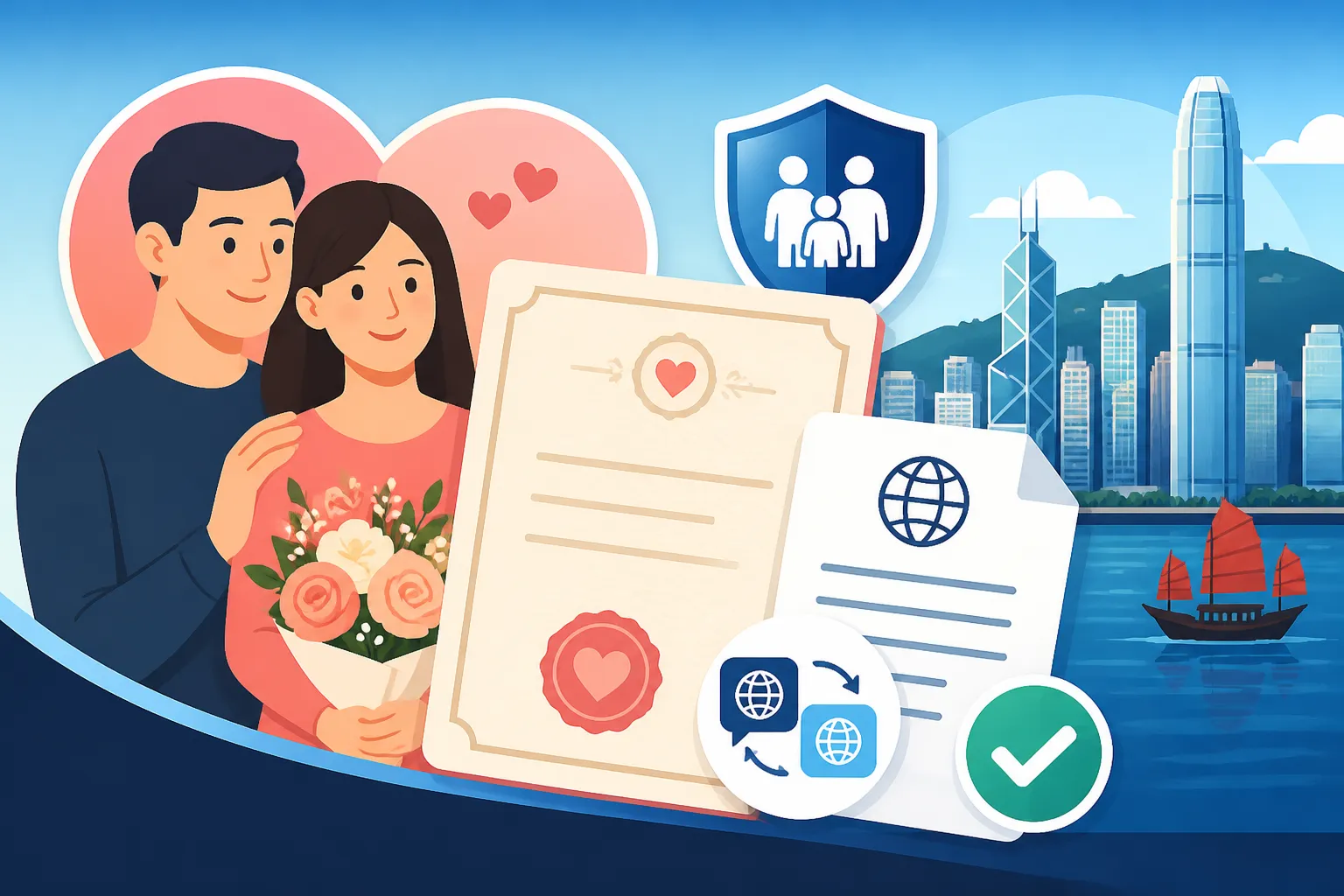
The Hong Kong Immigration Department is very specific about the format and authenticity of your marriage certificate. What they typically want is the original marriage certificate or a certified true copy issued by the relevant authority in the country where the marriage took place.
Let's break that down:
- Original Document: If you have it, always try to provide the original marriage certificate. The ImmD will usually review it and return it to you during the application process. Sometimes, they might ask for a photocopy along with the original for their records.
- Certified True Copy: This is where it gets a bit nuanced. A "certified true copy" isn't just any photocopy. It must be a copy that has been officially certified as a true likeness of the original by a recognized authority. In many countries, this means a solicitor, a notary public, or the issuing authority itself (e.g., a registrar's office). It will usually bear an official stamp, signature, and date, confirming that the certifier has seen the original document. Crucially, they typically need to see the original certificate to make this certification. Be wary of places that offer to certify copies without seeing the original, as the ImmD will likely not accept these. If you are ever in doubt about what constitutes a valid certified copy, referring to specific guidance like Certified Copies for Visa Applications Who Can Sign can clarify.
The ImmD is used to seeing various formats – a US marriage license, a UK marriage certificate, or a marriage extract from India or the Philippines. The key is that it must clearly state the names of both spouses, the date of marriage, and the place of marriage, and bear the official seal or signature of the government entity that registered the marriage.
The Critical Role of Translations and Apostilles for Non-English Documents
Here's a common stumbling block for many expats: your marriage certificate isn't in English or Chinese (Cantonese/Mandarin). If your document is in French, German, Spanish, or any other language, it must be translated.
The ImmD's requirements for translations are strict:
- Official Translation: The translation cannot be done by just anyone. It needs to be an official translation. This typically means a translation performed by a sworn translator, a public notary, or a professional translation service that can attest to the accuracy of the translation. You can't just have a bilingual friend translate it for you; that will almost certainly be rejected.
- Certification of Translation: The translation itself often needs to be certified, meaning the translator or translation agency provides a statement attesting that the translation is accurate and complete, usually with their official stamp and signature. Services like RushTranslate are invaluable here, as they specialize in certified translations that are accepted by immigration authorities worldwide, including Hong Kong. They understand the specific formatting and certification requirements that make a translation legitimate in the eyes of the ImmD.
- Apostille or Legalisation (if required): For documents issued in countries that are signatories to the Hague Apostille Convention, you may need an Apostille stamp on your original document. This is an international certification that legalises the document for use in other countries without further authentication. If your country is not a signatory, the document may need to be legalised through the consulate or embassy of Hong Kong (or China, if Hong Kong does not have a consulate) in the issuing country. This can be a complex step, and understanding Apostille Requirements for Foreign Marriage and Birth Certificates is absolutely essential to avoid delays. Always check the specific requirements based on your country of marriage.
For example, if you got married in Thailand and your certificate is in Thai, you would need to:
- Obtain an official English translation of the Thai marriage certificate.
- Have that translation certified by a professional translation service like RushTranslate.
- Potentially get an Apostille on the original Thai marriage certificate (if Thailand is a Hague Convention signatory) or have it legalised by the Chinese Embassy/Consulate in Thailand.
It's a multi-step process, but failing to follow it meticulously will undoubtedly lead to your application being stalled.
Birth Certificates: Establishing Parental Links for Dependent Children
Just like with marriage certificates, the ImmD requires clear and verifiable proof of parentage for any child dependent visa application. This comes in the form of birth certificates.
Standard Birth Certificates for Dependent Children
For each child applying for a dependent visa, you will need to provide their original birth certificate or a certified true copy. The principles are largely the same as for marriage certificates:
- Original or Certified True Copy: Again, the preference is for the original document. If that’s not possible, a certified true copy issued by the relevant government authority (e.g., Registrar of Births, Department of Vital Records) is acceptable. This certified copy must show the child's name, date of birth, place of birth, and crucially, the names of both parents. This is vital for the ImmD to establish the direct parental link to the principal visa applicant and their spouse.
- Official Translation: If the birth certificate is not in English or Chinese, it must be accompanied by a certified translation. Again, this means using a reputable, professional translation service. Don't take shortcuts here; the ImmD will not accept personal translations. The quality and accuracy of the translation are paramount.
- Apostille/Legalisation: Depending on the country of issuance, the birth certificate may also require an Apostille or legalisation, following the same rules as discussed for marriage certificates. It's an extra layer of authentication, but it's often non-negotiable for documents from certain jurisdictions.
Imagine you're applying for your child born in Germany. Their birth certificate is in German. You would need to get an official English translation of that German certificate, perhaps through a service like RushTranslate, and then ensure the original German document has the correct Apostille from the German authorities.
Special Cases: Adoption Papers and Guardianship
While most applications involve biological children, some expat families include adopted children or children under legal guardianship. These cases are naturally more complex and require additional, specific documentation:
- Adoption Certificates: If your child is adopted, you will need the official adoption order or certificate issued by the competent authority in the country where the adoption was legally finalized. This document must clearly state the names of the adoptive parents and the child, proving the legal parent-child relationship. Like other vital records, it will need a certified translation if not in English or Chinese, and potentially an Apostille or legalisation.
- Guardianship Documents: For situations involving legal guardianship (which is less common for standard dependent visa applications but can occur in specific, rare circumstances), you would need court orders or other official legal documents establishing your legal guardianship over the child. These documents would also be subject to the same translation and certification requirements. These scenarios often warrant consultation with an immigration expert in Hong Kong due to their intricate nature.
It's important to remember that these "special cases" add layers of complexity to the application. Prepare to provide even more exhaustive documentation and possibly face longer processing times as the ImmD verifies the legality and legitimacy of these arrangements.
Navigating Common Pitfalls and Ensuring Success
Even with the clearest instructions, the dependent visa application process can throw curveballs. Anticipating and avoiding common pitfalls is crucial for a smooth journey. The ultimate goal is to present an application so complete and unambiguous that the ImmD has no reason to ask for further clarification or, worse, reject it.
Incomplete or Incorrect Information: A Recipe for Delays
One of the most frequent reasons for delays or rejections is simply presenting incomplete or inconsistent information. This might seem obvious, but it’s easily overlooked amidst piles of paperwork.
- Name Discrepancies: This is a big one. Ensure that names on all documents – marriage certificates, birth certificates, passports, and even your Hong Kong Work Visas TTPS, GEP, QMAS, and IANG Explained application – match exactly. If a maiden name is used on a marriage certificate but a married name on a passport, you'll need to provide an official explanation or deed poll. The ImmD is very particular about this. A small typo or a slightly different order of names can trigger significant hold-ups.
- Outdated Documents: While birth and marriage certificates don't typically "expire," ensure any supporting documents (like your passport) are valid and up-to-date. Sometimes, an ImmD officer might question a very old document if its legibility is poor or if it lacks certain security features common in modern records.
- Missing Pages or Attachments: Double-check that all pages of multi-page documents are included and that any required appendices or explanatory notes are present. A single missing page can render an entire submission incomplete.
The golden rule here is meticulous attention to detail. Before submission, have someone else review your entire application package, specifically checking for consistency across all forms and documents. A fresh pair of eyes can often spot errors you might have become blind to.
The "Certified True Copy" Conundrum: Understanding HK Standards
We've touched on "certified true copies," but it's worth reiterating the nuances for Hong Kong. What one country accepts as a certified copy might not meet the ImmD's standards.
In Hong Kong, for official purposes, a "certified true copy" generally means a photocopy of an original document that has been sighted and then stamped/signed by a professional with legal standing. This typically includes:
- Solicitors or Notary Publics: These are often the safest bet. A local Hong Kong solicitor or a notary public in your home country can certify documents. They will physically examine the original document and then stamp and sign the photocopy, confirming its authenticity.
- Consulates or Embassies: The consulate of your home country in Hong Kong, or the Chinese/Hong Kong embassy in your home country, may also offer document certification services. However, this varies by country and often comes with a fee and a waiting period.
It is generally not sufficient to have a civil servant, a bank manager, or even a doctor certify your documents unless specifically stated by the ImmD or explicitly allowed by the laws of the issuing country and accepted by HK immigration. Always err on the side of using a solicitor or notary public. For more detail, you can refer to the discussion on Certified Copies for Visa Applications Who Can Sign.
The Advantage of Being Over-Prepared
The Hong Kong Immigration Department typically processes dependent visa applications within six to eight weeks, but this is merely a guideline. During peak periods, or if your application requires additional scrutiny, it can take much longer. I've known friends whose applications lingered for months. This waiting game can be incredibly stressful, especially if you're trying to coordinate travel plans or settle into a new life here.
Therefore, my best advice is to be over-prepared. If you think a document might be helpful, include it. If you're unsure if a translation is needed, get one. It's far better to provide slightly more information than requested than to have your application delayed because the ImmD needs to request further clarification. Each query from them adds weeks to the processing time.
Given how long visa processing can take – sometimes months longer than you'd expect – it's always wise to ensure you have comprehensive travel or expat insurance, like what SafetyWing offers, to cover any unforeseen gaps in your healthcare while you wait for your new life in Hong Kong to fully kick off. These plans can bridge the gap before you're fully integrated into the local healthcare system.
Finally, remember that once your dependent visa is approved and your family arrives, there are further steps to take. They will need to register for their Hong Kong Identity Cards HKID Registration and Smart IDs shortly after arrival. Make sure to schedule an appointment for Booking an Appointment for HKID Registration at ImmD Offices within their first 30 days to avoid any unnecessary complications.
Key Documents for Dependent Visa Applications
| Document Type | Purpose | Required Details | Special Considerations |
|---|---|---|---|
| Marriage Certificate | Proof of legal marriage for spouse | Names of both spouses, date, place of marriage | Original or certified true copy. Must be translated if not English/Chinese. May need Apostille/Legalisation. |
| Birth Certificate | Proof of parentage for dependent children | Child's name, DOB, POB, names of both parents | Original or certified true copy. Must be translated if not English/Chinese. May need Apostille/Legalisation. |
| Adoption Order | Proof of legal adoption (if applicable) | Names of adoptive parents & child, date of order | Official court document. Must be translated if not English/Chinese. |
| Passports | Identity & travel history for all applicants | Valid, clear photo, expiry date, visa stamps | Copies of all pages, current and expired, may be required. |
| Principal Applicant's Visa/HKID | Proof of sponsorship eligibility | Valid work/investment visa, HKID number | Copy of principal applicant's visa label and HKID card. |
Remember, while the immediate focus is on securing the dependent visa, the journey in Hong Kong is a long one. Keep an eye on long-term requirements, such as understanding How Absences from HK Affect Your 7-Year Permanent Residency Clock if permanent residency is a future goal. And for children, you’ll eventually need to consider aspects like Can Dependent Children Attend Local Public Schools? if you’re exploring schooling options beyond international schools.
Bringing your family to Hong Kong is a huge milestone. By taking the time to meticulously prepare and present your relationship documents, you're not just completing paperwork; you're laying the solid foundation for your shared life in this incredible city.
Disclaimer
The information provided in this guide is for general informational purposes only and does not constitute legal or immigration advice. While we strive to keep the content accurate and up-to-date, immigration laws and policies in Hong Kong can change rapidly. Always consult with the official Hong Kong Immigration Department website or seek advice from a qualified immigration professional for specific guidance regarding your individual circumstances.