Same-Sex Spouses and Dependent Visas in Hong Kong
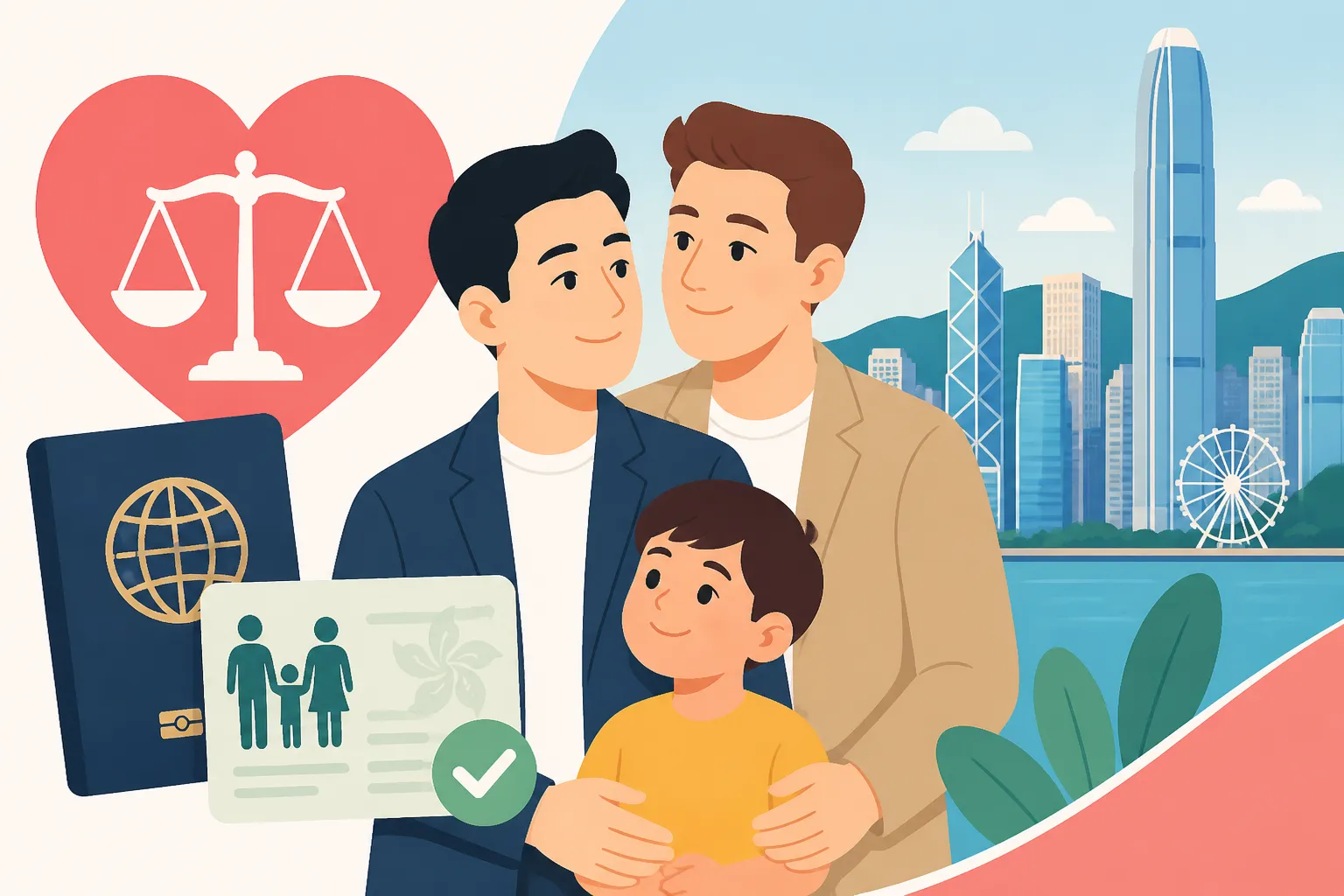
Navigating the labyrinth of immigration is stressful for any expat, but for same-sex couples, the uncertainty of legal recognition in a new country can be downright overwhelming. You might worry if your marriage is valid or if your partner will be forced to leave on a tourist visa. This guide solves those anxieties by detailing exactly how Hong Kong recognizes same-sex unions for dependent visas.
The Evolution of Same-Sex Dependent Rights in Hong Kong
For many years, the Hong Kong Immigration Department operated under a very narrow, traditional definition of marriage. If you weren't a man and a woman with a standard marriage certificate, your partner was essentially a stranger in the eyes of the law. This forced many couples into the precarious position of "visa runs" or applying for "prolonged visitor" status, which offered no right to work and no long-term security.
The turning point came with the landmark QT case in 2018. A British woman, known in court documents as QT, challenged the Director of Immigration after being denied a dependent visa because her same-sex civil partnership, entered into in the UK, was not recognized. The Court of Final Appeal eventually ruled in her favor, stating that excluding same-sex spouses from dependent visa eligibility was discriminatory and lacked a fair rationalization.
Since that ruling, the policy has shifted significantly. Today, if you hold a valid work visa, such as through the Top Talent Pass Scheme (TTPS): The Fast-Track Work Visa, or if you are a Permanent Resident, your same-sex spouse is eligible for a dependent visa. This change hasn't just been a legal win; it has transformed the city into a much more inclusive hub for global talent who previously bypassed Hong Kong due to these administrative hurdles.
Understanding the Current Legal Framework
The current policy does not actually change the legal definition of "marriage" within Hong Kong’s domestic laws (which still technically defines it as between a man and a woman). Instead, the Immigration Department has updated its policy to recognize "a local/overseas marriage, a local/overseas civil partnership, or a local/overseas civil union" for the purpose of dependent visa applications.
This distinction is important. While your marriage might not allow you to file joint taxes in the same way as a heterosexual couple in every single local department, for the purposes of Dependent Visas in HK: Bringing Spouses and Children, you are treated with parity. The key is that the union must be legally recognized in the place where it was celebrated. If you have a legal document from your home country or a third country, the Immigration Department is now obligated to process it.
The Shift from Prolonged Visitor Status
Before the 2018 ruling, many same-sex partners lived in Hong Kong on a "Prolonged Visitor" visa. I remember friends who lived this way for years; they were constantly looking over their shoulders, unable to open a bank account easily, and strictly forbidden from taking up even part-time work. It was a life lived in a legal gray area that made it impossible to truly settle down.
With the current rules, you should steer clear of the visitor route if you are legally married or in a civil union. Moving straight to a dependent visa is not just about the right to stay; it’s about dignity and integration. Once you have that dependent status, your partner becomes a resident with an ID card, which is the golden ticket to life in this city. You will want to look into Hong Kong Identity Cards (HKID): Registration and Smart IDs as soon as you arrive, as it’s the primary way you’ll interact with everything from libraries to hospitals.
Eligibility and Documentation for Same-Sex Dependent Visas
The success of your application hinges entirely on the quality of your paper trail. In Hong Kong, "almost" doesn't count. The Immigration Department is famously meticulous, and they won't just take your word for it. You need to prove the legality of your union and the financial ability of the sponsor to support the dependent without relying on public funds.
If you are coming in on a General Employment Policy (GEP): Standard Work Visas for Expats, you are the "sponsor." You must demonstrate that you have a job with a salary that can cover a flat (which isn't cheap here!) and daily living expenses for two people. The Immigration Department typically looks for a clean record and a genuine relationship. They aren't looking to catch you out, but they do require a very specific set of documents to check their boxes.
Qualifying as a Legally Recognized Spouse
The most common question I get is: "What if we just have a common-law marriage?" Unfortunately, Hong Kong does not recognize common-law relationships, regardless of whether you are in a same-sex or opposite-sex couple. You must have a certificate from a government body. This could be a marriage certificate from a state in the US, a civil partnership certificate from the UK, or a registered union document from places like Taiwan or Australia.
If you are currently living together but haven't formalized the union, you might need to consider a quick trip to a jurisdiction that allows for civil unions or marriages before you start your Hong Kong application. Without that piece of paper, your path to a dependent visa is essentially blocked. Some couples have had to delay their relocation by months just to fly to a jurisdiction where they could legally tie the knot to satisfy the Wan Chai bureaucrats.
Essential Documents for Your Application
You will need the original and a copy of your marriage or civil union certificate. Along with this, you’ll need proof of the sponsor's income—think employment contracts and recent bank statements. For the dependent, a valid passport with at least six months of validity is a must. You also need to fill out Form ID 997, which is the standard application for a dependent visa.
Sometimes, the department asks for "proof of relationship." This is where things get a bit more personal. They might want to see photos of the two of you together over several years, joint bank account statements, or even letters from family members. It feels invasive, but it’s standard procedure to ensure the marriage isn't just for visa purposes. If you have any doubts about what to include, checking the Apostille Requirements for Foreign Marriage and Birth Certificates is a great way to ensure your foreign documents are considered legitimate in a local context.
Translation and Notarization Requirements
If your marriage certificate is in any language other than English or Chinese, you must provide a certified translation. This is a non-negotiable step. Using a professional service like RushTranslate is often the easiest way to ensure the translation meets the strict standards of the Immigration Department. A simple translation by a friend or a non-certified translator will likely lead to a rejection or a frustrating "please resubmit" letter that adds weeks to your wait time.
Beyond translation, many documents require notarization or an apostille, depending on your home country. This confirms that the signatures on your documents are genuine. You should also check Certified Copies for Visa Applications: Who Can Sign to make sure you aren't wasting time with signatures that the department won't accept. Getting this right the first time is the difference between a three-week approval and a three-month headache.
| Document Type | Requirement for Same-Sex Spouses | Notes |
|---|---|---|
| Marriage Certificate | Must be from a recognized jurisdiction | Common-law is not accepted |
| Civil Union/Partnership | Accepted under the QT ruling | Must be a legal government document |
| Proof of Funds | Sponsor's bank statements/contract | Must show ability to support dependent |
| Translation | Certified English/Chinese translation | Required for all non-English/Chinese docs |
| Passport | Minimum 6 months validity | Copy of all pages including empty ones |
Rights and Restrictions for Same-Sex Dependents
One of the greatest fears for a trailing spouse is being "trapped" at home. The good news is that once a same-sex dependent visa is granted, the holder enjoys almost all the same rights as any other resident. This parity is crucial for a couple's long-term happiness in a high-octane city like Hong Kong.
Unlike some other jurisdictions where a dependent might need a separate work permit, Hong Kong is remarkably liberal in this regard. This allows the dependent spouse to pursue their own career, which is often a financial necessity given the cost of living in neighborhoods like Mid-Levels or Central.
Can Same-Sex Dependents Legally Work in Hong Kong?
Yes, they absolutely can. If the sponsor is in Hong Kong on a work visa (like GEP or TTPS) or is a Permanent Resident, the dependent is free to take up employment without needing prior permission from the Immigration Department. This is a massive relief. Your partner can walk into an interview, show their HKID with the dependent status, and start working the next day if they get the job.
The only exception to this rule is if the sponsor is in Hong Kong on a student visa. In that case, the dependent is generally restricted from taking up employment. But for the vast majority of expats moving for corporate or tech roles, the "right to work" for the spouse is a standard feature of the visa. If you're coming in on a graduate-style visa, you should read about the IANG Visa: The Ultimate Path for Non-Local Graduates to see how that sponsorship affects your spouse's ability to work.
Accessing Education and Healthcare as a Dependent
Your dependent visa also grants access to the local healthcare system. This means your spouse can get their own HKID card and access public hospitals at the "Eligible Person" rate, which is a fraction of what a tourist would pay. For peace of mind during the first few months, many expats use SafetyWing as a bridge until their local insurance or public health registration is finalized.
Once registered, you should look at Registering Your HKID for Subsidized Public Healthcare Rates to understand how the system works. On the education front, same-sex dependents are also entitled to study in Hong Kong. Whether it's a part-time MBA or a language course to pick up Cantonese, there are no additional study permits required. This makes the transition much smoother for couples who view their time in Hong Kong as a period of mutual growth.
The Road to Permanent Residency for Same-Sex Couples
Hong Kong has a very clear path to "Permanent Residency" (PR), also known as the Right of Abode. After seven years of "continuous ordinary residence," you can apply to stop worrying about visas forever. For same-sex couples, the clock for both the sponsor and the dependent starts the moment you enter Hong Kong on your respective residence visas.
Maintaining this status for seven years requires some planning. You can't just leave for two years and expect the clock to keep ticking. However, the Immigration Department is generally understanding of business trips or short holidays. The key is that your "ordinary residence" remains in Hong Kong.
Calculating the 7 Year Continuous Residence Requirement
The seven-year rule is strict but fair. Both you and your spouse must physically reside in Hong Kong for the majority of the year. If the sponsor loses their job but quickly finds another, the clock usually stays intact, provided the visa transition is handled correctly. If you're curious about the specifics, check out Right of Abode (Permanent Residency): The 7-Year Journey for a deep dive into the nuances of those 84 months.
For same-sex couples, the "continuous" part is vital. If one partner has to move back home for a year to care for a relative, their 7-year clock might reset, while the other partner’s clock continues. This can lead to a situation where one spouse becomes a Permanent Resident while the other is still on a dependent visa. It’s not the end of the world, but it does mean more paperwork down the line.
Maintaining Status During Career Transitions
If the sponsor changes jobs, they must notify the Immigration Department. As long as the new employer is willing to sponsor the visa, the dependent’s status remains safe. However, there is always a brief moment of anxiety during a job switch. It is important to ensure that Proving Relationship for Dependent Visas: Marriage Certificates and Translations are always kept up to date in your personal files, as you may need to resubmit proof during a visa extension or a change of sponsorship.
The reality is that Hong Kong wants to keep talented people here. The administrative hurdles for same-sex couples are now largely the same as for anyone else. The system is designed to be efficient, but it rewards those who are organized. If you stay on top of your renewals and keep your documents in order, that 7-year mark will arrive sooner than you think, offering you the ultimate security of never needing a visa again.
Practical Tips for a Smooth Application Process
Even with the law on your side, the "Immig Tower" in Wan Chai can be an intimidating place. It’s a massive building where thousands of lives are processed every day. My best advice? Be over-prepared. If they ask for three months of bank statements, bring six. If they want a copy of your marriage certificate, bring the original and three copies.
The staff at the Immigration Department are generally polite but very busy. They appreciate it when you have your forms filled out correctly and your documents organized in a logical order. Using a clear folder with tabs can actually make a difference in how smoothly your interview or submission goes.
Common Pitfalls to Avoid in the Immigration Tower
The biggest mistake I see is people forgetting to sign a specific box or using the wrong color ink (always use black or blue as specified). Another pitfall is not realizing that the sponsor must be physically present in Hong Kong when the dependent’s visa is activated. If you’re the sponsor and you’re away on a business trip when your spouse arrives to "land" their visa, you might run into issues.
Also, be aware of the 30-Day Rule for Registering a New HKID After Arrival. Once your dependent visa is pasted into your passport (or you receive the e-Visa QR code), you have a month to get that ID card. Don’t delay this. Without the ID, your spouse can’t easily sign up for a gym, get a mobile phone contract, or access the Private Health Insurance Plans Beyond VHIS for Expat Families that many expats rely on.
Relocating Your Household and Pets Together
For many of us, our "dependents" aren't just human spouses—they’re our pets too. Moving to Hong Kong with a dog or cat involves its own set of complex rules, including microchipping, vaccinations, and potentially quarantine. If you’re coordinating a move for a spouse and a pet, the logistics can get hairy.
Using a service like Pet-Journey can take the weight off your shoulders. They understand the specific requirements for importing animals into Hong Kong’s tropical climate and dense urban environment. Dealing with a visa for your spouse is one thing, but navigating the AFCD (Agriculture, Fisheries and Conservation Department) for a pet is another entirely. Getting professional help ensures that your whole family—furry members included—arrives safely and legally.
Social and Cultural Realities for LGBTQ+ Expats in HK
While the legal landscape has improved, the social reality of Hong Kong is a mix of traditional values and cosmopolitan openness. In expat-heavy areas like Soho, Sheung Wan, or Sai Ying Pun, being a same-sex couple is largely a non-issue. You’ll see couples holding hands and frequenting the many LGBTQ-friendly bars and cafes without a second thought.
However, in more traditional local neighborhoods or in some corporate environments, a degree of discretion is still common. It’s not that people are hostile; it’s more that Hong Kong culture tends to be private about personal lives. Understanding this balance is key to a happy life here. You’ll find a vibrant, supportive community if you look for it, but you should also be prepared for the occasional inquisitive look in more remote parts of the New Territories.
Navigating the Local Social Scene
The LGBTQ+ scene in Hong Kong is concentrated but energetic. From the annual Pride parade to the Pink Dot festival, there are plenty of opportunities to connect with both locals and other expats. Joining groups on platforms like Meetup or Facebook can help your spouse find their feet, especially if they aren't working right away.
Living in Hong Kong is an adventure, and doing it with your partner by your side makes it all the more rewarding. The city’s energy is infectious, and while the paperwork can be a slog, the reward is a life in one of the most dynamic places on earth. Don't let the initial bureaucracy dampen your spirits. Once that visa is in hand, the city is yours to explore together.
Financial and Legal Protections for Unmarried Partners
If you are not married and cannot get a dependent visa, you need to be very careful. As mentioned, Hong Kong does not recognize "de facto" partners for visa purposes. This means you won't have the same protections for medical emergencies or inheritance. If you are in this position, it is highly recommended to consult a local lawyer to draft a power of attorney and a clear will.
Without the dependent visa, your partner will likely need to find their own sponsorship through a Top Talent Pass Scheme (TTPS): The Fast-Track Work Visa or another employment route. This puts a lot of pressure on the relationship and the individual. If there is any way to formalize your union before moving, it is almost always the better path for a stress-free life in Hong Kong.
Disclaimer
The information provided in this guide is for general informational purposes only and does not constitute legal or professional immigration advice. Immigration policies in Hong Kong are subject to change at the discretion of the Hong Kong Immigration Department. While we strive to provide the most up-to-date information, you should always consult the official Gov.HK website or a qualified immigration consultant before making any major life decisions or submitting visa applications.