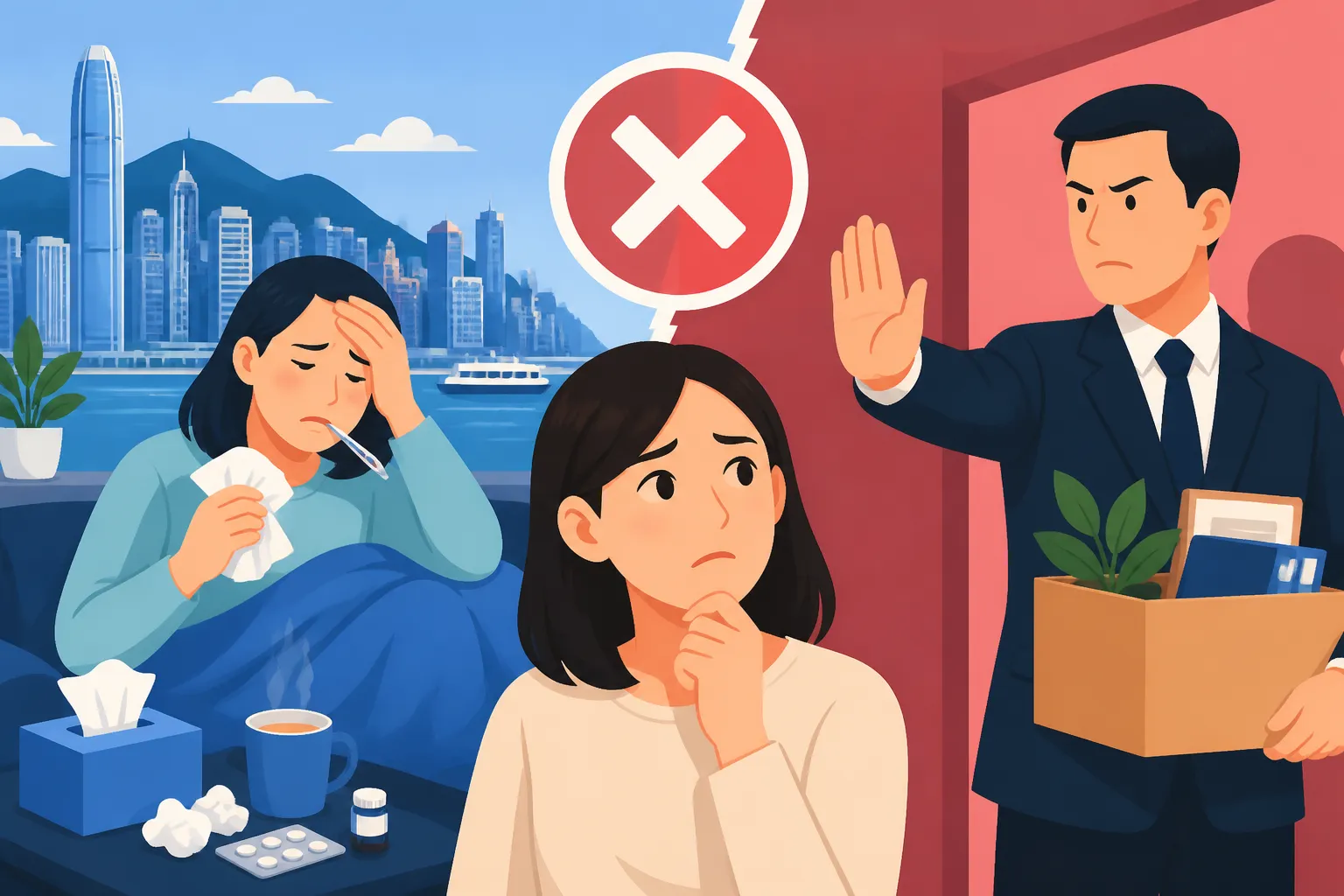
Can You Be Fired for Being Sick in Hong Kong?
Waking up with a pounding headache or a fever in the high-pressure environment of Hong Kong is a unique kind of stress. I remember one Tuesday morning in my second year here when I was staring at my thermometer, terrified that calling in sick would lead to my termination by lunchtime. This guide breaks down the legal protections and hard realities of sick leave under the Employment Ordinance to ensure you know your rights when your health fails.
The Legal Shield Against Dismissal During Sick Leave
The most important thing you need to know is that Hong Kong law provides a very specific and robust shield for employees who are genuinely ill. Under the Employment Ordinance, an employer is prohibited from terminating an employee's contract of employment on a day when the employee is on a "paid sickness day." This isn't just a suggestion or a "best practice" for HR; it is a statutory requirement that carries criminal penalties for the employer if violated.
Expats are often pressured into thinking that their "at-will" style expectations from back home apply here, but the Employment Rights in HK: Contracts, MPF, and Statutory Leave are quite clear on this point. If you have accumulated enough sickness days and you have provided the correct medical documentation, your employer cannot hand you a pink slip while you are sitting in the doctor’s waiting room. If they do, they are liable for prosecution and could be fined up to HK$100,000. Furthermore, they would be required to pay you wages in lieu of notice, an additional month’s wages as compensation, and your accrued sickness allowance.
There is, however, one massive exception: summary dismissal. If an employer can prove that you have committed "serious misconduct"—think fraud, physical violence, or extreme negligence—they can technically fire you even if you are sick. But being sick itself is never a valid ground for summary dismissal. The burden of proof is heavily on the employer in these cases, and the Labour Department rarely takes a kind view of companies trying to use summary dismissal as a loophole to fire someone with a flu.
Understanding How You Earn and Use Sickness Days
You don't walk into a new job on day one with a full bank of sick leave. In Hong Kong, you "earn" your sickness days over time. During your first year of employment, you accumulate paid sickness days at a rate of two days for every completed month of service. Once you hit your second year, that rate doubles to four days per month. You can accumulate these up to a maximum of 120 days.
This accumulation process is something you should keep a close eye on, especially during your Expat Checklist for the First Week at a New HK Office. Many new arrivals get hit by a "welcome to the humidity" chest infection in their third month, only to realize they’ve only banked six days of paid sick leave. If you haven't earned enough days to cover your absence, your employer isn't legally required to pay you for that time off, even if you have a valid doctor's note. They can treat it as unpaid leave, though they still cannot fire you for being ill if you have a valid medical certificate.
When you are reviewing your Understanding HK Employment Contracts: Notice Periods and Probation, check if your company offers "discretionary" sick leave. Many multinational firms in Central and Quarry Bay offer more than the statutory minimum. They might give you 10 or 15 days of "full-pay" sick leave from day one. This is a contractual benefit, not a statutory one, meaning the strict "no-firing" rule still applies to the statutory portion, but the payment terms are more generous than the law requires.
The Four Day Rule and the Sickness Allowance
One of the most confusing aspects of the local system for foreigners is the "Four-Day Rule." To be eligible for the statutory "sickness allowance"—which is essentially your paid sick leave—your absence must last for at least four consecutive days. If you are only sick for one, two, or three days, the law does not actually mandate that your employer pays you for that time, even if you have an MC (Medical Certificate).
However, in practice, almost every professional office in Hong Kong will pay for one or two days of sick leave as long as you show an MC. They do this because it’s administratively easier than docking pay and it keeps morale high. But if you find yourself working for a very strict local firm, don't be shocked if your paycheck is a little light after taking two days off for a stomach bug. You can find more detail on this in the guide on Minimum Sick Leave Days Required to Claim Statutory Sickness Allowance.
When you do qualify for the allowance (by being sick for 4+ days and having a certificate), you aren't paid your full salary by law. You are paid four-fifths (80%) of your average daily wages earned during the preceding 12-month period. This is a common point of frustration for expats who are used to 100% sick pay. If you are struggling to communicate these nuances with your local HR department, using a platform like Preply or iTalki to brush up on your business Cantonese can be a lifesaver. Being able to cite the "four-fifths" rule in the local tongue often signals to HR that you know exactly what your rights are.
| Feature | Statutory Minimum (HK Law) | Common Private Practice |
|---|---|---|
| Minimum Absence for Pay | 4 Consecutive Days | 1 Day |
| Payment Amount | 4/5ths (80%) of daily wage | 100% of daily wage |
| Medical Certificate | Required for all paid days | Required for 1 or 2+ days |
| Accumulation Rate | 2 days/month (Yr 1), 4 days/month (Yr 2+) | Varies (often 12-15 days/year) |
| Maximum Bank | 120 Days | Often resets annually |
Navigating the Medical Certificate Culture
In Hong Kong, the "MC" is king. Do not simply tell your boss you have a migraine and stay in bed. You must visit a doctor and get a physical (or digital) slip that explicitly states you are "unfit for work." Without this document, your absence is legally considered "unauthorized," and that is a very dangerous territory to be in. Unauthorized absence can be used as a ground for disciplinary action or, if it persists, termination of employment.
It is always wise to act Finding English-Speaking General Practitioners (GPs) in Central before you actually get sick. When you are shivering with a fever, the last thing you want to do is hunt for a clinic that understands your insurance. Make sure the doctor clearly writes the dates on the MC. If you need five days off, the MC must cover all five days. If it only covers three, and you take four, that fourth day is unprotected.
There are also very specific Occupational Health: Statutory Sick Leave Certificates (MC) Rules regarding who can issue these notes. Generally, it must be a registered medical practitioner, a registered dentist, or a registered Chinese medicine practitioner. If you prefer holistic approaches, note that Traditional Chinese Medicine practitioners are recognized, provided they are properly registered with the TCM Council of Hong Kong.
Discrimination and Chronic Illness Protection
What if you aren't just "sick" with a cold, but are dealing with a long-term condition or a disability? This is where the Disability Discrimination Ordinance (DDO) comes into play. In Hong Kong, it is unlawful for an employer to discriminate against an employee on the ground of their disability, which includes chronic illnesses like cancer, HIV/AIDS, or even severe clinical depression.
If an employer fires you because they find out you have a chronic condition that requires ongoing treatment, they aren't just violating the Employment Ordinance; they are violating anti-discrimination laws. The Equal Opportunities Commission (EOC) handles these cases. While the Healthcare in Hong Kong: Public vs Private Systems Explained (2027) offers excellent care for chronic issues, the workplace transition can be rocky. You have the right to "reasonable accommodation"—meaning your employer should try to adjust your duties or hours if your condition allows you to keep working.
If you ever feel that your illness is being used as a pretext to push you out of the company, you should immediately start documenting every interaction. Save emails, record the dates of "performance reviews" that suddenly turn sour after you mention your health, and consider Resolving Workplace Disputes: Utilizing the HK Labour Department as your first port of call.
The Reality of Overtime Culture and Sick Leave
While the law protects your job, it doesn't always protect your reputation in a city that prides itself on "Lion Rock Spirit" and working until 9 PM. There is a psychological pressure in Hong Kong to work through the pain. I have seen colleagues attend Zoom meetings from hospital beds. This is why knowing Statutory vs Public Holidays: Understanding the Difference in HK is useful, as it helps you map out your rest periods.
If you are new to the city, you might feel that taking sick leave will stall your career. This is a cultural hurdle rather than a legal one. To navigate this, communication is vital. If you are sick, notify your supervisor as early as possible—ideally before the workday begins. Provide the MC promptly. If you can, delegate urgent tasks before you go offline. This shows "work-ethic" even when you are physically incapacitated.
If the language barrier is making these sensitive conversations harder, I highly recommend using iTalki or Preply to find a tutor who can role-play these HR conversations with you. Learning the right "soft" phrases in Cantonese to express your regret for being sick while firmly standing by your need for rest can make a huge difference in how you are perceived by local management. A little bit of Learning Cantonese vs Mandarin for Career Growth in HK goes a long way in building the rapport that protects you during vulnerable times.
What to Do if You are Wrongfully Fired
If the worst happens and you are terminated while on a valid, doctor-certified sick leave, do not sign any "mutual separation" agreements immediately. These agreements often contain clauses where you waive your right to sue the company in exchange for a small severance. Once you sign, it is incredibly difficult to undo.
Instead, take your medical certificates, your employment contract, and your termination letter to the nearest Labour Relations Division office of the Labour Department. They provide a free conciliation service. Most "bad" employers will settle as soon as the Labour Department gets involved because the criminal liability is a massive deterrent. They don't want a permanent record of violating the Employment Ordinance.
Remember, your health is your most valuable asset in this city. Hong Kong's pace is relentless, and the law exists to ensure that a temporary bout of illness doesn't result in a permanent loss of your livelihood and your visa status. Stay informed, keep your MCs in order, and never let an employer tell you that your right to recover is secondary to the company's bottom line.
Disclaimer
This article is for informational purposes only and does not constitute legal or professional medical advice. While every effort has been made to ensure accuracy based on 2026 guidelines, Hong Kong labor laws and immigration policies are subject to change. Always consult with a qualified legal professional or the Hong Kong Labour Department regarding your specific circumstances.