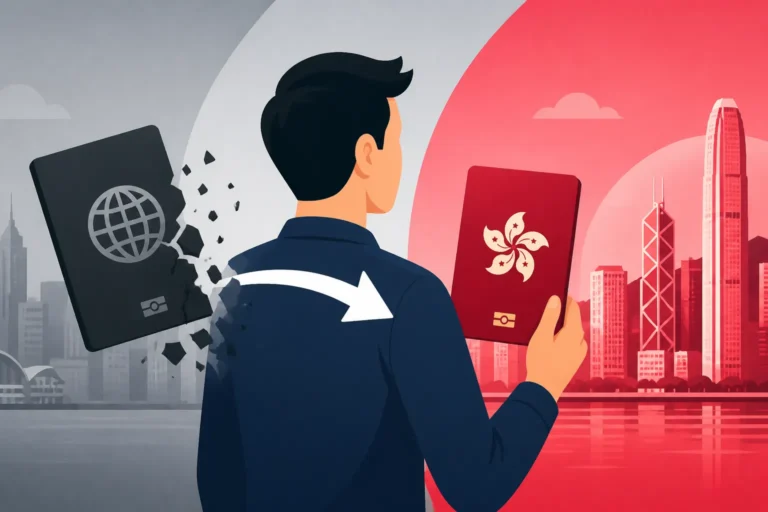
Form ID 881: Certificate of Entitlement Application
Navigating Hong Kong's immigration system can feel like deciphering an ancient scroll written in legal jargon, especially when it comes to the highly sought-after Right of Abode. Many expats and their families find themselves lost in a maze of forms and requirements, particularly when their claim to permanent residency isn't straightforward. This comprehensive guide is here to shed light on Form ID 881 and the Certificate of Entitlement, helping you understand this critical step towards securing your family's future in this vibrant city.
What Exactly is Form ID 881 and the Certificate of Entitlement (CoE)?
When you're trying to solidify your family's status in Hong Kong, the phrase "Certificate of Entitlement" might pop up, often followed by a collective groan from those who've navigated it before. It’s not just another piece of paper; it’s a vital document for specific individuals asserting their right to permanent residency in Hong Kong. Think of it as an official stamp of approval from the Immigration Department (ImmD) that confirms you (or your child) genuinely hold the Right of Abode (RoA).
Understanding the Purpose of the CoE
The Certificate of Entitlement (CoE) isn't the application for Right of Abode itself; rather, it’s the verification that you already possess it, typically because of your birth or your parent's status. I know, it sounds a bit circular, doesn't it? But here’s the rub: if you’re a Chinese citizen who claims permanent residency by descent (e.g., born outside Hong Kong to a parent who held RoA at the time of your birth) or if you're reclaiming your RoA after a prolonged absence, the ImmD needs to officially confirm your entitlement. It's their way of ensuring that while you might have a legitimate claim, you still meet all the specific legal requirements.
For instance, consider a scenario where you, a Hong Kong permanent resident, have a child born overseas. That child is a Chinese citizen by descent and inherently has the Right of Abode. However, before they can get their Hong Kong Permanent Identity Card (PIC) or even an HKSAR Passport, the ImmD needs to issue a CoE to formally recognize that inherent right. Without it, they can't simply walk into an ImmD office and apply for a PIC. It’s a prerequisite that often catches new parents off guard.
Who Needs to Apply Using Form ID 881?
The need for Form ID 881 specifically targets a few key groups, and it’s crucial to know if you fall into one of them. The most common scenario is for children who are Chinese citizens but were born outside Hong Kong to a parent who was a permanent resident of Hong Kong at the time of the child's birth. This is where many expat families who’ve had children abroad while one parent retained their HK permanent status come in. The child is technically a permanent resident from birth, but this form verifies it.
Another group includes individuals who previously held the Right of Abode but, perhaps due to long periods away from Hong Kong, lost their status as permanent residents (usually applies to non-Chinese citizens who lost "ordinary residence"). They need to re-establish their claim to RoA, and the CoE application through Form ID 881 is the pathway. It's important to differentiate between those who were never permanent residents and those who were but need official verification or re-establishment. If you’re a non-Chinese citizen simply reaching the seven-year mark, you apply directly for a Right of Abode (Permanent Residency): The 7-Year Journey via a different form, not ID 881. This form is very much about confirming an existing entitlement rather than earning it.
Eligibility Criteria: Do You Qualify for a CoE?
Before you even start looking for Form ID 881, you need to be absolutely sure that you (or the person you're applying for) actually meet the eligibility criteria for the Right of Abode. This is where a lot of confusion, and frankly, frustration, often sets in. Hong Kong’s laws on residency can be quite nuanced, making it easy to misinterpret your situation.
The "Ordinary Residence" Test
One of the most significant hurdles for many expat families is the concept of "ordinary residence," especially when applying for a child born overseas. For a child born outside Hong Kong to claim RoA as a Chinese citizen, their parent must have been a permanent resident at the time of the child's birth. Furthermore, the child must be a Chinese citizen. This usually means the parent had their HKID with the all-important three asterisks (***) or the letter 'R' beneath their birthdate. These symbols are critical indicators of permanent residency.
The "ordinary residence" test typically applies more strictly to non-Chinese citizens who are trying to claim or reclaim RoA. For them, it means establishing that Hong Kong has been their continuous, habitual home for at least seven years, and they haven't been absent for "more than just temporary or casual" reasons. The ImmD will scrutinise factors like where your immediate family lives, where you work, where your children go to school, your property ownership, and how long you've spent outside Hong Kong. It’s about proving your "centre of life" is here. If your parent was a non-Chinese citizen permanent resident who spent significant time abroad before your birth, you might need to dig deep into their travel history and ties to Hong Kong at that specific time to prove their "ordinary residence" status. Understanding How Absences from HK Affect Your 7-Year Permanent Residency Clock is crucial for both parents and children seeking RoA.
Key Categories for Right of Abode
The eligibility for the Certificate of Entitlement is intrinsically linked to the broader Right of Abode categories in Hong Kong. There are several ways one can qualify for RoA, and Form ID 881 typically applies to these specific situations:
- Chinese citizens who were born in Hong Kong: If you were born here and are a Chinese citizen, you inherently have RoA. You usually just apply for an HKID, but if there's any doubt about your citizenship or birth status, CoE might come up.
- Chinese citizens who have resided in Hong Kong for a continuous period of not less than seven years: This is the classic "seven-year rule" for Chinese citizens.
- Persons of Chinese nationality born outside Hong Kong to a parent who, at the time of the person’s birth, was a Chinese citizen with the Right of Abode in Hong Kong: This is the most common scenario for Form ID 881 applications from expat families. Your parent needs to have met criteria 1 or 2 above when you were born.
- Non-Chinese citizens who have ordinarily resided in Hong Kong for a continuous period of not less than seven years and have taken Hong Kong as their place of permanent residence: This is the direct route for many expats. After fulfilling the seven-year continuous residence with a valid visa and having no restrictions on stay, you apply directly for a permanent HKID.
- A person under 21 years of age born in Hong Kong to a parent who is a permanent resident: This category ensures that children of non-Chinese permanent residents also gain RoA.
- A person who had the Right of Abode but lost it and is now re-establishing it: This often applies to non-Chinese citizens who spent significant time outside HK.
For families, the third category is usually the most pertinent to Form ID 881. It’s not just about a parent having a permanent HKID; it’s about their status at the precise moment of the child's birth. If your child was born outside Hong Kong, and one of you was a Chinese citizen permanent resident, Form ID 881 is likely your next step.
Step-by-Step Guide to Completing and Submitting Form ID 881
Alright, you’ve determined you (or your family member) likely need a Certificate of Entitlement. Now for the fun part: the paperwork. Believe me, the ImmD leaves no stone unturned, so precision and thoroughness are your best friends here. Don’t rush, and double-check everything.
Gathering Your Documentation
This is often the most time-consuming part, and where many applicants get stuck. The ImmD requires a mountain of documents to prove your claim, and they must be originals or certified true copies. For any documents not in English or Chinese, you’ll need official translations. This is where services like RushTranslate can be incredibly useful to ensure your foreign birth certificates, marriage licenses, or other official records are accurately translated and certified, saving you headaches down the line.
Here’s a general checklist of what you’ll typically need:
-
For the Applicant (the person claiming CoE):
- Completed and signed Form ID 881.
- The applicant’s birth certificate (original or certified copy).
- The applicant’s current passport or travel document (photocopy of identification page).
- Any previous Hong Kong identity cards or travel documents, if applicable.
- Proof of the applicant's ordinary residence in Hong Kong, if they have ever resided here (e.g., school reports, utility bills, tenancy agreements, employment records).
-
For the Parent(s) through whom the RoA is claimed:
- The parent’s birth certificate.
- The parent’s current and past passports or travel documents (photocopy of identification pages and all entry/exit stamps related to their time in Hong Kong).
- The parent’s Hong Kong Identity Card (HKID) – crucially, a photocopy of both sides, showing the "**" or "R" symbol*. This is non-negotiable proof of their permanent residency.
- The parent’s marriage certificate (if applicable, to establish the marital status at the time of the applicant's birth, especially for Proving Relationship for Dependent Visas: Marriage Certificates and Translations).
- Evidence of the parent's ordinary residence in Hong Kong for the continuous seven years leading up to their attainment of permanent residency, and at the time of the applicant's birth (e.g., employment contracts, tax returns, utility bills, property deeds/rental agreements, school records for children). This can involve a lot of historical digging.
- Parent's declaration of no objection to their child becoming a permanent resident (if necessary).
Remember, the ImmD is looking for a clear, unbroken chain of evidence. If you have any gaps in your documentation or if something looks inconsistent, they will ask for more information. Don't be surprised if they request bank statements or even old phone bills to confirm residency. It’s all part of their diligent process to prevent fraudulent claims.
Filling Out Form ID 881 Accurately
Form ID 881 is fairly straightforward, but every box needs to be filled completely and accurately. Pay close attention to dates, names, and addresses. Any discrepancies, even minor ones, can lead to delays or rejection.
- Personal Particulars: Ensure the applicant's name, date of birth, place of birth, and nationality match exactly what's on their birth certificate and passport.
- Relationship to Parent: Clearly state your relationship to the parent claiming RoA. Attach certified copies of marriage and birth certificates to establish this link.
- Residential History: This is a big one. You'll need to list all addresses where the applicant has resided, both in Hong Kong and overseas, along with the dates. If the applicant is a child, this will mostly be their parents' addresses. For the parent, you'll need to detail their entire residential history in Hong Kong to prove their "ordinary residence" status leading up to their RoA.
- Absences from Hong Kong: Be truthful and thorough about any periods of absence from Hong Kong for both the applicant and the parent. Even short trips need to be accounted for. Provide reasons for these absences. The ImmD is looking for patterns that might suggest the "centre of life" was not in Hong Kong.
Cases occur where people get tripped up on vague dates or missing addresses from years ago. If you can’t remember exact dates, provide the closest approximation and add a note explaining the difficulty. Consistency across all documents is key. Take your time, cross-reference everything, and if you’re unsure, it’s always better to seek clarification from the ImmD or a qualified immigration advisor rather than guessing.
Submission Process and Expected Timelines
Once your Form ID 881 is complete and you have all your supporting documents in hand (originals and a full set of photocopies), you're ready to submit.
You can submit your application in person at the Hong Kong Immigration Department headquarters in the Immigration Tower, Wan Chai. Alternatively, you can mail your application to the Right of Abode Section, Immigration Department, 2/F, Immigration Tower, 7 Gloucester Road, Wan Chai, Hong Kong. If you're submitting by post, remember to send certified copies of your documents, not originals, unless specifically requested.
Processing times for CoE applications can vary widely, but generally, you should expect it to take several months, often longer. Don't be surprised if it's 6-9 months, or even a year, especially if your case is complex or requires extensive background checks. The ImmD typically issues an acknowledgement of receipt, but after that, it's often a waiting game. Patience is truly a virtue here. My advice: make a complete copy of everything you submit and keep it organised. You never know when you might need to refer back to it, or if the ImmD asks for duplicates.
What Happens After Submission? Common Hurdles and Next Steps
The journey doesn't necessarily end once you drop off that thick envelope. The ImmD is known for its meticulousness, and it’s very common to have follow-up requests. This is not necessarily a bad sign, just part of their due diligence.
Potential Requests for Additional Information
It's almost a rite of passage for many expats: receiving a letter from the ImmD requesting more documents. Don't panic. This is normal. They might ask for more recent utility bills, school records for your children, bank statements showing regular transactions in Hong Kong, or employment records stretching further back than you initially provided. They are simply trying to build a complete picture and resolve any ambiguities in your application.
For example, if there were significant absences recorded, they might ask for reasons, supporting evidence (like proof of overseas employment or study), or even just a detailed itinerary. If you're applying for your child, they might want more concrete proof of your own continuous presence in Hong Kong around the time of their birth. This is where those meticulous records of your family's history in Hong Kong really pay off. Respond promptly and comprehensively to these requests to avoid further delays.
Understanding the Interview Process If Applicable
While not every CoE applicant is called for an interview, it's a possibility, especially if your application presents complex circumstances or if the ImmD needs clarification on certain details. The interview typically aims to verify the information provided in your application and assess the genuineness of your claim to permanent residency. They might ask questions about:
- Your family history: Details about your parents' residency status, marriage, and your birth.
- Your (or the parent's) ties to Hong Kong: How long you’ve lived here, what activities you engage in, your employment, social connections, and future intentions for living in Hong Kong.
- Any discrepancies or ambiguities: They'll usually focus on anything that was unclear in your submitted documents.
Be prepared to answer questions truthfully and consistently with your application. Bring any additional documents they might have requested. While it can feel intimidating, remember they are just doing their job to ensure legal compliance.
Receiving Your Certificate of Entitlement
If your application is successful, the ImmD will issue you a Certificate of Entitlement. This is a formal declaration that the applicant has the Right of Abode in Hong Kong. Congratulations! This document is incredibly important, as it confirms your legal status.
Once you have your CoE, the next crucial step is to apply for your Hong Kong Permanent Identity Card (PIC). The CoE is a prerequisite for the PIC. You’ll need to book an appointment with the ImmD for your HKID registration. Make sure to check Applying for the HK Permanent Identity Card (PIC) for a full breakdown of that process, including what documents to bring to your appointment (which will now include your shiny new CoE!). For non-Chinese citizens, receiving the CoE effectively confirms their Right of Abode and they can proceed to apply for their PIC. If you've previously lost or had your HKID stolen, you'll need to follow the process outlined in Lost or Stolen HKID: How to Report and Replace It after your CoE is confirmed. Getting your permanent HKID is the final step in officially cementing your status as a permanent resident of Hong Kong.
Key Documents for Form ID 881 Application
To make things a little easier, here's a summary of the common documents required. Remember, the ImmD may request more specific items based on your individual case.
| Document Type | Applicant (Claiming RoA) | Parent (Through whom RoA is Claimed) | Notes |
|---|---|---|---|
| Identity & Birth | Birth Certificate | Birth Certificate | Originals or certified copies; translations if non-English/Chinese |
| Current Passport/Travel Document (ID page copy) | Current & Past Passports (ID pages & entry/exit stamps copy) | To prove travel history and identity | |
| Any previous HKID (if applicable) | Hong Kong Identity Card (both sides, showing *** or R code) | Crucial proof of permanent residency | |
| Relationship Proof | – | Marriage Certificate (if married) | Certified copies, especially for children born overseas |
| – | Proof of parentage (e.g., birth certificate listing parents) | To establish direct family link | |
| Residency Proof | Proof of HK residence (if ever resided) | Proof of continuous HK residence (7+ years for parent) | Utility bills, tenancy agreements, employment records, school reports |
| – | Tax returns, MPF statements, property deeds | Demonstrates strong ties and "ordinary residence" | |
| Immigration Forms | Completed Form ID 881 | – | Fill completely and accurately |
| Other | Any past immigration correspondence | Any past immigration correspondence | |
| Parental consent (if child applicant) | – |
This table is a general guide; the ImmD may have specific requirements for your nationality or situation. Always refer to the official ImmD guidelines and forms.
Disclaimer
The information provided in this guide is for general informational purposes only and does not constitute legal or immigration advice. Hong Kong immigration laws and policies can change, and individual circumstances vary. While we strive to provide accurate and up-to-date information, we recommend consulting directly with the Hong Kong Immigration Department or a qualified immigration professional for advice tailored to your specific situation. Reliance on any information in this guide is solely at your own risk.