Weather Warnings and School Closures: T8 and Red Rainstorm Rules
Waking up to the frantic sound of a WhatsApp group notification at 5:30 AM is a rite of passage for every newcomer in Hong Kong. I still remember my first "T8" morning, staring at a clear sky and wondering why the MTR was empty while I frantically searched for my office's policy. This guide deciphers the Hong Kong Observatory's warning system and details exactly when schools close and when you stay home.
Understanding the Hong Kong Tropical Cyclone Warning Signals
Hong Kong’s weather system is remarkably efficient, but for the uninitiated, the numbering can be confusing. It is not just about the wind speed; it is about the proximity of the storm and the potential impact on the city’s infrastructure. When you first arrive and go through your Essential Health Checklist for Your First 30 Days in Hong Kong, you might not think to check the weather app, but in the summer months, it becomes your most-used tool.
The Significance of the T1 and T3 Signals
The Standby Signal No. 1 (T1) is simply a "heads up." It means a tropical cyclone is within 800 kilometers of Hong Kong. Life goes on as normal, but seasoned expats know this is the time to check if you have enough groceries. The Strong Wind Signal No. 3 (T3) is where things get interesting. Winds are expected to reach speeds of 41 to 62 km/h. While most offices remain open, kindergartens usually close at this stage. It is a subtle warning that a higher signal might be on the horizon.
The Critical T8 Signal and Above
The No. 8 Gale or Storm Signal (T8) is the one that stops the city. When the Hong Kong Observatory issues a "Pre-No. 8" special announcement, it usually gives the public two hours to get home. This is the moment you will see thousands of people rushing toward the MTR. If the wind gets worse, we move to T9 or T10, which are rare but signify extreme danger. During these times, you are expected to stay indoors and away from windows.
Rainstorm Warning Signals and Their Impact
While typhoons get all the glory, the rainstorm warning system is arguably more disruptive because it can change rapidly during your morning commute. The system is color-coded: Amber, Red, and Black. Each color represents the intensity of the rainfall measured in millimeters per hour, and the rules for schools and offices change with each level.
Amber and Red Rainstorm Rules
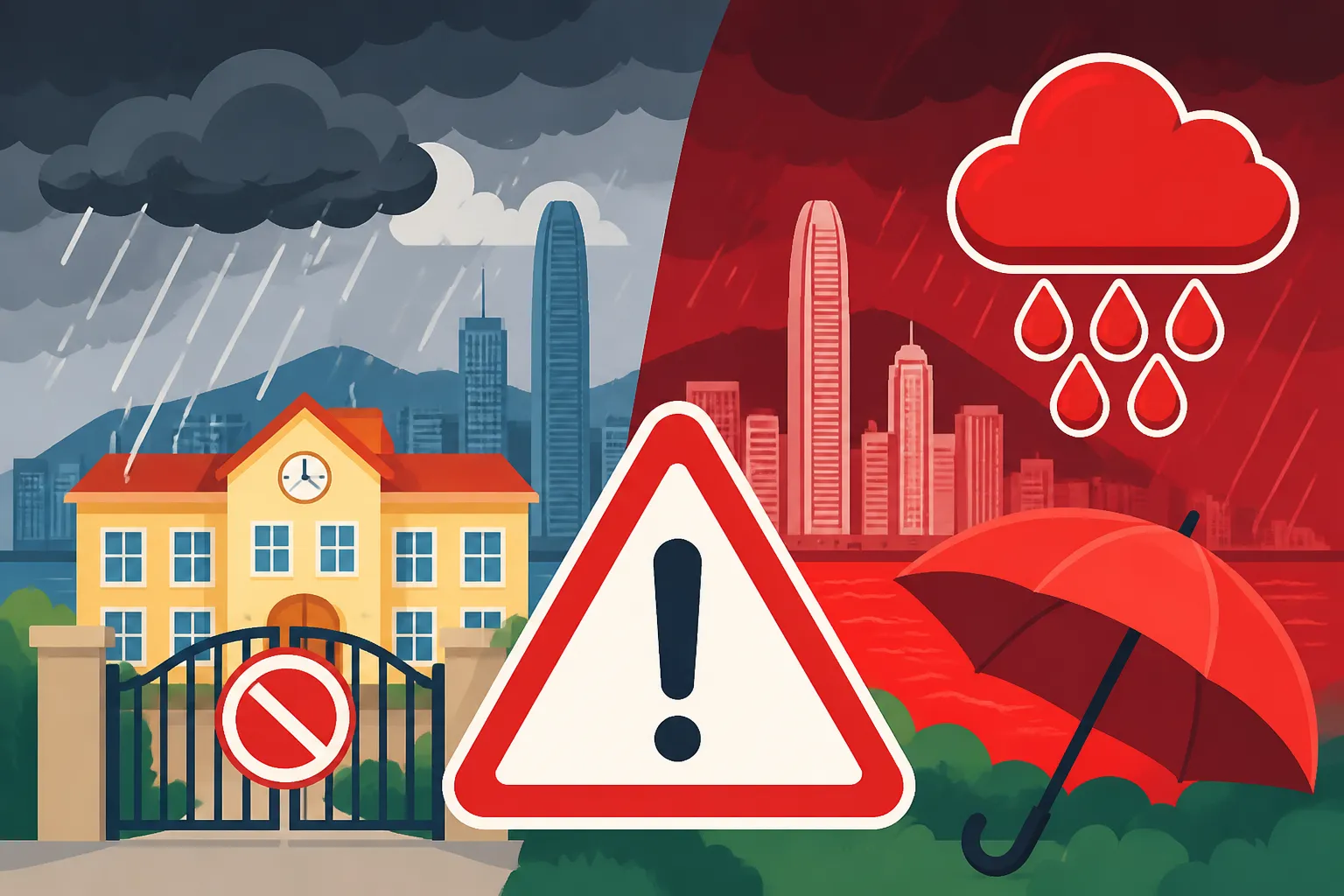
An Amber warning means heavy rain is falling (30mm/h) and may continue. Schools remain open, and work continues. However, a Red Rainstorm Warning (50mm/h) is a major trigger for school closures. If the Red warning is issued before students leave for school, classes are suspended. If it is issued while they are already at school, the school must keep them in a safe place until the end of the day. For parents, this is often the most stressful scenario, as it requires balancing work expectations while your children are suddenly sent home—or stuck at school.
The Black Rainstorm Lockdown
The Black Rainstorm Warning (70mm/h) is the highest level. At this point, the city effectively locks down. It is considered dangerous to travel because of potential landslides and severe flooding. If you are at work when the Black warning is issued, the standard advice is to stay where you are unless it is unsafe. I have spent many evenings stuck in a Wan Chai office building waiting for a Black rain signal to drop, and believe me, it is better than trying to navigate a flooded street.
| Signal Level | School Status | Office/Work Status | Public Transport |
|---|---|---|---|
| T1 | Open | Open | Normal |
| T3 | Kindergartens Closed | Open | Normal |
| T8 | All Schools Closed | Generally Closed/WFH | Limited/MTR Only |
| T9 / T10 | All Schools Closed | Closed | Suspended/Limited |
| Amber Rain | Open | Open | Normal |
| Red Rain | Generally Closed | Open | Normal/Delays |
| Black Rain | All Schools Closed | Stop Work/Stay Put | Severely Limited |
School Closure Protocols for Expat Parents
Navigating school closures is one of the biggest hurdles for families Living in Mid-Levels and Central: Pros, Cons, and Commutes or other residential hubs. The Education Bureau (EDB) usually makes announcements based on the signals, but private and international schools sometimes have their own specific variations.
Timing is Everything for School Announcements
The EDB typically issues announcements between 5:30 AM and 6:15 AM. If a T8 or Red/Black rain signal is in force by this time, you can assume all ESF Primary and Secondary Schools: Catchment Areas and Zones will be closed for the morning session. If the signal is lowered by mid-morning, some schools might open for the afternoon session, but this varies. Always check your school’s dedicated app or portal.
The Dilemma of the Mid-Day Signal Change
One of the most confusing situations is when a signal is raised while children are already at school. For a T3, kindergartens might ask parents to pick up their children early. For a T8 or Red Rain, schools are mandated to remain open and provide a safe environment until it is safe for students to return home. This often means your child will stay at school past the usual 3:00 PM bell. During these forced indoor days, many parents use online platforms like iTalki to keep their kids engaged with language tutors from the safety of their living room.
Workplace Expectations and Employee Rights
The transition to a T8 signal creates a unique legal and cultural situation in Hong Kong. While there is no specific law that says you must have the day off, the Labour Department’s Code of Practice is followed by almost all reputable employers. Understanding your Employment Rights in HK: Contracts, MPF, and Statutory Leave is crucial before typhoon season hits.
The Shift to Work From Home
Before 2020, a T8 meant a genuine "typhoon holiday" for most office workers. However, the rise of remote work has changed the landscape. Many companies now expect staff to continue working from home if a T8 is raised. You should clarify this with your HR department early on. If your role requires you to be physically present—such as in healthcare or essential services—your contract should specify "inclement weather" allowances or transport arrangements.
Returning to Work After the Signal is Lowered
A common point of frustration is the "2-hour rule." If a T8 or Black Rain signal is lowered at or before 2:00 PM, most employees are expected to return to the office within two hours, provided the conditions are safe. If the signal is lowered after 2:00 PM, most offices allow staff to stay home for the remainder of the day. If you are still navigating the Working in Hong Kong: Visas, Job Market, and Hiring Culture (2027), be sure to ask about these specific policies during your onboarding. If you find yourself with a sudden morning off, it is a perfect time to jump on Preply and practice your business Cantonese with a tutor to get ahead in the local market.
Transportation and Daily Life During Warnings
Public transport is the lifeblood of the city, but it scales back significantly during severe weather. If you are used to the efficiency of the Public Transport in HK: MTR, Trams, Buses, and Ferries, the sudden stop can be a shock.
MTR and Bus Reductions
During a T8, the MTR usually continues to run but at reduced frequencies, typically every 10 to 20 minutes. However, buses and trams generally stop running entirely once the T8 is in full effect. The Star Ferry also ceases operations, which can be a problem if you live on an island like Lantau or in Discovery Bay.
The Reality of Taxis and Surcharges
When the buses stop, taxis become the only way to move if you aren't near an MTR station. However, be warned that Catching a Taxi During a Typhoon Shift: Surcharges and Rules can be a nightmare. Many taxi drivers will demand a flat fee of HKD 200-500 extra to take you across town during a T8, as their insurance is often technically void during high signals. While this is technically illegal, in a torrential downpour, many people find themselves paying it just to get home.
Essential Preparation and Safety Measures
Veteran expats have a "typhoon kit" ready by May every year. This is not just about food; it is about protecting your home from the unique challenges of Hong Kong's high-rise living.
Protecting Your Apartment
The most common issue in modern flats is water seepage through window frames during the horizontal rain of a T8. Keeping a stack of old towels near your windows is a must. You will also see many locals putting masking tape in an "X" shape on their windows. While modern safety glass doesn't strictly require this for strength, it can prevent large shards from flying if a window were to break. If you are unsure about your building's safety, it's worth checking with your management office.
Staying Informed with the Right Tools
The most important tool you have is the Hong Kong Observatory app. It provides real-time tracking of storms and push notifications for signal changes. You should also regularly check the Using the HK Observatory App for Accurate Weather Warnings guide to understand the radar maps. Beyond the weather, if you are an expat parent looking at International Schools in HK: Curriculums, Debentures, and Applications, ensure you are on their emergency SMS list.
Navigating the Emotional Toll of Storm Season
For those coming from calmer climates, the intensity of a Hong Kong storm can be unnerving. The howling wind between skyscrapers and the sheer volume of water during a Black Rainstorm are things you have to experience to truly understand.
The Social Side of Typhoons
Interestingly, T8 days often become social events. "Typhoon parties" in residential complexes are common, where neighbors gather for hotpot or drinks because no one can leave the building. It is a strange but effective way to bond with your community. If you are stuck inside alone, platforms like Preply offer a way to connect with others and stay productive, making the "locked-in" feeling much more manageable.
Long-Term Planning for Weather Disruptions
If your job allows for flexibility, it is wise to plan your heavy commute days away from the peak typhoon months of August and September. If you are a freelancer or business owner, you should have a clear policy for your own staff regarding Typhoons and Black Rainstorms: Are You Legally Required to Work? to avoid any confusion or safety risks. Ultimately, the city is built to handle these events, and as long as you follow the rules and stay indoors, you will find that the "storm day" becomes just another part of the Hong Kong experience.
Disclaimer
The information provided in this guide is for general informational purposes only and does into constitute legal or professional advice. Weather patterns and government policies can change rapidly. Always refer to the official announcements from the Hong Kong Observatory and the Education Bureau for the most up-to-date information during a weather emergency. Individual company policies regarding work-from-home and school-specific rules may vary.