Catching a Taxi During a Typhoon Shift: Surcharges and Rules
Standing on a wind-whipped street corner in Wan Chai while the sky turns an ominous shade of charcoal is a rite of passage for every Hong Kong expat. When the Hong Kong Observatory issues a pre-arrival warning for a Signal No. 8, the city transforms from a hyper-efficient metropolis into a scene of controlled chaos. This guide solves the mystery of the "typhoon surcharge," explains the unwritten rules of the taxi shift, and helps you navigate the high-stakes world of emergency transport when the city shuts down.
Understanding the Typhoon Signal System and Transport Impact
The first thing you learn as an expat is that the Hong Kong Observatory is the most important app on your phone. The system isn't just a weather report; it is a legal and operational trigger for the entire territory. When a Signal No. 1 or No. 3 is hoisted, life largely continues as usual, though the wind starts to rattle the windows of high-rise apartments. However, once the "Pre-No. 8 Special Announcement" is made, the countdown begins. Usually, the government gives the public a two-hour window to get home before the T8 signal is officially hoisted.
During this two-hour window, the pressure on the transport network is immense. Millions of workers are released from their offices simultaneously. The MTR increases frequency to its absolute maximum, but even then, platforms become dangerously crowded. For those who live in areas less served by the rail network, such as parts of the New Territories or the Southside, the situation becomes even more dire. Buses and ferries begin to wind down their services. Ferries, in particular, are the first to stop because of sea conditions, often ceasing operations well before the T8 is officially in place.
By the time the T8 is active, the Public Transport in HK: MTR, Trams, Buses, and Ferries system undergoes a massive shift. The MTR typically continues to run on limited underground sections but stops all overground services (like the Airport Express or the Disneyland line) to prevent derailment from flying debris. This is when the humble red taxi becomes the only lifeline for those still stranded, leading to the phenomenon of the "typhoon shift" where the standard rules of engagement on the road simply evaporate.
The Mechanics of the Pre-No. 8 Mad Dash
The "Pre-No. 8" period is a frantic scramble. If you are new to the city, you might think you have plenty of time. You don't. The moment the announcement is made, queues for taxis at major hubs like IFC or Pacific Place can stretch for hundreds of meters. I’ve spent many afternoons watching the panic set in as the wind picks up and the realization dawns that the last ferry to Discovery Bay has already departed. This is a critical time to check Weather Warnings and School Closures: T8 and Red Rainstorm Rules to understand exactly when your children’s school or your workplace is legally required to let you go.
The "shift" also refers to the literal changeover of taxi drivers, which usually happens around 4:00 PM. If a typhoon warning coincides with this time, the difficulty of finding a ride triples. Drivers are trying to return their cars to the garage and get home to their own families before the storm peaks. During this time, you will see taxis with their "Out of Service" signs up, or drivers pointing aggressively at their watches as they zoom past desperate commuters. It feels personal, but it is purely logistical.
Why Surface Transport Becomes a Risk
It isn't just about the wind speed; it's about the debris. Hong Kong is a vertical forest of scaffolding, signs, and loose roof tiles. During a T8 or T9, these objects become lethal projectiles. This is why bus companies like KMB and Citybus pull their fleets off the road. Large double-decker buses are prone to tipping in high gusts, especially on exposed bridges like the Tsing Ma.
When buses stop, the demand for taxis skyrockets. However, many taxi drivers also choose to go home. The ones who remain on the road are taking a significant physical and financial risk. This leads us to the most controversial aspect of Hong Kong life: the typhoon surcharge. Understanding the risks involved helps you prepare for the reality of Natural Disasters in HK: Typhoon and Black Rainstorm Preparedness and why the city essentially goes into a defensive crouch.
The Legality and Reality of Taxi Surcharges during T8+
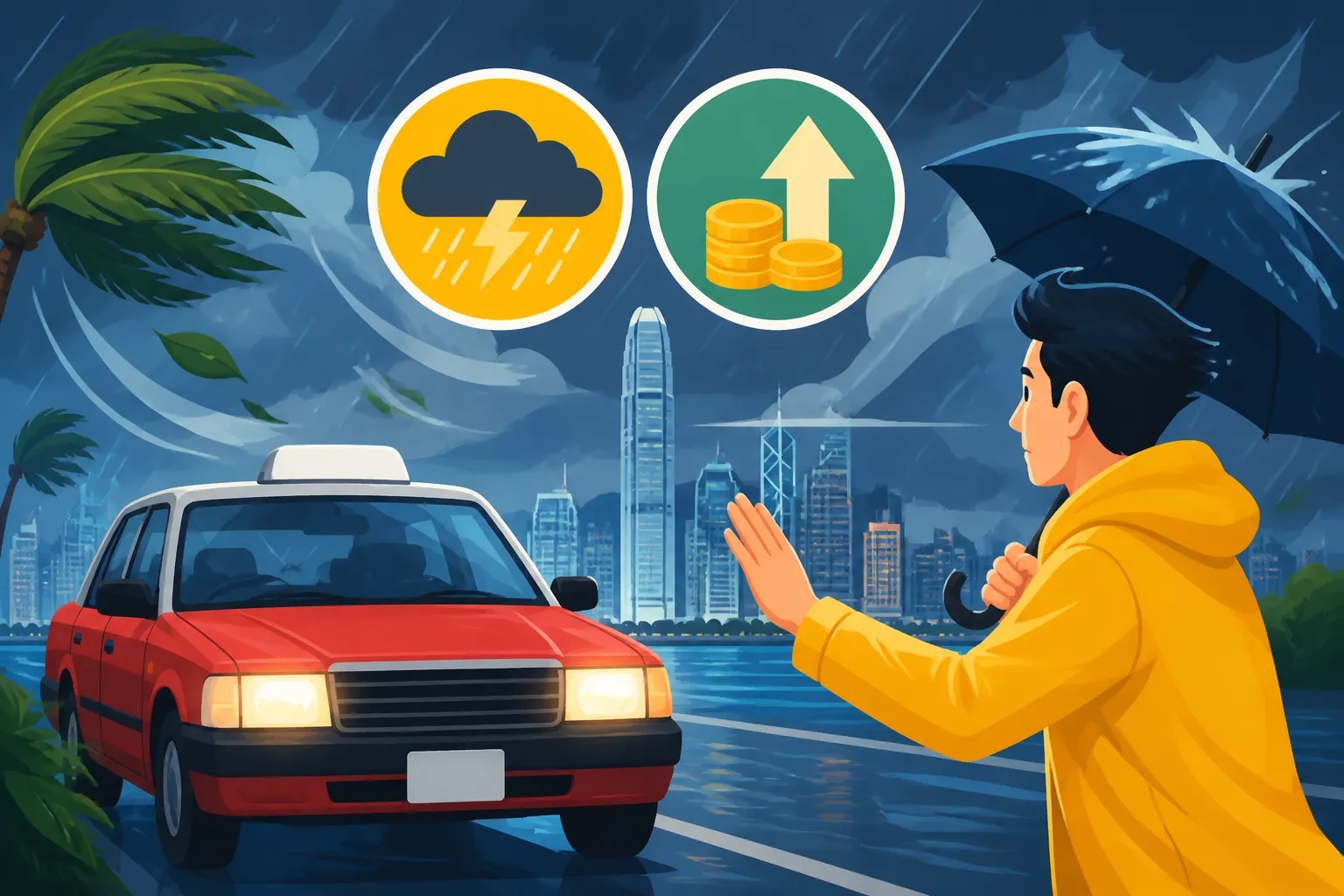
If you consult a government manual, you will be told that it is illegal for a taxi driver to charge anything other than the fare shown on the meter. In a perfect world, that would be the end of the story. But on a rain-slicked street in Tsim Sha Tsui during a T8, the "meter price" is often a fantasy. Drivers will pull up, roll down their windows just a crack, and shout a number. This is the "surcharge," and it can range from an extra HK$50 to several hundred dollars over the metered fare.
Why does this happen? The primary reason is insurance. Almost all commercial vehicle insurance policies in Hong Kong contain a "Typhoon Clause" that voids coverage once the T8 signal is hoisted. This means if a tree falls on the taxi or a gust of wind causes a collision, the driver is personally liable for every cent of the damage. They are also risking their lives in conditions where the government has advised everyone to stay indoors. From the driver’s perspective, the surcharge is a "hazard pay" premium to cover the risk of losing their livelihood.
How to Negotiate (or Accept) the Surcharge
When you encounter this, you have two choices: wait indefinitely for a driver who will go by the meter (a rare find during a storm) or negotiate. The standard "customary" surcharge usually starts at HK$100. If you are traveling from Central to the New Territories during a T9, don't be surprised if the driver asks for HK$300 or HK$500 on top of the fare. It is a brutal example of supply and demand.
While it is technically illegal, the police rarely intervene during a typhoon unless the price gouging is truly egregious. The unspoken rule is that if you agree to the price and the driver gets you home safely, the transaction is closed. If you are uncomfortable with this, your best bet is to use the Using the HK Observatory App for Accurate Weather Warnings to ensure you are never in a position where you need a taxi after the signals have gone up.
Insurance and Your Own Safety
Beyond the driver's insurance, you should consider your own. Most travel and accident insurance policies also have caveats regarding "disregarding government warnings." If you are out in a T8 for non-essential reasons and get injured, your claim could be contested. This is why many expats living in managed apartments provided by companies like Blueground or Habyt choose to simply stay put. These modern living solutions often have robust building management that keeps residents informed and safe, reducing the need to travel during the "typhoon shift."
If you are in the middle of a move, perhaps coordinated by a firm like Sirelo, and a typhoon hits, everything will stop. Professionals in the city are well-versed in these delays. No one will expect you to risk your life to move a sofa. In fact, most reputable services will have clauses in their contracts specifically addressing T8 signals and the resulting work stoppages.
| Transport Mode | T1 / T3 Status | T8 Status | T9 / T10 Status |
|---|---|---|---|
| MTR (Underground) | Normal | Limited Service | Very Limited / Special |
| MTR (Overground) | Normal | Suspended | Suspended |
| Buses | Normal | Gradually Suspended | Suspended |
| Ferries | Normal / Caution | Suspended | Suspended |
| Taxis | Normal | Limited (Surcharges Likely) | Rare (High Surcharges) |
| Trams | Normal | Suspended | Suspended |
Strategies for Getting a Taxi during a Typhoon Shift
If you find yourself stuck and the MTR is not an option, you need a strategy. Hailing a cab on the street is the most difficult method because you are competing with every other person in sight. Drivers will often keep their doors locked and only open the window to hear your destination. If it’s "out of their way" or doesn't offer a high enough tip, they will simply drive off. This can be incredibly frustrating and feels like a violation of Everyday Etiquette and Safety in Hong Kong: A Survival Guide, but it is the reality of the storm.
A better approach is using taxi-hailing apps like HK Taxi or Uber. During a typhoon, the HK Taxi app usually includes an option to add a "tip" or "surcharge" upfront. By offering an extra HK$100 or HK$200 through the app, you are much more likely to get a driver to accept your booking. It creates a digital record of the agreement and saves you from standing in the rain trying to shout through a car window.
The Rise of E-hailing during Storms
Uber operates in a legal gray area in Hong Kong, but during typhoons, it becomes a major player. Uber's dynamic pricing (surge pricing) automatically kicks in when demand is high. While this can result in eye-watering fares, it provides a level of certainty that street-hailing lacks. You know the price before you get in, and the driver is tracked via GPS. However, be aware that even Uber drivers may cancel if the wind becomes too dangerous.
For those who have just arrived and are following an Essential Health Checklist for Your First 30 Days in Hong Kong, you might not have all the apps set up yet. I highly recommend downloading HK Taxi and linking it to your credit card or Octopus card early on. When the "typhoon shift" happens, you don't want to be fumbling with app registrations while the wind is howling.
Safety Tips: When to Give Up and Stay Put
There comes a point in every T8 or T9 storm where the safest option is simply not to move. If you are in a safe building—whether it's your office, a mall, or a friend's place—stay there. Hong Kong’s infrastructure is designed to be a "shelter in place" system. Most major office buildings have emergency supplies, and many malls stay open (though shops close) to provide a safe haven for those who can't get home.
If you are a tourist or a new expat staying in a hotel or a serviced apartment from a provider like Habyt, you are in luck. These facilities are built to withstand the highest signals. If you are stuck at the airport, do not try to take a taxi to the city during a T9 or T10. The roads are often blocked by fallen trees, and the risk of an accident is high. In these cases, checking Is the Ambulance Free in Hong Kong for Tourists and Expats? is a grim but necessary bit of research, as emergency services are also stretched thin during these times.
Alternatives and Practical Living Tips for Typhoon Season
The best way to handle a typhoon shift is to avoid it entirely. This requires a bit of local "typhoon prep" that you’ll see every local family doing. When the T3 is hoisted, people head to the supermarket. You’ll see the shelves of Wellcome and ParknShop emptied of bread, milk, and instant noodles. It’s a collective cultural response to the impending shutdown.
If you are living in a long-term rental or a co-living space managed by Blueground, you should ensure your balcony is clear of furniture and your windows are properly latched. Many locals use masking tape in an "X" shape across their windows; while its effectiveness is debated, the goal is to prevent the glass from shattering inward if hit by debris. It is also the time to ensure your electronics are charged and you have a backup power bank, as power flickers are common in more rural areas like Sai Kung or Lantau.
Preparing for the "Post-Typhoon" Scramble
The "typhoon shift" doesn't end when the signal is lowered. When the T8 is lowered to a T3, there is a legal requirement for most employees to return to work within two hours if the signal is lowered during business hours. This creates a second "mad dash" as everyone tries to get back to the office at once. This is covered extensively in Typhoons and Black Rainstorms: Are You Legally Required to Work?, and understanding these employment laws is vital to ensure you aren't penalized for a slow commute.
The taxi demand during this "re-opening" phase is just as high as during the shutdown. The surcharges usually vanish the moment the T3 is hoisted, as insurance coverage resumes. However, the queues for the MTR and buses will be legendary. My advice? If you can work from home for the remainder of the day, do it. The stress of the post-storm commute is rarely worth the few hours of productivity you’ll manage at the office.
Using Serviced Apartments as a Strategic Base
For newcomers still looking for permanent housing with companies like Sirelo, a common option is staying in a centrally located serviced apartment during the summer months (June to September). Locations in Sheung Wan or Wan Chai are ideal because they are connected by the covered walkway system. This allows you to move between your apartment, the grocery store, and the MTR without ever stepping into the rain.
Providers like Habyt and Blueground offer apartments in these high-connectivity zones. This "bridge living" effectively bypasses the need for taxis during a typhoon shift altogether. You can watch the storm from your window, knowing you have everything you need within a five-minute walk through a protected corridor. It is the ultimate Hong Kong power move during typhoon season.
If you find yourself in a medical situation during the storm, do not rely on taxis. Call 999 immediately. The Hong Kong Fire Services Department operates specialized ambulances that can handle extreme weather. For more details on this, see Navigating Medical Emergencies During T8 Typhoons or Black Rainstorms to understand how triage works when the city is under siege.
Short-Term Serviced Apartments for Your First Month in HK
Choosing where to stay during your first few months can dictate how you experience your first typhoon season. While a village house in Sai Kung offers peace and space, it also makes you entirely dependent on taxis and minibuses—a nightmare during a T8. For your initial landing, consider a Short-Term Serviced Apartments for Your First Month in HK that offers "podium living." This means the apartment building is built directly on top of a shopping mall and an MTR station.
This setup is the gold standard for typhoon safety. You can get groceries, visit the pharmacy, and even go to the cinema without ever being exposed to the gale-force winds outside. It eliminates the "typhoon shift" drama from your life entirely. Once you’ve lived through a few storms and understand the rhythm of the city, you can then look for that dream house on the coast, perhaps using the professional relocation services of Sirelo to move your belongings once the weather stabilizes.
Disclaimer
This guide is for informational purposes only and reflects the personal experiences of the author. Transport regulations and insurance policies in Hong Kong can change. Always prioritize official instructions from the Hong Kong Observatory and local authorities during extreme weather events. Do not attempt to travel during Signal No. 9 or No. 10 unless it is a life-threatening emergency.