Expat Guide to Tipping Etiquette in Hong Kong Restaurants
One of the most common head-scratchers for expats new to Hong Kong, or even those who've been here a while but haven't quite cracked the code, is the baffling question of tipping. Coming from cultures where a 15-20% tip is standard, the lack of clear guidance here can leave you feeling awkward, unsure if you're insulting someone by not tipping, or overpaying by doing it. This guide is here to clear up the confusion, helping you navigate the unique tipping landscape in Hong Kong restaurants and beyond with confidence.
The Cultural Context of Tipping in Hong Kong: It's Not What You Think
Let's get this straight right off the bat: Hong Kong is generally not a tipping culture, at least not in the Western sense. If you're coming from North America, Europe, or other places where gratuities form a significant part of service workers' income, you need to recalibrate your expectations entirely. This isn't because Hong Kongers are stingy, but rather due to deeply ingrained cultural and economic factors that underpin the service industry here. The concept of "service charge" is often already built into the system, directly impacting how workers are compensated and how the customer perceives the value of the service.
Service Charges vs. Tips
The most important thing to understand about dining out in Hong Kong, especially in mid-range to high-end restaurants, is the ubiquitous "service charge." Typically, this is a 10% charge automatically added to your bill, and it’s clearly stated. Unlike many Western countries where a "service charge" might still be seen as an arbitrary fee or a suggestion, in Hong Kong, this 10% is considered part of the staff's remuneration and is almost always shared among them. It's essentially an institutionalized tip.
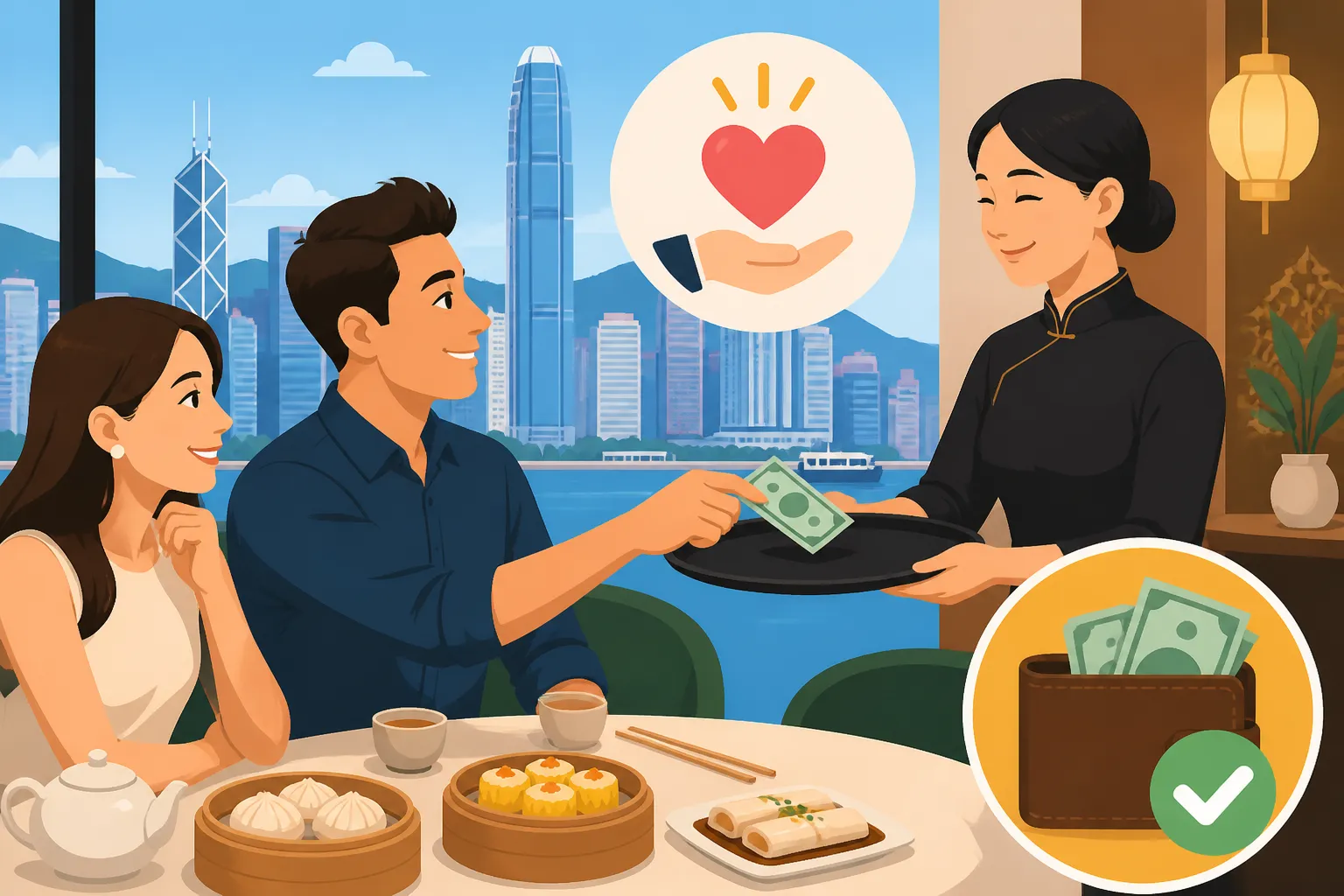
What this means for you, the diner, is that there’s no expectation for an additional tip on top of this 10%. In fact, trying to leave extra cash might even cause confusion. The staff might genuinely think you've forgotten your change, or they might feel a little awkward, unsure of how to handle it. I remember once, early in my Hong Kong journey, I left a 15% tip on top of the 10% service charge at a lovely restaurant in Central. The waiter chased me down the street to give me back what he thought was my "forgotten" money. It was mortifying, but also a crystal-clear lesson in Hong Kong's tipping norms! This is a stark difference to many countries, and a key point in understanding your Everyday Etiquette and Safety in Hong Kong: A Survival Guide.
Implicit Expectations: What's Already Included
The wages for service staff in Hong Kong are generally structured to account for the work, and the 10% service charge is a significant component of that. Therefore, unlike in countries where servers might earn a sub-minimum wage with the expectation that tips will make up the difference, Hong Kong’s system aims to provide a more stable income through salaries and service charges.
This also means that good service is just… expected. It’s part of the standard package, not something you "reward" with an extra handout. Of course, you’ll encounter varying levels of service, just like anywhere in the world. But the cultural norm is that you pay for the food and the service as a bundled package, with the 10% explicitly covering the latter. This also explains why staff might not be as effusive or overtly friendly as you might experience in a heavily tip-dependent culture; their compensation model doesn't rely on it. This integrated approach can certainly affect your overall Everyday Budgeting in HK: Cost of Living Benchmarks (2026) when considering dining out.
When Tipping Might Be Expected or Appreciated (Rare Cases)
While the general rule is "no extra tip," there are a few nuanced situations where a small gesture might be appropriate, or at least understood, particularly in certain types of establishments. However, even in these cases, it's never truly expected in the way it is elsewhere.
High-End Dining and International Hotels
In some very high-end, fine-dining restaurants, especially those located within luxury international hotels or establishments catering heavily to an international clientele, you might encounter a slightly different dynamic. These places often aim to provide a global standard of service, which sometimes includes subtly accommodating Western tipping habits.
If you've received truly exceptional, beyond-the-call-of-duty service in such an establishment—think a sommelier going above and beyond, or a waiter meticulously catering to specific dietary needs with genuine grace—leaving a small additional tip (perhaps rounding up or adding 5%) might be accepted. However, this is still often a discreet affair, perhaps by simply leaving a few extra hundred-dollar notes on the table as you depart, rather than explicitly handing it to a server. Even then, it’s not required, and many staff would still consider the 10% service charge sufficient. Your decision here is less about obligation and more about a personal desire to acknowledge extraordinary effort.
Exceptional Service in Casual Settings
What about those little local eateries, the cha chaan tengs, or the noodle shops where there's no service charge? This is where it gets even trickier, because the expectation of a tip here is virtually non-existent. Staff in these places are paid their wages, and the business model doesn't typically factor in gratuities.
If you try to leave a tip in these places, it’s almost guaranteed that the staff will try to return it to you. They often see it as you forgetting your change, and it would be considered poor form on their part not to correct it. It’s not uncommon to have a server run after you down the street because you left a HKD 20 bill behind. This isn't just a hypothetical; it happens all the time! Trying to insist can feel awkward for everyone involved. So, for the vast majority of casual dining experiences, including those amazing dim sum spots or local noodle houses, just pay your bill as presented. Your appreciation is best shown by returning for another meal. When splitting the bill with friends, you'll also find that the Split Bills and "AA" Culture in Hong Kong Dinners culture means everyone just pays their exact share, with no room for adding tips.
Specific Scenarios
- Bar Staff: In more upscale cocktail bars or hotel lounges, if a bartender crafts you an amazing bespoke drink or provides really engaging service, rounding up your bill by a small amount (say, HKD 20-50 for a substantial tab) might be quietly accepted. Again, it’s not obligatory. In local pubs or casual bars, it's not expected.
- Delivery Drivers: For food delivery services, tipping is also not customary. The fees are already set, and drivers are compensated through the platform. Some platforms allow for an optional digital tip, but it's not a common practice here.
- Takeaway: When you pick up takeaway, there is absolutely no expectation to tip. You're simply paying for the food.
Practical Guidelines for Expats: What to Do (and Not Do)
Navigating Hong Kong's tipping scene really boils down to observation and understanding local customs. Here are some actionable tips.
Reading the Bill: How to Spot Service Charges
Always, always check your bill thoroughly. Look for a line item that says "Service Charge" (服務費), usually 10%. If it's there, you're good. Pay the total, and don't add anything extra. Most mid-range to high-end restaurants will have this.
If you're at a very casual local spot, like a dai pai dong, a tiny noodle shop, or a fast-food joint, you almost certainly won't see a service charge. In these cases, just pay the exact amount. The total on the bill is all they expect. This applies whether you're paying with cash, Octopus card, or using one of the popular Digital Payments in HK: Octopus, AlipayHK, PayMe, and WeChat Pay options.
Rounding Up and Small Gestures
Sometimes, people might feel compelled to leave something. If you absolutely must, and you're at a place with no service charge where the bill comes to, say, HKD 98, you could leave HKD 100 and indicate that the change is for them. However, be prepared for them to still try and give you the HKD 2 back. It's truly not a common practice.
A more widely accepted, albeit still rare, gesture for excellent service, especially if paying cash, is simply telling them to "keep the change" if it's a very small amount (e.g., a few dollars). But honestly, most Hong Kong service staff would prefer you didn't, as it just creates a slightly awkward moment. Your best bet is to just be polite, say "thank you" (多謝, doh jeh in Cantonese), and pay the bill.
Avoiding Over-Tipping and Awkward Situations
The biggest mistake an expat can make is to apply Western tipping norms here. It can lead to confusion, discomfort, and might even be perceived as showing off or misunderstanding the local culture. Hong Kong is a place where directness is often valued, and paying what is stated on the bill is the respectful, correct approach.
Imagine if someone kept trying to give you money you hadn't earned; it's a bit like that. Over-tipping can set a false expectation for other customers, and it simply isn't how things work here. Embrace the local custom, save your money, and put it towards enjoying more of Hong Kong's incredible food scene. After all, figuring out if Is Dining Out Cheaper Than Cooking at Home in HK? is often a question of economics, not gratuities.
Beyond Restaurants: Other Tipping Scenarios
While the focus is on restaurants, it's worth briefly touching on other service industries where tipping might cross your mind. The general rule of "no tip expected" largely holds true, but with a few minor variations.
Taxis and Private Drivers
For regular taxis, tipping is not expected. Most people simply round up to the nearest dollar or five dollars, or pay the exact fare. For example, if your fare is HKD 47, you might give HKD 50 and tell the driver "no change" (唔駛找, mh sai jaau), but even this is a courtesy, not an expectation. If the driver handles a lot of heavy luggage, a small token of HKD 10-20 might be appreciated, but don't feel obligated. For more on this, you might be interested in whether Do Taxis in Hong Kong Accept Credit Cards or Only Cash? and how that impacts payment. The landscape is a little different when you consider Uber vs HK Taxis: Legal Gray Areas and Convenience, where app-based services may have built-in tipping options, though again, it's not a strong local custom to use them.
Hairdressers and Salons
Similar to restaurants, many mid-to-high-end hair salons will include a service charge, or the pricing will simply reflect the cost of the service and the stylists' pay. If you frequent a specific local salon and have a long-standing relationship with your stylist who consistently delivers exceptional results, a small gift around festive seasons (like Chinese New Year) or rounding up a small amount might be a subtle way to show appreciation. But again, it's not a regular practice. For general visits, just pay the bill.
Hotel Staff
In hotels, especially international ones, there might be a slightly higher tolerance for small tips, again primarily from international guests.
- Porters: A small tip of HKD 10-20 per bag for a porter who helps with luggage to your room is generally accepted, especially in luxury hotels.
- Housekeeping: Leaving a small amount (e.g., HKD 20-50) on your pillow for housekeeping is not a common local practice but would likely be appreciated by staff who are used to international visitors. However, it's certainly not mandatory.
- Concierge: If a concierge goes above and beyond, securing impossible reservations or providing extensive assistance, a small thank you of HKD 50-100 might be appropriate, or a small gift. This is more in line with global luxury hospitality norms than a specific Hong Kong expectation.
Spas and Massage Therapists
At many spas and massage parlours, you’ll often find a discrete tip box near the reception, or the therapist might indicate a preference. If the service was good, a tip of 5-10% or rounding up your bill by HKD 50-100 is generally common and appreciated, especially at more local establishments. This is one of the few areas where a direct tip is somewhat more common than in dining.
Key Tipping Norms in Hong Kong
To make things easier, here's a quick reference table for common scenarios:
| Service Category | Tipping Expectation in HK | Typical Action for Expats |
|---|---|---|
| Restaurants (with 10% S.C.) | No additional tip expected | Pay the bill exactly as presented. |
| Restaurants (no S.C.) | No tip expected; staff may return "forgotten" change | Pay the bill exactly as presented. Don't leave extra cash. |
| Casual Eateries / Fast Food | No tip expected | Pay the bill exactly as presented. |
| Bars (Upscale) | Small rounding up (HKD 20-50) for exceptional service | Discretely leave a small amount or round up if service was truly outstanding. |
| Bars (Local/Casual Pubs) | No tip expected | Pay the bill. |
| Taxis | Not expected; slight rounding up (HKD 1-5) is common | Round up to the nearest convenient note, or pay exact fare. |
| Private Hire Cars (Apps) | Not expected; optional digital tip on app | Use the app's payment system. Optional small digital tip if allowed. |
| Hotel Porters | Small tip (HKD 10-20 per bag) accepted in luxury hotels | Offer HKD 10-20 per bag. |
| Hotel Housekeeping | Not customary; small token (HKD 20-50) might be accepted | Optional: leave HKD 20-50 on pillow if you wish, but not expected. |
| Spas/Massage | Often expected/appreciated (5-10% or HKD 50-100) | Look for a tip box, or offer discreetly to the therapist or at reception. |
| Hairdressers/Salons | Not expected; occasionally a festive gift for regular clients | Pay the bill. Festive gifts for regular, long-term stylists are a cultural alternative. |
| Food Delivery Drivers | Not customary | Pay the billed amount via app/cash. |
At the end of the day, Hong Kong's service culture is about efficiency and direct pricing. The best way to show appreciation is often through loyalty, positive reviews, and simply being a pleasant customer. Don't stress about carrying extra cash for tips, especially with the prevalence of Digital Payments in HK: Octopus, AlipayHK, PayMe, and WeChat Pay. Just enjoy the fantastic service and delicious food that Hong Kong has to offer!
Disclaimer
The information provided in this guide is for general informational purposes only and does not constitute professional advice. Tipping customs can be fluid and may vary slightly over time or by specific establishment. Always observe local practices and exercise your best judgment.