Uber vs HK Taxis: Legal Gray Areas and Convenience
You are standing on a street corner in Central, the humidity is hitting 90%, and a sudden downpour has just turned the pavement into a slip-and-slide. You see a red taxi, but the "Out of Service" sign is lit. You open your phone to check Uber, only to see a massive surge price. This guide explores the complex, often frustrating choice between traditional taxis and Uber in Hong Kong, solving the dilemma of which service actually serves you best when you are trying to navigate the city's unique legal and cultural landscape.
The Reality of the Red Taxi: Charm, Frustration, and Cash
The iconic red Toyota Crown Comfort taxis are as much a part of the Hong Kong skyline as the skyscrapers themselves. For a new arrival, they represent the most immediate form of point-to-point transit. However, as any veteran expat will tell you, the relationship between a passenger and a taxi driver in this city is one governed by unwritten rules and a very specific set of frustrations. Understanding Public Transport in HK: MTR, Trams, Buses, and Ferries is essential, but the taxi remains the fallback for many.
One of the first things you will encounter is the "shift change." Around 3:30 PM to 4:00 PM every single day, the city’s taxi fleet seemingly disappears or becomes remarkably picky about their destination. This is because drivers are heading to specific depots to hand over the car to the night-shift driver. If you aren't going in their direction, they simply won't pick you up. It is a legendary pain point that often leaves expats stranded just as the evening rush begins. During these times, knowing Everyday Etiquette and Safety in Hong Kong: A Survival Guide can help you manage the rejection without losing your cool.
Another hurdle is the payment system. While the rest of the city has embraced digital payments, a significant portion of the taxi fleet remains stubbornly cash-only. If you don't have a few crisp HK$20 or HK$100 notes, you might find yourself in an awkward standoff. Some drivers have started using The Octopus Card: Hong Kong's Essential Transport & Payment Tool, but it is never a guarantee. You should always check the window for stickers indicating accepted payments before you hop in, or better yet, read our deep dive on Do Taxis in Hong Kong Accept Credit Cards or Only Cash? to avoid being caught short.
The Flag-Down Culture and Hidden Etiquette
Flagging a taxi in Hong Kong is an art form. You don't just wave; you use a specific downward patting motion with your hand. Furthermore, you must be aware of "no stopping" zones indicated by yellow lines on the curb. A driver will not risk a heavy fine to pick you up in a restricted zone, no matter how hard it’s raining. If you are living in a managed property like those offered by Blueground, the concierge can often assist, but on the street, you are on your own.
There is also the matter of the "Cross-Harbour" signal. If you are on Hong Kong Island and want to go to Kowloon, or vice versa, you should make a wave-like motion with your hand to signify crossing the water. This alerts the driver that you are a "long haul" fare, which some prefer if they are near the end of their shift and need to head back across the tunnel anyway. If you fail to do this, you might sit in the back only to be told to get out because the driver "doesn't do the tunnel."
The "No Change" Trap and Tipping
Legally, taxi drivers are required to carry change for HK$100, but anything larger—like a HK$500 or HK$1,000 note—is technically at the driver's discretion. Many will claim they have no change to force a larger tip or simply because they genuinely haven't had enough fares yet. It is common practice to "round up" the fare. If the meter says HK$27.50, giving HK$30 and saying "keep the change" is the standard expat move. It keeps the wheels of the city turning and avoids the disgruntled grunt that often follows a precise payment.
Uber in Hong Kong: The Convenience vs. Legal Uncertainty
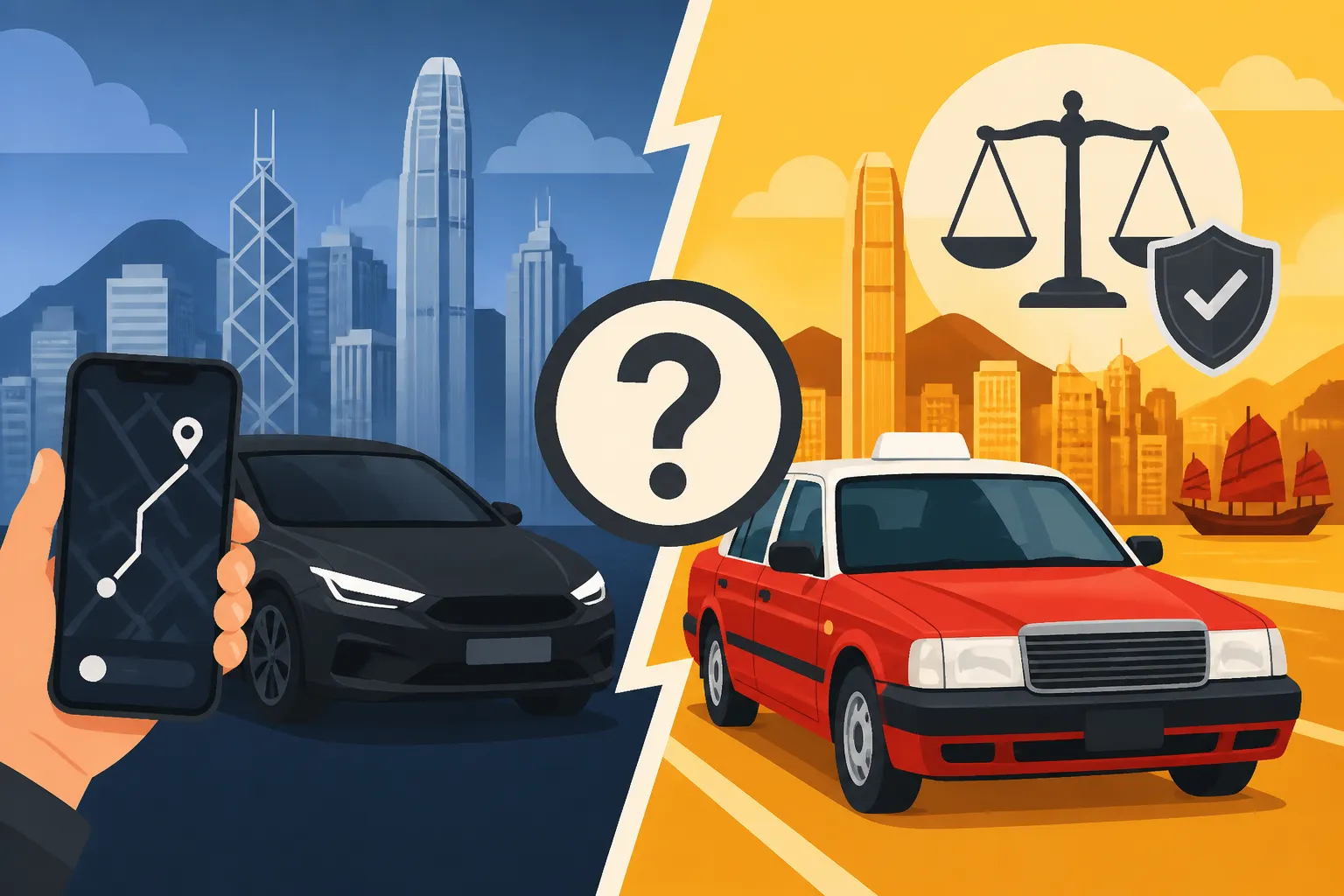
Uber occupies a fascinating "gray area" in Hong Kong. While the app works seamlessly and the cars are generally much cleaner and newer than the average taxi, the service has faced years of legal challenges. The Hong Kong government technically considers ridesharing in private cars without a hire-car permit to be illegal. However, from a passenger's perspective, the risk is virtually non-existent. You won't get arrested for being in an Uber, but the driver is constantly looking over their shoulder for police stings.
Despite the legal drama, Uber is often the preferred choice for expats who have just moved via companies like Sirelo and haven't yet mastered the local geography or Cantonese. The ability to input a destination in English and have a GPS-guided driver take you there without a single word spoken is a massive relief. For those staying in flexible housing like Habyt, where you might be moving between neighborhoods, the consistency of Uber is a major draw.
Uber has also introduced "Uber Taxi," which allows you to book a traditional red taxi through the app. This effectively bridges the gap between the two worlds. You get the professional driver and the legal standing of a taxi, but with the GPS tracking and credit card payment of the Uber platform. It is often the best "hack" for navigating the city during peak hours when private Ubers are surging and street-hail taxis are ignoring you.
Why Expats Gravitate Toward Ridesharing
The primary reason for Uber's popularity among the international community is accountability. In a traditional taxi, if you leave your phone in the back, it is likely gone forever unless the driver is exceptionally honest. With Uber, you have a digital trail, the driver’s name, and a support team to contact. When you are still figuring out Where to Live in HK: Neighborhood Guide for Expat Families, having that safety net is invaluable.
Furthermore, the quality of the ride is significantly higher. Hong Kong taxis are built for durability, not comfort. The suspension is often shot, and the smell of stale cigarettes or medicinal oil can be overwhelming. Uber Black or even UberX usually provides a much more "civilized" experience, which matters when you are heading to a high-stakes business meeting in Central or an expensive dinner in Tsim Sha Tsui.
Navigating the Legal Gray Areas
It is important to understand that while you as a passenger aren't breaking the law, the insurance situation can be murky. In the event of a serious accident, the third-party insurance on a private car being used for Uber might be voided because the car was used for "hire or reward" without the proper permit. Most regular users accept this as a marginal risk, but it is something to keep in mind. The government has periodically cracked down on drivers, leading to temporary drops in availability, especially near major transport hubs or the airport.
Practical Comparison: When to Choose Which?
Choosing between the two often comes down to the specific scenario. If you are in a rush and see a taxi with its light on, grab it. The meter starts at a relatively low base rate, and for short hops across a neighborhood, it is almost always cheaper than an Uber. However, for longer trips or specific conditions, the math changes.
| Feature | HK Red Taxi (Street Hail) | Uber (UberX / Uber Black) |
|---|---|---|
| Payment | Mostly Cash / Limited Octopus | In-app Credit Card / Apple Pay |
| Language | Cantonese preferred / Limited English | App-based (No English needed) |
| Legal Status | Fully Legal and Regulated | Gray Area (Hire-car permit issues) |
| Availability | High (except 4 PM shift change) | Depends on surge and location |
| Cleanliness | Hit or miss; often older cars | Usually high; newer vehicles |
| Tunnels | Passenger pays both ways often | Fees included in upfront price |
Airport Runs and Bulky Luggage
When you are heading to the airport, the choice is more nuanced. Taxis have a flat fee for every piece of luggage placed in the trunk (usually around HK$6 per bag). Uber generally doesn't charge per bag, but you need to ensure you book a large enough vehicle (UberXL) if you are moving with a lot of suitcases. For those who have just finished a relocation with Sirelo, an UberXL is often the only way to get those last few essential boxes to your new flat.
Also, consider the toll situation. If you take a taxi through the Western Harbour Crossing, you are responsible for the toll. For many years, you also had to pay the driver's return toll. With the implementation of Driving in Hong Kong: License Conversion, HKeToll, and Car Ownership, the process has become more automated, but the cost still falls on the passenger. Uber's upfront pricing usually bundles these tolls, so the price you see is the price you pay, which helps with budgeting.
Typhoons and Black Rainstorms
This is where things get truly "Hong Kong." During a Typhoon Signal No. 8 or a Black Rainstorm, taxi insurance is technically void. However, many drivers stay on the road to make a killing. They will often hide their meters and demand "flat rates" that can be three or four times the normal price. This is illegal but widely practiced because the MTR often shuts down or becomes dangerously crowded. For more on this, see Catching a Taxi During a Typhoon Shift: Surcharges and Rules.
Uber, on the other hand, will simply apply a massive surge. During a T8, an Uber from Central to Repulse Bay might cost HK$600 instead of the usual HK$150. The advantage here is that the transaction is still handled through the app, avoiding the need to negotiate with a driver in the middle of a storm. However, wait times can be astronomical as fewer drivers are willing to risk their personal vehicles in high winds.
Alternative Modes and Long-term Transit Solutions
While the Uber vs. Taxi debate dominates the "door-to-door" conversation, you shouldn't ignore the backbone of the city: the MTR. Most expats find that for 80% of their journeys, the train is faster and more reliable than any car. Using our MTR Network Guide: Maps, Fares, and Interchange Stations will save you a fortune in the long run. Even if you live in a more remote area, the combination of a green minibus and the MTR is the true "local" way to travel.
If you are living on the Island, don't forget the charm of Riding the "Ding Ding": Hong Kong Island's Historic Trams. It is the cheapest way to get from Western to Eastern district, and while it's slow, it offers a great view of the city's hustle and bustle. For those who prioritize a low-stress lifestyle, choosing a home near these lines—perhaps through a provider like Blueground—can drastically reduce your dependence on either Uber or taxis.
Octopus Cards and Integration
Regardless of whether you choose taxis or the MTR, your life will revolve around your Octopus card. It is the one thing you must set up in your first 24 hours. From buying a coffee at 7-Eleven to paying for a minibus, it is the grease that makes the Hong Kong machine run. If you are struggling with Setting Up Utilities: Electricity, Water, Gas, and Broadband in HK, you will find that even some utility providers allow for payment via the Octopus app or linked bank accounts.
In the end, the "Uber vs. Taxi" choice isn't about loyalty; it's about strategy. Use taxis for short, cheap trips when you have cash and the weather is fine. Use Uber for late nights, airport runs, or when you simply don't have the mental energy to navigate a language barrier. Hong Kong is a city of efficiency, and learning when to use which tool is part of becoming a true resident.
Disclaimer
This guide is for informational purposes only. The legal status of ridesharing services in Hong Kong is subject to change based on government regulations and court rulings. Users should be aware that using non-permitted hire-car services may carry inherent risks regarding insurance coverage and local law enforcement actions. Always verify the current status of transport regulations during your stay.