How to Read Water Meters and Understand the Billing Cycle
One of the most disorienting aspects of settling into a new home in Hong Kong is the discovery that utilities don't always arrive monthly, and meters are often hidden behind locked service doors. If you have ever opened a bill from the Water Supplies Department (WSD) only to be baffled by the four-month cycle or the distinction between fresh and flushing water, you are not alone. This guide provides a deep dive into locating your meter, decoding the dials, and mastering the tiered billing system to avoid expensive "estimated" bill shocks.
Locating and Accessing Your Water Meter in Hong Kong
In many Western countries, water meters are prominently displayed in the front yard or a basement. In the vertical jungle of Hong Kong, space is at a premium, and aesthetics often dictate that utility hardware is tucked away out of sight. When you first move in, perhaps after coordinating your arrival with a relocation service like Sirelo, your priority should be finding these meters to take an initial reading.
Common Meter Locations in High-Rise Buildings
In a typical Hong Kong apartment complex, your water meter is rarely inside your flat. Instead, it is usually located in a communal "meter room" or a service cupboard on your floor’s hallway. These are often small, inconspicuous doors near the elevators or fire stairs. Because of security and safety regulations, these rooms are frequently locked. You will likely need to contact your building’s Management Office (the "Sino" or "MTR" management staff) to have a security guard unlock the door for you.
Once inside, you will see a cluster of pipes and meters, each labeled with a flat number. It is essential to double-check that the label matches your specific unit (e.g., Flat 12B) to ensure you aren't monitoring your neighbor's usage. If you are staying in managed properties like Blueground or Habyt, these logistics are often handled for you, but knowing the location is still vital if you suspect a leak or an error in your statement.
Village House Meter Pits
If you have opted for a more spacious lifestyle by Living in Sai Kung and Clearwater Bay: Space vs Commute, your meter setup will be entirely different. In the New Territories, water meters for village houses are often found in "meter pits" located outside the house, usually near the main entrance or the boundary of the lot.
These pits are covered by heavy iron or plastic lids. You may need a "T-key" or a simple screwdriver to pry the lid open. Be warned: these pits can collect rainwater, leaves, and the occasional resident frog or spider. Keeping this area clear is your responsibility, as the WSD meter reader needs clear access every four months to provide an accurate reading. If they can’t get in, they will issue an "estimated" bill, which often leads to a massive correction bill later in the year.
Identifying the Right Meter for Fresh vs. Flushing Water
A unique quirk of Hong Kong is our dual-water system. We use freshwater for drinking, cooking, and bathing, but most of the city uses seawater for flushing toilets. Consequently, many older buildings have two separate meters. The freshwater meter is usually larger and more prominent. The flushing water meter—if your building uses a metered saltwater system—is often smaller. Note that some older buildings have a "communal" flushing system where the cost is covered by your management fee rather than an individual WSD bill. Before you finalize your move, it is worth asking How to Negotiate Rent with a Hong Kong Landlord to see if flushing water costs are included in the gross rent or management fees.
Decoding the Meter Face and Taking a Reading
Once you have located the meter, the next hurdle is actually reading it. Hong Kong uses the metric system, so all readings are in cubic meters (m³). One cubic meter equals 1,000 liters.
Reading the Digital and Dial Displays
Most modern Hong Kong apartments feature a combination of a digital odometer-style display and several small circular dials.
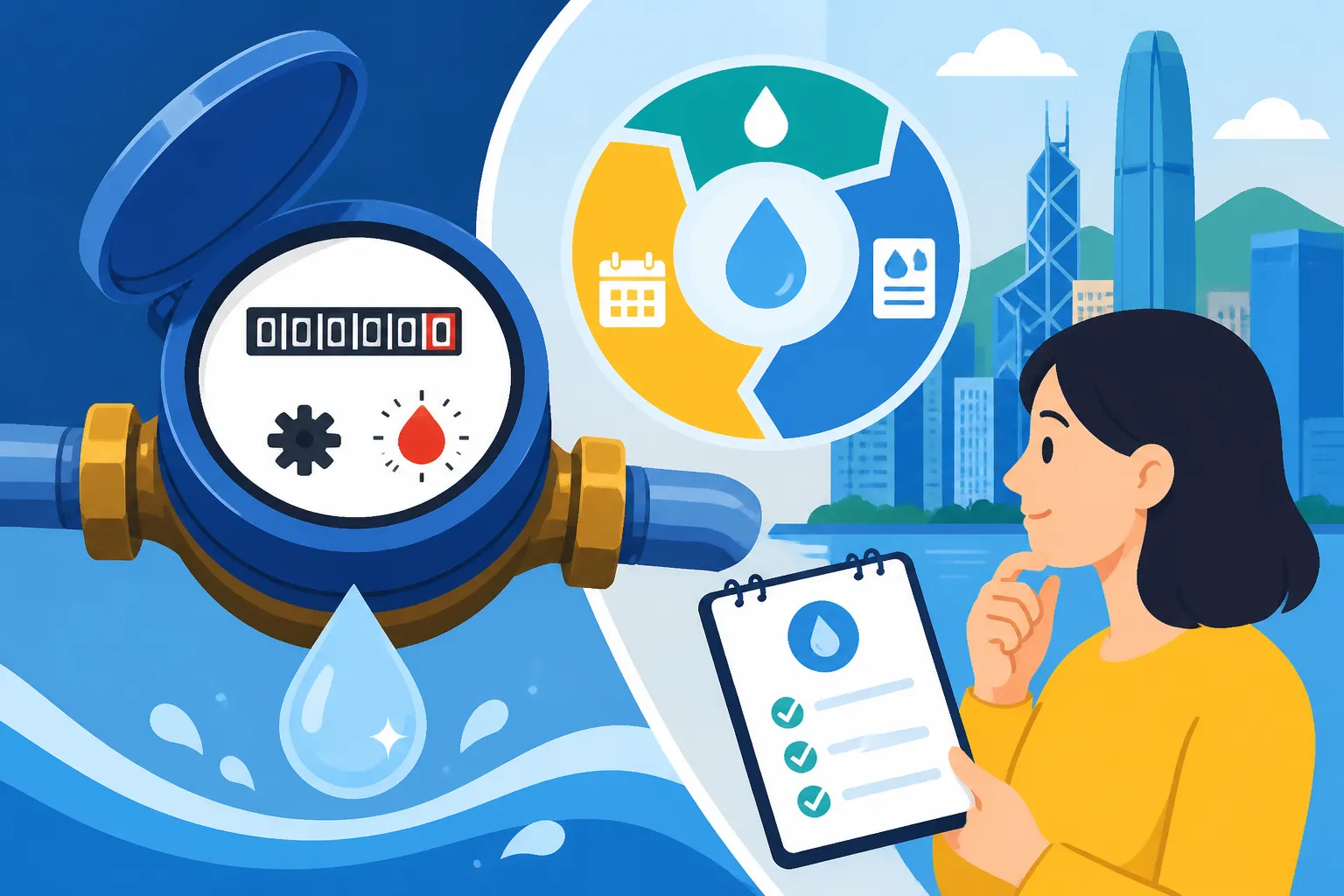
- The Main Odometer: This shows the total cubic meters used. The white numbers on a black background represent the full units (m³). The red numbers (if present) represent decimal points (liters). When the WSD asks for a reading, they generally only require the black-and-white digits.
- The Small Circular Dials: These often indicate smaller increments like 0.1, 0.01, and 0.001. You will see a small needle spinning rapidly when you turn on a tap. If these needles are moving while all your taps are off, you likely have a hidden leak.
- The Meter Serial Number: Always cross-reference the serial number on the meter with the one printed on your WSD bill. This ensures you are paying for your own consumption.
The Importance of the Initial Reading
You must take a photo of the meter the day you receive the keys. This is part of the Essential Health Checklist for Your First 30 Days in Hong Kong and your broader housing checklist. Landlords occasionally forget to close the previous tenant's account, or the WSD might use an old "estimated" figure as your starting point. Having a dated photo of the meter helps you dispute any legacy charges that aren't yours. If you are using a co-living provider like Habyt, check your contract to see if they perform this check for you or if you are expected to provide the opening reading.
Understanding the WSD Billing Cycle and Tiers
The Hong Kong water billing system operates on a four-month cycle. For many expats used to monthly bills, this can lead to "out of sight, out of mind" budgeting errors. Because you only pay three times a year, the bills can feel unexpectedly large if you haven't accounted for the tiered pricing structure.
The Tiered Freshwater Pricing System
To encourage conservation, the WSD uses a four-tier system for domestic freshwater consumption. The more you use, the more you pay per unit. This is designed to ensure that basic needs are affordable while heavy users (like those with large soaking tubs or garden irrigation) pay a premium.
| Tier | Consumption (per 4-month period) | Rate per Cubic Meter (HKD) |
|---|---|---|
| 1st Tier | First 12 m³ | Free |
| 2nd Tier | Next 31 m³ | $4.16 |
| 3rd Tier | Next 19 m³ | $6.45 |
| 4th Tier | Remainder | $9.05 |
Flushing Water Charges
If your building uses seawater for flushing, you generally receive the first 30 cubic meters for free every four months. Anything above that is charged at a flat rate (currently around $4.58 per m³). Since seawater is corrosive and difficult to process, the WSD encourages minimal usage even though it isn't "fresh" water. If you live in an area that doesn't have a seawater infrastructure (like some remote parts of Lantau or high-elevation areas), you might use freshwater for flushing, which is billed at a different, subsidized rate.
The "Estimated" Bill Trap
Because WSD meter readers only visit once every four months, they sometimes miss a reading if they cannot access the meter room. When this happens, the WSD issues an "Estimated" (E) bill based on your historical usage. While this seems convenient, it can be dangerous. If you have been Dealing with Humidity and Mold in Your Apartment by running dehumidifiers or taking more frequent showers, your actual usage might be much higher than the estimate. When a reader finally gains access four or eight months later, you will receive a "Corrective" bill that captures all the unpaid usage at once—often pushing you into the expensive 4th tier.
Troubleshooting Spikes and Managing Payments
If your bill suddenly jumps from $400 to $2,400, your first instinct might be to panic. However, high water bills in Hong Kong are usually caused by three things: a correction of a previous under-estimate, a leaking toilet valve, or a malfunctioning meter.
Identifying Hidden Leaks
The most common culprit for a bill spike is a "silent" toilet leak. Because many Hong Kong toilets use saltwater, the internal valves can corrode faster than those in freshwater systems. You might not hear the water running, but it is constantly trickling into the bowl. To test this, put a few drops of food coloring in the toilet tank and wait 15 minutes. If the color appears in the bowl without flushing, you have a leak. Replacing these parts is usually a tenant's responsibility, though it is worth reviewing Who Pays for Repairs: Landlord or Tenant Obligations? before calling a plumber.
Modern Payment Methods
Paying your water bill is significantly easier than it used to be. The WSD has embraced the "Smart City" initiative, allowing for several digital options.
- FPS (Faster Payment System): You can scan the QR code on your bill using almost any banking app in Hong Kong. This is the fastest way to ensure your payment is recorded instantly.
- WSD e-Bill: You can sign up for the electronic billing service to receive your statements via email rather than waiting for the physical green-and-white envelope to arrive in your mailbox.
- The "HA Go" and Utility Apps: While primarily for health, many residents use the integrated payment features of their banking apps to manage all utilities at once. For more on digital payments, see our guide on How to Pay Your Hospital Authority Bill Online via FPS.
- Autopay: If you are staying long-term, setting up an autopay instruction through your bank is the safest way to avoid the "Late Payment Surcharge" (usually 5% of the bill). This is a standard part of Setting up FPS Auto-Debit for Your Rent and Credit Card Bills.
Moving Out and Final Readings
When it is time to leave Hong Kong, you must settle your "Final Account." This requires giving the WSD at least 14 days' notice. You should provide a final meter reading on your last day to ensure the account is closed accurately. If you forget this step, the WSD will continue to bill you based on the new tenant's usage, and since your name is on the account, you remain legally liable. This is a critical step in Leaving Hong Kong Financially Prepared: Taxes, Banks, and MPF. If you are moving within the city to a new Blueground apartment, you will need to close the old account and open a new one simultaneously.
Final Tips for the Savvy Expat
Understanding your water meter is more than just an administrative chore; it is a way to integrate into the local rhythm of the city. Hong Kong's water supply is a precious resource, largely imported from the Dongjiang River in mainland China. Being mindful of your usage tiers not only saves you money but also contributes to the city's sustainability efforts.
When you receive your first bill, take a moment to look at the "Consumption Chart" on the back. It shows your usage over the last year. If you notice a steady climb, it might be time to check your showerheads or consider shorter laundry cycles. For those new to the city, navigating these small hurdles is part of the journey. For more advice on local life, don't forget to check our Everyday Etiquette and Safety in Hong Kong: A Survival Guide, which covers everything from MTR manners to managing your first T8 typhoon.
Disclaimer
This guide is for informational purposes only. Utility rates, tiers, and WSD policies are subject to change by the Hong Kong Government. While we strive for accuracy, always refer to the official Water Supplies Department website or contact their customer service hotline for the most current pricing and regulatory information.