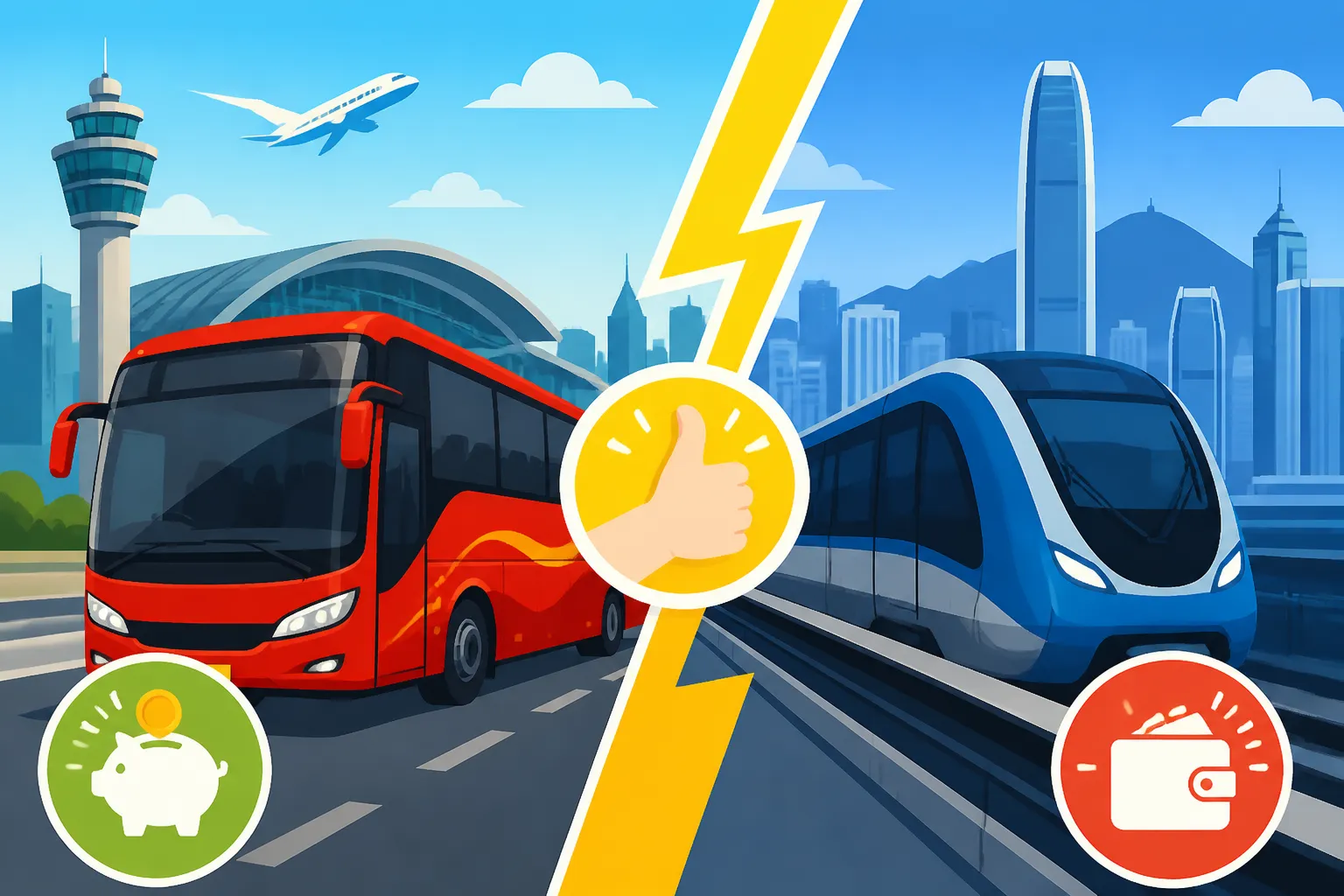
Cityflyer Airport Buses: Cheap Alternatives to the Airport Express
Landing at Hong Kong International Airport (HKIA) after a long-haul flight is a sensory overload, and the immediate pressure to navigate the HKD 400 taxi queues or the pricey Airport Express can be overwhelming for newcomers and veteran residents alike. This guide breaks down the Cityflyer bus network, proving why these gold-and-red double-deckers are the ultimate hack for saving money while reaching your doorstep directly.
Why Cityflyer is the Unsung Hero of Hong Kong Transit
When I first moved here, I was conditioned to think that the Airport Express was the only civilized way to leave Chek Lap Kok. I spent a small fortune on tickets and then even more on "last mile" taxis from the Hong Kong or Kowloon stations to my actual flat. It took me six months to realize that the Cityflyer system offers a premium experience for a fraction of the cost, often dropping you much closer to your final destination than the MTR ever could.
The Cost-to-Comfort Ratio
The primary reason most expats stick to the Airport Express is the perceived speed, but when you factor in the transfer times, the Cityflyer often wins on convenience. While the Airport Express costs roughly HKD 110 to HKD 115 for a one-way trip to the city center, a Cityflyer bus like the A11 or A21 will set you back only HKD 35 to HKD 45. For a family of four, that is a saving of nearly HKD 300—essentially the cost of a very nice dim sum lunch.
The buses are not your standard commuter vehicles. These are "A" routes, specifically designed for airport travelers. They feature plush, reclining seats, free Wi-Fi that actually works, and USB charging ports. If you are staying in temporary accommodation through a provider like Blueground, you will find that many of their centrally located apartments are just a three-minute walk from a major Cityflyer stop, making the bus a far more logical choice than dragging suitcases through MTR tunnels.
Direct Access vs The Last Mile Luggage Struggle
One of the most frustrating aspects of Public Transport in HK: MTR, Trams, Buses, and Ferries is the "last mile" problem. The Airport Express is fantastic at getting you to a central hub, but unless you live inside the International Finance Centre, you still have to navigate transfers. This often involves wrestling with heavy bags on escalators or waiting in long lines for the station's free shuttle buses, which have become increasingly infrequent.
Cityflyer routes are strategically mapped to wind through major residential and hotel districts. Whether you are heading to the high-rises of Living in Mid-Levels and Central: Pros, Cons, and Commutes or the bustling streets of Mong Kok, the bus stops are often right outside major landmarks. If you have just arrived and are moving into a co-living space managed by Habyt, checking the nearest Cityflyer stop should be your first priority. It eliminates the need to lift your bags more than twice: once onto the bus rack and once off it.
Scenic Views vs Dark Tunnels
There is an emotional component to the Cityflyer that the MTR simply cannot replicate. After being cooped up in a pressurized metal tube for 12 hours, the last thing most people want is to go underground into another dark tunnel. The Cityflyer takes you across the Lantau Link, offering breathtaking views of the Tsing Ma Bridge—one of the longest suspension bridges in the world—and the shimmering waters of the Ma Wan Channel.
If you can snag the front-row seats on the upper deck, the journey becomes an introductory tour of your new home. You see the container terminals of Kwai Chung, the skyline of West Kowloon emerging from the horizon, and the dense neon forests of the city. It turns a mundane commute into a moment of reflection. For those still working through their Essential Health Checklist for Your First 30 Days in Hong Kong, this gentle introduction to the city's geography can actually help reduce that initial "new city" anxiety.
Navigating the Cityflyer Network: Routes and Fares
The network can look like a bowl of spaghetti at first glance, but it is remarkably logical once you understand the numbering system. The "A" prefix stands for Airport (Direct), whereas "E" stands for External (Standard). As a rule of thumb: always take the A-bus. The E-buses are cheaper (around HKD 20), but they wander through the airport cargo terminal and residential areas of Tung Chung, adding 30 minutes to your trip.
Major Routes for Popular Expat Hubs
To make your life easier, I have highlighted the heavy lifters of the Cityflyer fleet. These routes cover about 80% of where most foreigners end up living or staying during their first few weeks.
| Route Number | Major Destination Areas | Estimated Fare (HKD) | Frequency |
|---|---|---|---|
| A11 | Sheung Wan, Central, Wan Chai, Causeway Bay, North Point | $41.90 | Every 15-20 mins |
| A12 | Sai Ying Pun, Kennedy Town, Quarry Bay, Chai Wan | $45.00 | Every 20-30 mins |
| A21 | Tsim Sha Tsui, Jordan, Mong Kok, Hung Hom Station | $34.60 | Every 10-15 mins |
| A29 | Tseung Kwan O, Po Lam, Kwun Tong | $44.00 | Every 20 mins |
| A10 | Pok Fu Lam, Aberdeen, Ap Lei Chau | $49.70 | Every 30 mins |
If you have chosen Kennedy Town Living: Transport Links and Vibe, the A12 is your best friend. It bypasses the congestion of Central by using the Western Harbour Crossing, often getting you home faster than a combination of the MTR and a taxi would. Similarly, the A11 is the lifeblood for those heading to the Island's core business districts.
Fare Structures and Payment Methods
Hong Kong is a world leader in digital payments, and the Cityflyer is no exception. You do not need to worry about having exact change in coins, which is a godsend when you have just landed with foreign currency. The most common way to pay is by using The Octopus Card: Hong Kong's Essential Transport & Payment Tool. Simply tap your card on the reader as you board.
However, if you haven't had time to buy an Octopus card yet, the Cityflyer buses now accept contactless credit cards (Visa, Mastercard, UnionPay) and mobile wallets like Apple Pay and Google Pay. You just tap your phone or card on the same reader used for Octopus cards. For those who prefer a physical ticket, there is a Citybus ticket office at the Airport Ground Transportation Centre where you can buy a paper fare or a "Cityflyer Pre-paid Return Ticket," which offers a slight discount for round trips.
Real-Life Comparison: Bus vs Airport Express vs Taxi
Let’s look at a hypothetical scenario: You are traveling from the airport to a hotel in Tsim Sha Tsui.
- Airport Express + Taxi: You pay HKD 105 for the train to Kowloon Station, then roughly HKD 40-50 for a taxi to your hotel. Total: HKD 150+. Time: 45 minutes.
- Uber/Taxi Direct: A taxi will cost approximately HKD 280-320 including tunnel tolls. An Uber might be slightly more depending on surge pricing. Total: HKD 300+. Time: 35 minutes (depending on traffic).
- Cityflyer A21: You pay HKD 34.60. The bus stops right on Nathan Road, likely within two blocks of your hotel. Total: HKD 34.60. Time: 55 minutes.
Unless you are in a desperate rush for a board meeting, the Cityflyer is the clear winner for anyone watching their wallet. For those arriving with massive amounts of luggage—perhaps after using Moving Companies in HK: Man with a Van vs Full Relocation for your bulk items—having a few suitcases on the bus is perfectly acceptable and expected.
Practical Tips for a Stress-Free Bus Journey
Taking the bus with luggage requires a bit of strategy, especially during peak hours. The Cityflyer is designed for this, but a few veteran tips will make the experience much smoother.
Managing Luggage on Board
Every Cityflyer bus has a large, dedicated luggage rack on the lower deck near the entrance. You are expected to lift your bags onto these racks yourself. Here is the pro tip: if you are sitting on the upper deck, there is a CCTV monitor that cycles through views of the luggage racks. You can keep an eye on your bags from your seat throughout the journey.
While Hong Kong is incredibly safe, and the risk of someone walking off with a 30kg suitcase is low, it provides significant peace of mind. If you are worried about your bags shifting during the turns, try to place them on the lower shelves of the rack. If you are moving your life's belongings and have more than three large suitcases, you might find a taxi more practical, but for a standard two-bag move, the bus handles it with ease.
Timing Your Trip: Beating the HK Traffic
The only real "con" of the Cityflyer is that it is subject to the whims of Hong Kong traffic. The MTR Network Guide: Maps, Fares, and Interchange Stations will always be more predictable because trains don't get stuck in traffic jams at the Cross-Harbour Tunnel.
If you are heading to the airport on a Friday afternoon between 5:00 PM and 7:00 PM, allow an extra 30 minutes for your journey. The Western Harbour Crossing is generally faster than the other tunnels, but accidents on the Lantau Link can happen. Conversely, early morning and late-night trips are incredibly fast, often beating the official schedule because the roads are clear. If you are ever unsure about whether you can afford the time, remember that the Everyday Etiquette and Safety in Hong Kong: A Survival Guide suggests arriving at the airport at least two hours early anyway; the bus just means you might need to leave home two hours and forty-five minutes before your flight.
Boarding at the Airport and In-City Stops
At the airport, follow the signs for "Bus" or "Ground Transportation Centre." It is a well-lit, covered terminal located to the right as you exit Arrivals Hall B. Each route has a clearly marked pillar with a queue system.
When you are heading to the airport from the city, the stops are marked with distinctive yellow-and-red signs featuring an airplane icon. Unlike local buses where you might need to squint to read the numbers, the Cityflyer stops are very prominent. Make sure to signal the driver by waving your hand as the bus approaches, otherwise, they might assume no one at the stop is heading to the airport and drive past.
Integrating Cityflyer into Your Expat Lifestyle
Once the initial "move-in" phase is over, you will find the Cityflyer remains a staple of your life. Whether you're heading off on a weekend trip to Thailand or welcoming family members for a visit, the bus system is part of the city's rhythm.
Using the Citybus App for Live Arrivals
Do not stand at a bus stop wondering when the next A11 will arrive. Download the "Citybus" app (formerly "Bravo Bus") immediately. It provides real-time GPS tracking for every bus in the fleet. It will tell you exactly how many minutes away the next bus is and even how crowded it is.
This is particularly useful when you are leaving your flat. You can check the app, see that the A21 is 8 minutes away, and time your walk perfectly. For those who have just settled into Where to Live in HK: Neighborhood Guide for Expat Families, this app is as essential as WhatsApp or Google Maps. It also helps you find the nearest stop if you are in an unfamiliar part of town.
Night Owls: The N Bus Alternatives
Flights into Hong Kong often arrive at odd hours—2:00 AM arrivals from Europe or the Middle East are common. The Airport Express stops running around 12:45 AM, and taxis apply a late-night surcharge. This is when the "N" buses (Night buses) save the day.
Routes like the N11, N21, and N12 follow similar paths to their "A" counterparts but operate throughout the night. They are slightly cheaper and a bit slower because they stop at more locations, but they ensure you are never stranded at the airport. It is a comforting feeling knowing that no matter what time your flight lands, there is a safe, affordable way to get home without arguing with a taxi driver about Uber vs HK Taxis: Legal Gray Areas and Convenience.
Long-term Living and Commuting Logistics
If you end up working in the logistics or aviation sectors near the airport, or if you simply enjoy the quieter life in Tung Chung or Discovery Bay, the bus network becomes your primary commute. Many residents use the "E" buses for daily work trips to save money, reserving the "A" buses for when they have guests or luggage.
When friends or family come to visit, I always send them a screenshot of the Cityflyer stop nearest to my house along with a photo of the bus itself. It empowers them to navigate the city independently from the moment they land. If they are worried about the language barrier, remind them that all Cityflyer buses have automated English announcements and digital displays showing the next stop. It is arguably more tourist-friendly than the local minibus system, where you often have to yell your stop in Cantonese.
Disclaimer
The information provided in this guide is for general informational purposes only and is based on the transport schedules and fare structures available as of 2026. While we strive to keep our content accurate, bus routes, frequencies, and prices in Hong Kong are subject to change by the Transport Department and individual operators like Citybus. Always check the official Citybus app or website for the most current service updates before beginning your journey. This guide does not constitute legal or financial advice.