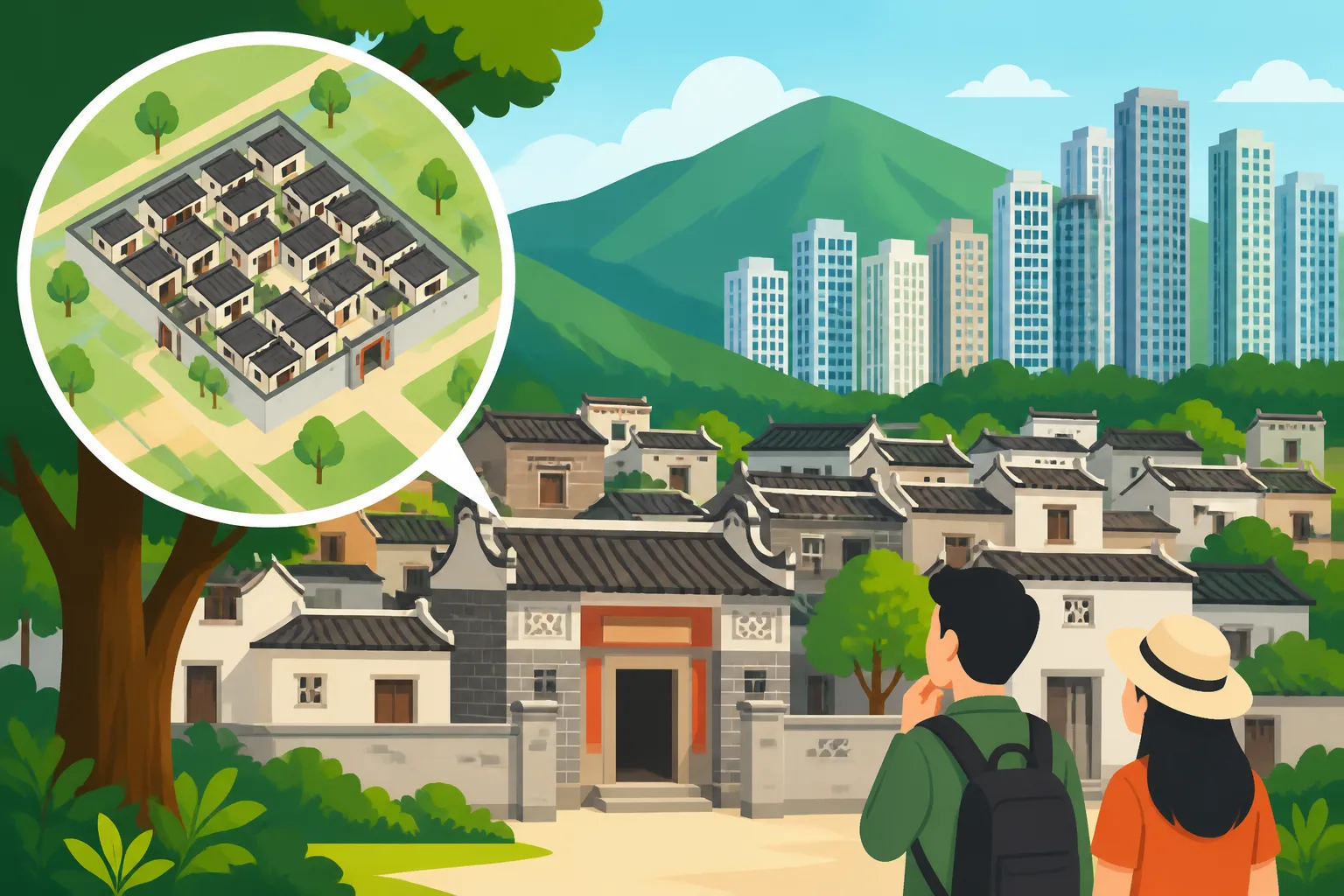
Understanding the Village House System in the New Territories
Most expats arrive in Hong Kong and head straight for the glass towers of Mid-Levels or the cramped streets of Kennedy Town, only to realize their "luxury" flat is the size of a walk-in closet. This guide explores the New Territories' village house system—the secret to gaining actual living space, a rooftop, and a garden without the Manhattan-style price tag.
The Legal Framework: What Defines a Village House
To navigate the New Territories, you first need to understand the Small House Policy. Established in 1972, this policy allows male indigenous villagers (descendants of people living in the New Territories in 1898) to build one small house in their ancestral village. This "Ding" right, as it is colloquially known, created a very specific architectural footprint that defines the landscape of the New Territories today. Every official village house is built to a strict set of dimensions: three stories high, with each floor measuring exactly 700 square feet, totaling 2,100 square feet of potential living space.
While the exterior architecture is often uniform—a boxy structure with a flat roof—the interior configurations vary wildly. Some houses are split into three separate units (one per floor), while others are "whole houses" connected by internal staircases. For a newcomer, Renting in Hong Kong: Apartments, Leases, and Tenant Rights takes on a different dimension here. You aren't just dealing with a corporate landlord; you are often dealing with a local family who has owned the land for generations. This brings a level of personality (and sometimes complexity) that you won't find in the sterile high-rises managed by companies like Blueground or Habyt, which focus on more standardized, urban living solutions.
Understanding the "Saleable Area" is also critical. Unlike city apartments where "Gross Area" includes a share of common lobbies and elevator shafts, a village house is relatively honest. If you rent a 700-square-foot floor, you generally get 700 square feet of actual floor space. However, the legal nuances regarding "Unauthorized Building Works" (UBWs) can be a headache. Many villagers have added glass enclosures to their rooftops or illegal balconies over the years. As a tenant, while you aren't legally responsible for these structures, you may find yourself dealing with government inspectors or, worse, a leaky roof that the landlord refuses to fix because the structure shouldn't be there in the first place.
Choosing the Right Village Neighborhood
The "New Territories" is a massive area, and living in a village in Sai Kung feels worlds apart from living in a village in Yuen Long or Tai Po. For those seeking the classic expat experience, Sai Kung and Clearwater Bay are the gold standard. Here, you’ll find a high concentration of English-speaking families, pet-friendly cafes, and a "village vibe" that feels more like a Mediterranean coastal town than a high-density Asian metropolis. You can find more detail on this in my guide on Living in Sai Kung and Clearwater Bay: Space vs Commute.
If you prefer something more rugged and "local," Tai Po and the villages near the Chinese border offer a deeper cultural immersion. Life here moves slower, and the rent is significantly cheaper than in the expat bubbles. However, you must be prepared for a steeper learning curve regarding language and local customs. In places like Lamma Island or Mui Wo on Lantau, the village system is even more unique because these areas are largely car-free. You exchange the convenience of a taxi to your door for a bicycle and a ferry ride.
Safety and community are major factors in these neighborhoods. While Hong Kong is exceptionally safe, village houses lack the 24-hour security guards found in private estates. Instead, you have village chiefs and local residents who keep an eye on things. It’s a "nosy neighbor" system that actually works in your favor. If you are moving a large amount of furniture into these often narrow, winding village paths, hiring a specialized firm like Sirelo is a wise move, as they understand the logistical nightmares of "village access"—which often involves hand-carrying sofas up three flights of narrow stairs or navigating a van through a path designed for a wheelbarrow.
The Infamous Unauthorized Building Works (UBWs)
One of the most common frustrations for foreigners in the village system is the prevalence of illegal structures. Walk through any village in the New Territories and you will see "glass houses" on rooftops, extended balconies, and even makeshift sheds on the ground floor. These are technically illegal under the Buildings Ordinance. The government occasionally goes on a "cleaning" spree, issuing removal orders to landlords. If you are living in a top-floor unit with a rooftop glass room that you're using as an office, a government order could mean your workspace disappears mid-lease.
Before signing anything, you should conduct a land search. This sounds technical, but it’s a standard part of a Step-by-Step Guide to Renting an Apartment in Hong Kong. A land search will reveal if there are any outstanding "encumbrances" or "building orders" against the property. If the government has already flagged the house for an illegal rooftop structure, the landlord might be looking for a tenant to subsidize the upcoming demolition costs or simply to hide the issue until you've already moved in.
Beyond the legalities, these structures impact your comfort. A poorly built rooftop enclosure will turn into a greenhouse in the summer, skyrocketing your electricity bill. Because village houses aren't built to the same thermal standards as modern high-rises, you also need to be wary of external factors. For instance, Dealing with Humidity and Mold in Your Apartment is a full-time job in a village house, where the surrounding greenery and lack of "wind tunnels" between buildings create a perfect breeding ground for spores during the humid spring months.
Practicalities: Utilities, Parking, and Pets
Living in a village house requires a much higher degree of self-sufficiency than living in a managed apartment. In a high-rise, if a pipe bursts, you call the management office. In a village, you call a local plumber and hope he speaks enough English to understand the problem. You also need to be prepared for the quirks of Setting Up Utilities: Electricity, Water, Gas, and Broadband in HK. While electricity (CLP) and water are standard, many older village houses do not have "town gas" (piped gas). Instead, you will have to deal with LPG cylinders that are delivered by a guy on a motorbike and swapped out manually when you run out of hot water mid-shower.
Broadband internet is another common pain point. While the city has world-leading fiber optics, some remote villages are still stuck on ancient ADSL lines with speeds that feel like the 1990s. Before you commit to a house, especially if you work from home, check which providers (PCCW, HKBN, etc.) actually serve that specific village house number. Sometimes, the house across the path has fiber, but yours doesn't because the villager who owns the land wouldn't give the telecom company permission to dig a trench.
Parking is the final hurdle. Unlike private estates with underground garages, village parking is often controlled by the village's "informal" economy. You might have to pay a local villager a monthly fee for a "spot" on a patch of dirt that isn't technically a legal parking space. If you plan on Driving in Hong Kong: License Conversion, HKeToll, and Car Ownership, make sure you clear the parking situation with your landlord first. If you're an expat, you'll also likely need to navigate Converting an Overseas Driving License to a HK License (TD637) to ensure you are fully legal on the road.
| Feature | Village House (New Territories) | Private Estate (City/Urban) |
|---|---|---|
| Average Size | 700 – 2,100 sq. ft. | 350 – 800 sq. ft. |
| Outdoor Space | Rooftops, Balconies, Gardens | Small Balconies (if any) |
| Pet Friendliness | Very High | Variable (Check Deed of Mutual Covenant) |
| Security | Minimal (Village Community) | 24-Hour Gated / Doorman |
| Internet | Can be slow/unreliable | Ultra-High Speed Fiber |
| Maintenance | Tenant/Landlord direct | Management Office / On-site Staff |
| Commute | Often requires car/minibus | MTR/Bus at doorstep |
Lifestyle and Cultural Integration
The real beauty of the village house system is the lifestyle it affords. If you are Bringing Pets to HK: AFCD Quarantine Groups and Import Permits, a village house is almost a necessity. Trying to house-train a Labrador in a 40th-floor apartment in Wan Chai is a nightmare; doing it in a village house with a garden or nearby hiking trails is a joy. The New Territories offer a level of peace that the city cannot match. You will wake up to the sound of birds (and occasionally feral cows or barking dogs) rather than the screech of the MTR.
However, you must be prepared for the cultural nuances of village life. Many villages are tight-knit communities where everyone knows everyone. Traditional festivals, such as the Hungry Ghost Festival or Lunar New Year, are celebrated with firecrackers (technically illegal but ubiquitous) and loud communal dinners. Being a "good neighbor" in a village means more than just being quiet; it means participating in the rhythm of the area.
You also need to be realistic about furniture. Most village houses are unfurnished. Unlike the furnished flexibility of a Habyt or Blueground unit, you will be starting from scratch. Many expats rely on Buying Second-Hand Furniture on Carousell and AsiaXpat to fill these large spaces affordably. Just remember that what looks like a great deal on a three-seater sofa might become a nightmare when you realize it won't fit through the narrow stairwell of a 1980s village house.
The Financial Reality of Village Living
While the "sticker price" of village rent is often lower than city rent for the same square footage, the hidden costs can add up. You are likely to spend more on transportation—whether that’s a car, frequent taxis, or the "green minibus" that becomes your lifeline. You will also spend more on electricity; cooling a 2,100-square-foot house with split-type air conditioners is significantly more expensive than cooling a compact apartment.
That said, for families, the trade-off is often worth it. The ability to have a dedicated playroom for kids, a home office, and a place to barbecue on the weekends is a luxury that few can afford in the city center. If you are moving from a large house in the US, Europe, or Australia, the village house is the only thing in Hong Kong that will feel remotely like "home." It requires more effort and a bit of a thick skin to deal with the administrative hurdles, but the reward is a side of Hong Kong that most people never get to experience.
Disclaimer
This guide is for informational purposes only and does not constitute legal or professional real estate advice. The Small House Policy and village land rights in Hong Kong are complex and subject to ongoing legal challenges and policy changes. Always perform a formal land search and consult with a qualified real estate agent or legal professional before entering into any tenancy agreement or property purchase in the New Territories.