Umbrella Etiquette and Navigating Crowded HK Sidewalks
Step into any Hong Kong district during the rainy season and you will immediately face the chaotic dance of thousands of umbrellas competing for space on narrow pavements. This guide solves the frustration of navigating the city’s extreme pedestrian density, offering the unspoken rules of sidewalk etiquette and technical umbrella maneuvers every expat must master to avoid conflict and stay dry.
The Geometry of a Hong Kong Sidewalk
The first thing you realize when you land in Hong Kong is that the sidewalk is not just a path; it is a high-stakes, multi-layered ecosystem. Whether you are navigating the elevated walkways of Central or the bustling, market-heavy streets of Mong Kok, the sheer volume of people is staggering. For someone coming from a sprawling city in North America or Europe, the lack of personal "bubble" space can be a genuine cultural shock. You will find yourself shoulder-to-shoulder with thousands of people, and in this environment, your spatial awareness needs a significant upgrade.
Hong Kong’s urban planning prioritizes verticality, which means you are often not just walking on the street level but moving through a complex web of footbridges and underground tunnels. In areas managed by premium residential providers like Blueground, you might find that your daily commute is almost entirely indoors or sheltered, but the moment you hit the public pavement, the rules change. You have to account for "the flow." Pedestrians in Hong Kong generally keep to the left, a carry-over from British influence, but this rule is frequently broken by tourists or distracted residents. The key is to look several meters ahead rather than at your feet. You aren't just looking for gaps; you are predicting the trajectory of everyone around you.
One of the biggest frustrations for newcomers is the "sudden stop." In a city of eight million people, a single person stopping to check a WhatsApp message can cause a human pile-up. This is particularly prevalent near MTR exits and at the base of escalators. As a veteran expat, my advice is simple: if you need to stop, pull over to the side like a car on a highway. Never stop in the middle of a high-traffic zone, especially in districts like Causeway Bay or Tsim Sha Tsui where the pedestrian speed is high. Understanding Everyday Etiquette and Safety in Hong Kong: A Survival Guide is essential for your first few months here to avoid the unintentional glares from locals who are simply trying to get to work on time.
The Unspoken Laws of Umbrella Etiquette
When the clouds burst—and they do, frequently and violently—the Hong Kong sidewalk transforms into a sea of nylon and metal spikes. This is where the real tests of character happen. If you have moved your life here through a service like Sirelo, you likely already have your household goods, but you need to invest in a high-quality, sturdy umbrella immediately upon arrival. However, owning one is only half the battle; knowing how to wield it without blinding a neighbor is the true mark of a seasoned resident.
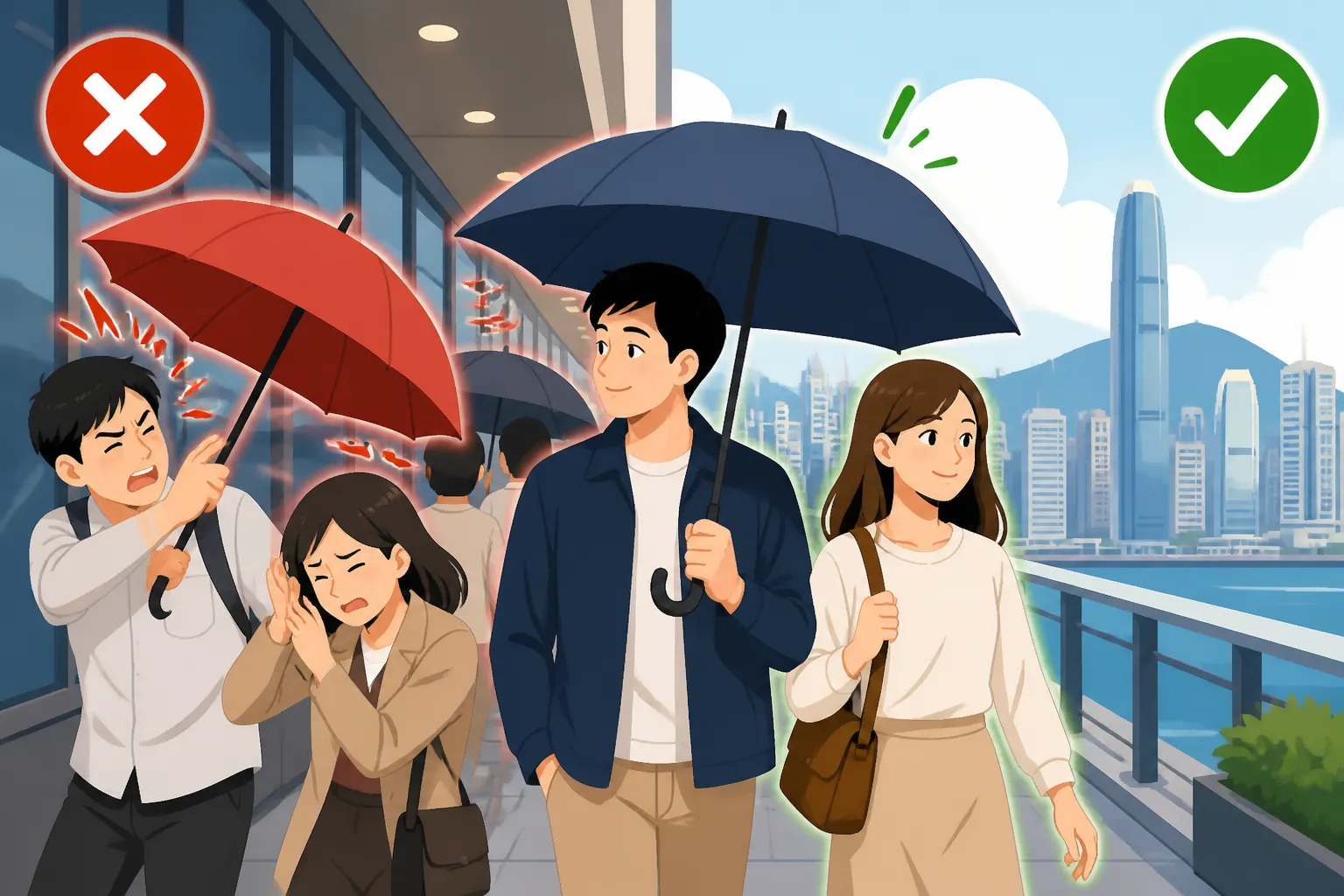
The "Tilt and Lift" is the most important maneuver in the Hong Kong umbrella playbook. When two people walking in opposite directions are about to pass each other, the person with the taller umbrella should lift theirs higher, while the shorter person tilts theirs away. This prevents the umbrellas from locking together or, worse, one person’s umbrella dumping a gallon of runoff water directly down the other person’s neck. If you are significantly taller than the average local resident, the burden of lifting usually falls on you. It is an exhausting but necessary workout for your forearms during the humid summer months.
Another critical rule involves the handling of wet umbrellas indoors. Most malls and office buildings provide long plastic sleeves at the entrance. While there is a growing environmental movement to phase these out in favor of umbrella dryers (large absorbent pads you rub your umbrella against), the rule remains the same: never carry a dripping umbrella into a shop or onto public transport. A wet umbrella on a crowded MTR carriage is a recipe for a very unhappy commute for everyone standing near you. If you are staying in a flexible living space like Habyt, you will appreciate their streamlined entryways, but always ensure your gear is shaken out before you step inside to maintain the harmony of shared living spaces.
Mastering the Pedestrian Flow and Crowd Dynamics
Crowd dynamics in Hong Kong are an art form. To survive, you must understand the different "speeds" of the city. There is the "Salaryman Sprint," usually found in Central and Admiralty between 8:30 AM and 9:30 AM. During this time, the sidewalk is a high-speed transit zone. Then there is the "Domestic Helper Sunday," particularly in Central and Causeway Bay, where sidewalks become communal living rooms. Navigating these requires different approaches. When you are moving through a high-speed zone, do not dawdle. If you are moving slow, stay to the absolute edge.
Queueing is another area where many expats struggle. Whether it’s for a bus, a lift, or even a popular street food stall, the queue is sacred. However, "cutting" isn't always obvious. Sometimes a queue might look like a disorganized huddle, but there is an internal logic to who arrived first. When in doubt, look for the person at the head of the group and ask, "Is this the end of the line?" This level of politeness goes a long way. You can learn more about how these systems integrate with the city's infrastructure in our guide on Public Transport in HK: MTR, Trams, Buses, and Ferries.
The "Smartphone Zombie" is perhaps the greatest threat to a smooth sidewalk experience. With the high penetration of mobile gaming and social media, many residents walk with their eyes glued to their screens. While frustrating, the "veteran" move is not to get angry, but to use a slight "cough" or a gentle "mm-goi" (excuse me in Cantonese) to alert them to your presence. Physical contact should be avoided, but in a city this dense, a shoulder brush is often inevitable. Do not take it personally; it is simply the physics of the city. If you are commuting from residential hubs, understanding the local vibe is key, especially if you have chosen Living in Mid-Levels and Central: Pros, Cons, and Commutes as your primary base.
| Scenario | The Wrong Move | The Pro Expat Move |
|---|---|---|
| Heavy Rain on Narrow Path | Holding your umbrella low and straight ahead. | The "Tilt and Lift": raising or tilting to accommodate others. |
| Entering the MTR | Rushing the doors before people have exited. | Standing to the side and waiting for the "clear" signal. |
| Checking Google Maps | Stopping dead in the center of the pavement. | Stepping into a shop doorway or against a wall. |
| Wet Umbrella in a Lift | Letting the umbrella lean against someone’s leg. | Keeping the umbrella vertical and close to your own body. |
| Walking with a Partner | Walking side-by-side on a narrow street. | Switching to single-file to let faster people pass. |
Practical Preparation for the Pedestrian Life
Living in Hong Kong means your feet are your primary mode of transport. Even if you use the MTR or taxis, you will likely clock 10,000 steps just doing basic errands. This means your choice of footwear is not just a fashion statement; it is a health requirement. During the rainy season, the marble floors of many Hong Kong building entrances become incredibly slippery. Many expats have taken a spectacular tumble because they were wearing leather-soled dress shoes. Invest in shoes with high-grip rubber soles.
Weather awareness is your best defense against sidewalk misery. The Hong Kong Observatory is world-class, and their app is a mandatory download for any resident. It provides rain intensity maps that are accurate down to the minute. If the app shows a purple "heavy rain" cell moving over your district, wait ten minutes in the mall or office. The tropical downpours here are often intense but brief. Knowing when to step off the sidewalk and take cover is a skill you will develop quickly. For more on this, check out our guide on Using the HK Observatory App for Accurate Weather Warnings.
Finally, consider the environmental impact of your sidewalk gear. Hong Kong generates a massive amount of plastic waste from umbrella sleeves. Buying a high-quality "dry bag" for your folding umbrella can save hundreds of plastic bags a year and keeps your bag dry when you're on the go. This is particularly useful if you are in temporary housing and trying to keep your belongings organized while Renting in Hong Kong: Apartments, Leases, and Tenant Rights. Keeping your apartment dry is also a battle against the elements, so don't forget the importance of Buying Dehumidifiers and Air Purifiers for HK Weather to deal with the dampness you inevitably bring home on your clothes and gear.
Weathering the Storm with Grace
The Hong Kong sidewalk is a microcosm of the city itself: crowded, fast-paced, and occasionally overwhelming, but also incredibly efficient and full of life. By mastering the art of the umbrella tilt and respecting the flow of the crowd, you transition from being a "tourist" to a true local. It’s about more than just staying dry; it’s about participating in the collective social contract that allows eight million people to live on a tiny rock in the South China Sea.
When the signals go up—whether it's a Red Rainstorm or a T8 Typhoon—the sidewalk rules change again. At this point, safety overrides etiquette. You should be heading home or staying put. If you find yourself caught out, remember that the city's infrastructure is designed to handle this. From the massive drainage tunnels beneath your feet to the sturdy glass canopies above, you are generally safe if you stay away from the coastline and steep slopes. For a deeper dive into these extreme scenarios, read our advice on Natural Disasters in HK: Typhoon and Black Rainstorm Preparedness.
Whether you are here for a few months in Short-Term Serviced Apartments for Your First Month in HK or you are planning to make this your forever home, the way you carry yourself on the street defines your experience. Be patient, stay alert, and always, always keep your umbrella tilted away from your neighbor's face.
Disclaimer
The information provided in this guide is for educational and informational purposes only. While every effort has been made to ensure accuracy, the "unspoken rules" of social etiquette can vary by district and specific local context. Always prioritize personal safety and follow the instructions of local authorities and the Hong Kong Observatory during extreme weather events. This guide does not constitute legal or professional advice.