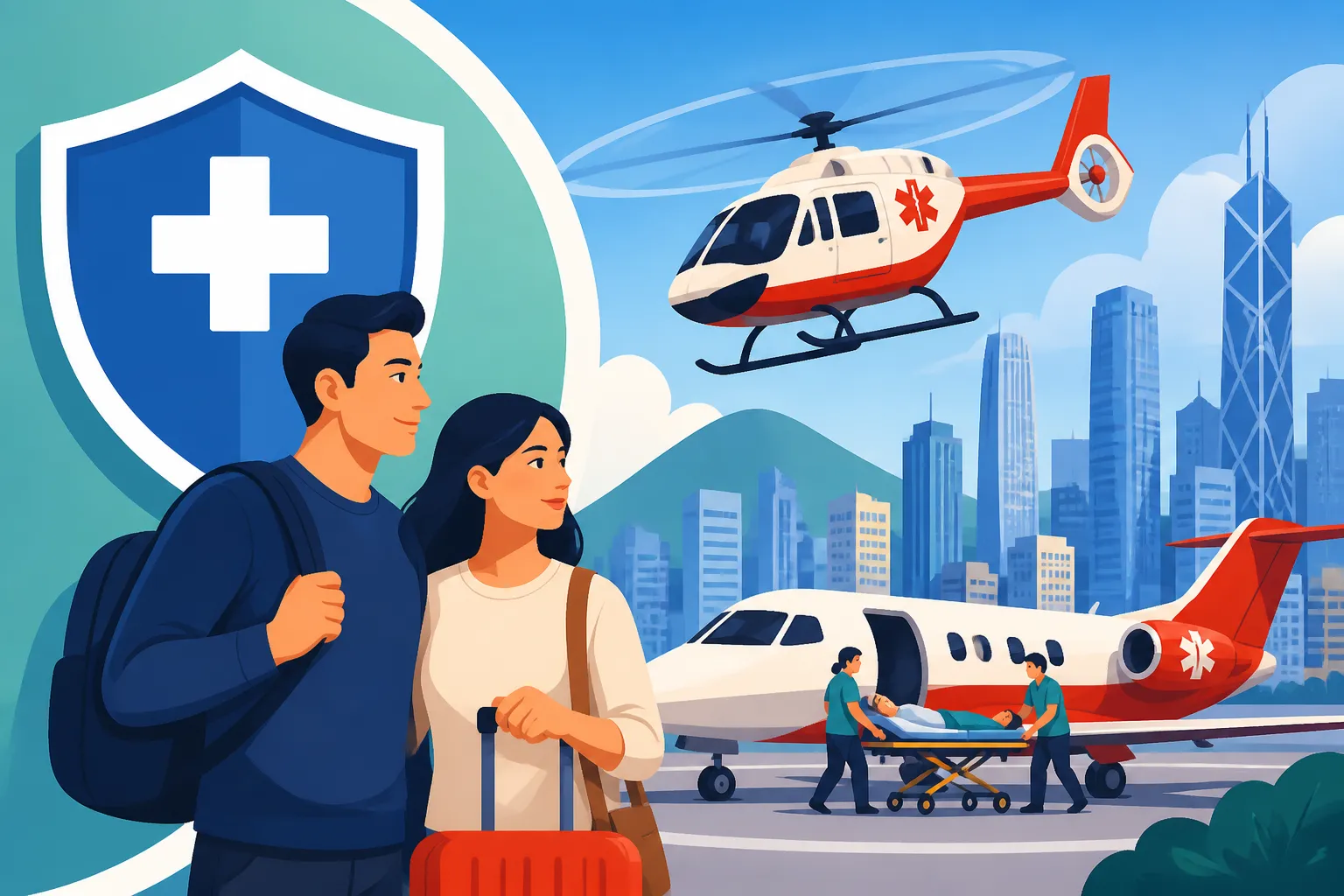
Emergency Medical Evacuation Insurance for Expats Traveling Regionally
Living in the high-octane environment of Hong Kong means that Southeast Asia’s most beautiful, remote islands are just a three-hour flight away for a weekend escape. However, the moment a serious accident occurs in a region with limited medical infrastructure, the realization hits that your standard local health cover won't bring you home. I once spent a frantic night in a rural Thai clinic helping a friend negotiate a plane charter after a motorbike accident, and it was a logistical nightmare I wouldn't wish on anyone. This guide explains how emergency medical evacuation insurance bridges the gap between a regional crisis and the safety of Hong Kong’s world-class hospitals.
The Reality of Regional Travel from a Hong Kong Base
Hong Kong is arguably one of the safest cities in the world with access to incredible medical care, but its proximity to developing nations creates a "safety paradox" for many expats. We get used to the efficiency of the Hospital Authority (HA) Guide: Accessing Public Healthcare for Expats and forget that just a few hundred miles away, the "Golden Hour" of emergency response simply does not exist. If you are hiking in the mountains of northern Vietnam or diving off a remote reef in the Philippines, the nearest facility capable of performing neurosurgery or treating complex trauma could be hours or even days away by ground transport.
In these scenarios, the goal isn't just "medical treatment"—it is "stabilization and extraction." A regional medical evacuation policy is designed specifically to handle the terrifying middle ground between the accident site and the hospital bed. Without a dedicated plan, you are left at the mercy of local provincial hospitals that may lack basic diagnostic equipment. Veteran expats know that while Hong Kong’s Accident and Emergency (A&E) Triage Categories in Public Hospitals are world-standard, getting back to the city to access them is a private logistical feat that requires professional intervention.
Furthermore, the administrative burden during a crisis is something most people underestimate. If you are incapacitated, who is calling the jet charter? Who is handling the cross-border permits for a medical flight to land at Chek Lap Kok? These are the questions that brands like Cigna Global and SafetyWing answer through their 24/7 assistance hubs. They don't just pay the bill; they act as the command center for your survival, coordinating with ground ambulances, flight crews, and receiving doctors in Hong Kong.
The Contrast in Standards of Care
When we talk about "regional" travel, we are often looking at a massive disparity in medical technology. In Hong Kong, you might complain about waiting times, but you know the equipment is cutting-edge. In many neighboring holiday destinations, "emergency services" might consist of a converted van with a stretcher and a driver with minimal first-aid training. This is a far cry from the Emergency Medical Services in HK: Calling 999 and A&E Wards that we rely on at home.
An evacuation policy ensures that if the local facility cannot provide a "standard of care" comparable to what is necessary for your condition, the insurance provider is contractually obligated to move you. This "adequacy of care" clause is the most important sentence in your policy. It means you aren't stuck in a subpar ward just because the local doctor says they "can handle it" when your gut (and your insurance company’s medical director) knows better.
Logistics of a Medical Extraction
Extracting a patient involves more than just a plane. It requires "bed-to-bed" coordination. This means a specialized team arrives at the rural clinic, takes over the patient's care, monitors them during a high-altitude flight in a pressurized cabin designed for intensive care, and hands them over to a waiting team at Private Hospitals in Hong Kong: Admission, Costs, and Insurance.
This level of detail is why standalone travel insurance or basic credit card cover often fails. They might have a "limit" that sounds high, but they lack the specific "assistance" infrastructure to make the flight happen in time. When you are dealing with Navigating Medical Emergencies During T8 Typhoons or Black Rainstorms, the logistics become even more complex, requiring a provider who understands the unique meteorological and bureaucratic challenges of the South China Sea.
Breaking Down the Cost of Air Ambulance Services in Asia
The sticker shock of a private medical evacuation is enough to bankrupt most families. A flight from Bali to Hong Kong on a dedicated Learjet equipped with an ICU suite and a specialized medical team can easily cost upwards of USD 35,000 to USD 50,000. If you are further afield, such as in the Maldives or remote parts of China, those costs can double. Most people assume their employer-provided health insurance covers this, but often, those plans are restricted to "local" or "in-patient" care within the territory.
When you look at providers like SafetyWing, their model is built for the modern expat who might be hopping between countries. They understand that the "home base" for an expat in this region is Hong Kong, and the goal is always to get the patient back to their support network. Without insurance, the charter company will often require the full payment via wire transfer before the wheels even leave the tarmac. In a medical emergency, you do not have the time to move USD 40,000 between accounts or wait for bank approvals.
The insurance provider acts as the financial guarantor. This allows the medical team to focus on the patient rather than the credit card limit. For those of us who have lived through the stresses of Healthcare in Hong Kong: Public vs Private Systems Explained (2027), we know that even within the city, costs can escalate. Adding a five-figure flight on top of that is a financial burden that can take years to recover from.
| Type of Evacuation Service | Estimated Cost (USD) | Primary Goal |
|---|---|---|
| Local Ground Ambulance (Regional) | $150 – $900 | Transport to nearest clinic |
| Commercial Flight (Medical Escort) | $3,000 – $8,000 | Non-critical stabilized return |
| Regional Air Ambulance (ICU Suite) | $25,000 – $55,000 | Critical extraction to Hong Kong |
| International Medevac (Long-Haul) | $80,000 – $160,000 | Return to home country/HK from afar |
| Search and Rescue (SAR) | $5,000 – $20,000 | Location and initial recovery |
Why Credit Card Insurance Often Fails
Many expats rely on the "free" insurance provided by their premium credit cards. While these are fine for lost luggage or a bout of food poisoning that requires a few stitches, they are notoriously difficult to trigger for full-scale medical evacuations. They often require the trip to be paid for entirely on that specific card, and the "evacuation" benefit is frequently capped at a low amount or subject to the "sole discretion" of an overworked claims adjuster in a different time zone.
In contrast, a dedicated expat health plan from Cigna Global offers a much higher degree of certainty. These plans are designed for people whose lives are inherently international. They understand that a "resident" of Hong Kong might be in Singapore for business one day and Cambodia for leisure the next. The "Emergency Assistance" component is a core part of the premium, not a secondary "perk."
Hidden Costs of Evacuation
Beyond the flight itself, there are several "hidden" costs that insurance needs to cover. These include the repatriation of a traveling companion, the return of minor children who might be left unattended, and the "repatriation of remains" in the worst-case scenario. If you are the primary breadwinner, having a policy that ensures your family is taken care of during the extraction process is vital. This is especially true if you have domestic help traveling with you; you should always check if your Medical Checkups for Helpers: What Employers Must Legally Cover includes travel extensions, or if they need their own regional coverage.
What to Look for in a Policy: Evacuation vs. Repatriation
One of the biggest points of confusion for expats is the difference between "Medical Evacuation" and "Medical Repatriation." Understanding this distinction is critical when reading the fine print of your policy. Medical Evacuation is the act of moving you to the nearest facility where you can be treated properly. If you are in a remote part of Indonesia, that might mean being flown to Singapore or Hong Kong.
Medical Repatriation, on the other hand, is the process of flying you back to your home country or your primary country of residence (Hong Kong) for long-term recovery once you are stable. Some cheaper policies only cover the evacuation to the "nearest" hospital. This could leave you stuck in a hospital in a foreign city where you have no friends, no family, and no long-term right to stay once your visa expires. For most of us, the priority is getting back to the Private Hospitals in Hong Kong: Admission, Costs, and Insurance network where our primary doctors are located.
When choosing between providers, look at how they define the "destination" of the evacuation. A good policy will state that they will move you to your country of residence or a facility of your choice, provided it is medically necessary. SafetyWing, for instance, is highly popular among the digital nomad and younger expat crowd because their language is clear and their digital interface makes it easy to manage these specifics on the fly.
The Fit to Fly Requirement
No evacuation happens without medical clearance. The insurance company's medical team will consult with the local attending physician to determine if you are "Fit to Fly." This can be a point of friction. If the local hospital wants to keep you there for "observation" (and to collect more fees), but the insurance company knows the facility is inadequate, they will advocate on your behalf. This professional advocacy is arguably more valuable than the money itself.
They also manage the "continuum of care." This ensures that the medical records, scans, and medications administered in the regional clinic are accurately translated and handed over to the receiving team in Hong Kong. Without this, you might find yourself repeating expensive and painful tests the moment you arrive at a Finding a Direct-Billing Clinic for International Expat Insurance facility.
Coverage for Pre-Existing Conditions
Most regional evacuation policies—especially those that are travel-focused—will exclude emergencies arising from pre-existing conditions. However, premium expat plans like those from Cigna Global can often include these if they have been declared and underwritten. If you have a known heart condition or a history of respiratory issues, you must ensure your evacuation cover isn't voided the moment the doctors find out your "emergency" was a complication of a known issue.
For those traveling to high-altitude areas or engaging in "adventure sports" (like trekking in Nepal or skiing in Japan), you must ensure that your policy doesn't have an "exclusion list" for these activities. Many standard policies will not cover a helicopter evacuation from a hiking trail if it's above a certain altitude or if the activity is deemed "high risk."
Seamless Integration with Hong Kong’s Medical Infrastructure
The final piece of the puzzle is what happens when the plane lands in Hong Kong. A well-coordinated evacuation doesn't end at the airport. The insurance provider should have a direct line to the admissions department of your preferred hospital. In Hong Kong, this often means coordinating with the private sector for immediate specialist care.
If you are covered by a high-end global policy, they will often handle "Direct Billing." This means that upon your arrival, you aren't asked for a HKD 50,000 deposit at the hospital's front desk while you are still on a stretcher. The insurance provider has already sent a "Guarantee of Payment" (GOP). This allows you to focus on Accident and Emergency (A&E) Triage Categories in Public Hospitals and getting the surgery or treatment you need without the administrative nightmare of credit card swipes.
For those who prefer the public system, the evacuation team can also coordinate a transfer to a facility like Queen Mary or Princess Margaret, especially if the injury requires the specialized trauma units found in the public sector. Even in the public system, having the "assistance" side of your insurance manage the communication can speed up the process of getting a patient number and ensuring your records are in the system. You can learn more about this in our Hospital Authority (HA) Guide: Accessing Public Healthcare for Expats.
Staying Prepared Before You Fly
Before you head out on your next regional trip, there are three things you should do:
- Download the Digital Card: Ensure your insurance details and the "Emergency Hotline" number are available offline on your phone and printed in your passport cover.
- Share the Plan: Make sure your emergency contact in Hong Kong (or your spouse/partner) knows exactly who to call. In a crisis, they will be the ones initiating the claim while you are being treated.
- Check the Vaccination Status: Many regional emergencies are actually preventable illnesses. Visit one of the Travel Clinics in Hong Kong: Vaccinations for Southeast Asia at least two weeks before your trip to ensure you are protected against local endemic diseases that could lead to a medical crisis.
Living the expat dream in Hong Kong involves exploring the incredible diversity of Asia. But being a "veteran" expat means knowing that the "It won't happen to me" mindset is a liability. Whether you choose the comprehensive stability of Cigna Global or the flexible, travel-centric approach of SafetyWing, having a plan for emergency medical evacuation is the ultimate "peace of mind" investment. It ensures that no matter how far you wander, the path back to Hong Kong’s safety is always open.
Disclaimer
This guide is for informational purposes only and does not constitute financial or legal advice. Insurance policies and coverage limits in Hong Kong are subject to frequent changes. You should always consult with a licensed insurance broker or read the specific Product Disclosure Statement (PDS) of your chosen provider to understand the terms, conditions, and exclusions of your policy.