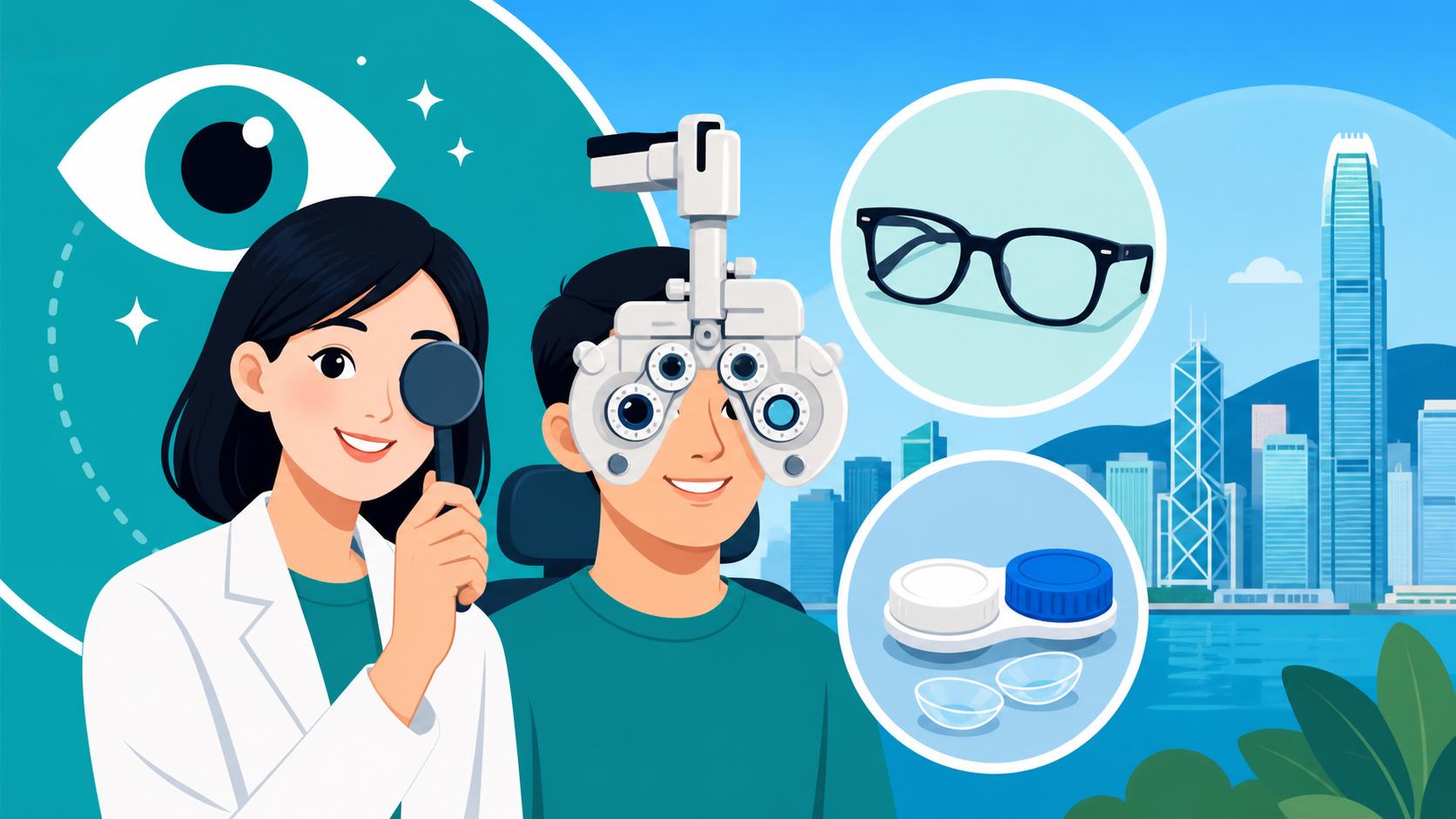
Optometrists and Eye Health: Getting Glasses and Contact Lenses
Finding yourself squinting at the dim text of an MTR map or struggling to read the dim sum menu under the bright lights of a local cha chaan teng is a classic expat rite of passage. I remember the panic of losing a contact lens during my first junk boat trip and realizing I had no idea where to find a replacement. This guide solves the confusion by mapping out exactly how to navigate Hong Kong’s optometrists, boutique optical shops, and eye clinics.
Navigating Eye Care in Hong Kong
When you first arrive, the sheer volume of optical shops can be overwhelming. From the neon-lit storefronts in Mong Kok to the sleek, minimalist boutiques in the IFC Mall, it seems like everyone is selling spectacles. However, understanding the hierarchy of eye care professionals is the first step to ensuring your vision is actually being protected, rather than just fitted for a trendy frame.
Professional Distinctions: Optometrists vs. Ophthalmologists
In Hong Kong, there is a clear distinction between an optometrist and an ophthalmologist, and knowing which one to visit can save you significant time and money. Optometrists in the city are regulated by the Supplementary Medical Professions Council and are categorized into different parts. A Part I Registered Optometrist is what most expats should look for; they are degree-holders who can perform comprehensive eye exams, prescribe various optical aids, and use diagnostic drugs to check the health of your retina.
Ophthalmologists, on the other hand, are medical doctors specializing in eye surgery and the treatment of complex diseases. If you are dealing with a standard blurry vision issue or need a routine check-up, an optometrist is your first port of call. However, for serious issues like cataracts or glaucoma, you would likely be referred to a specialist within Private Hospitals in Hong Kong: Admission, Costs, and Insurance or a dedicated eye clinic. Most expatriates find that a high-quality optometrist in a private practice offers the best balance of thoroughness and convenience for yearly screenings.
Where to Find English-Speaking Eye Doctors
While most younger healthcare professionals in Hong Kong speak excellent English, there is a certain comfort in visiting a clinic where the nuances of your vision history won't be lost in translation. For those living or working in the CBD, Finding English-Speaking General Practitioners (GPs) in Central is often the starting point for medical referrals, but many top-tier optometrists operate independent practices in the same area. You’ll find world-class facilities in buildings like Jardine House or the Prince’s Building, where the staff is well-versed in the specific requirements of the international community.
If you are located on the Kowloon side, the major shopping hubs in Tsim Sha Tsui host several professional optical centers that cater specifically to tourists and expats. These clinics often utilize advanced technology, such as digital retinal imaging and OCT scans, which provide a much deeper look into your eye health than a basic "is it better one or two" refraction test. When booking, always ask if they have a Part I Optometrist on-site, as some smaller retail-focused shops may only have technicians who are limited in the types of diagnostic tests they can legally perform.
Buying Glasses and Frames in the City
Hong Kong is arguably one of the best places in the world to buy eyewear. The speed of service is legendary—often, you can have a new pair of prescription glasses ready in under an hour if your prescription is standard. But this efficiency comes with a wide spectrum of quality and price points that require a bit of savvy to navigate.
High-End Boutiques vs. Local Optical Chains
If you are looking for value, chains like Optical 88 or Egg Optical offer transparent pricing and a massive selection of "house" frames. These are fantastic for a backup pair of glasses or for children who might be prone to breaking them. These shops are ubiquitous, found in almost every major shopping mall from Shatin to Causeway Bay. For those Living in Mid-Levels and Central: Pros, Cons, and Commutes, however, the preference often leans toward independent boutiques that curate unique frames from Japan, Germany, and Italy.
These high-end boutiques offer a more personalized experience, often spending upwards of forty-five minutes just on the frame fitting. They understand that a frame needs to sit differently on different facial structures, and they often provide bespoke adjustments that the high-volume chains simply don't have time for. Expect to pay a premium here, but for something that sits on your face every single day, many expats find the investment in a pair of Lindberg or Mykita frames to be well worth the cost of the "Hong Kong look."
The Cost of Lenses and Special Coatings
The frame is only half the story; the lenses are where the real technology—and cost—lies. Hong Kong's optometrists usually offer lenses from major global players like Hoya, Essilor, or Zeiss. Because of the city’s intense digital culture, "blue light" filters are pushed heavily. While the science on these is still debated, many find them helpful for reducing the glare from the ubiquitous LED screens found in every office and MTR carriage.
If you have a high prescription, you will want to ask for "high-index" lenses. These are thinner and lighter, preventing that "coke-bottle" look. In Hong Kong, these can be significantly cheaper than in Europe or North America, but you should still budget between HKD 1,500 and HKD 4,000 for top-tier, multi-coated lenses. These coatings usually include anti-reflective, scratch-resistant, and hydrophobic layers—the latter being particularly useful during the humid summer months when glasses tend to fog up the moment you step out of a freezing cold office into the 90% humidity of the street.
Contact Lenses: Prescriptions and Availability
For many of us, contact lenses are a daily necessity, especially if you enjoy an active lifestyle. Whether you are hiking the Dragon's Back or playing rugby in Happy Valley, glasses can be a hindrance. However, the rules for buying contacts in Hong Kong might be slightly more relaxed—or more stringent—than what you are used to back home.
Getting a Professional Fitting in HK
In some countries, you can buy contact lenses with a spectacles prescription. In Hong Kong, a responsible optometrist will insist on a separate contact lens fitting. This is because the lens sits directly on your cornea, and the "fit" (the base curve and diameter) is just as important as the power. Many new arrivals try to skip this step, only to end up with corneal abrasions or chronic dry eye because they were wearing a lens that didn't allow enough oxygen to reach the eye.
During a fitting, the optometrist will use a slit-lamp to check the health of your ocular surface. They will also provide you with trial lenses. In Hong Kong, daily disposables are king. Given the city's air quality and the tendency for dust to accumulate, wearing a fresh pair every day is often more hygienic than trying to maintain monthly lenses in a humid environment where bacteria can thrive. If you are managing your family's health, you might also be looking at Child Developmental Screenings at Maternal and Child Health Centres for early signs of myopia, which is incredibly common in Hong Kong school children.
Subscriptions and Buying Contacts Online
Once you have your prescription, you aren't tied to the shop where you had your exam. Hong Kong has several reputable online retailers that deliver within 24 to 48 hours. Prices online are generally 20-30% lower than in-store. However, be cautious of third-party sellers on social media platforms; always stick to established HK-based websites to ensure the lenses are genuine and haven't been stored in a hot, non-climate-controlled warehouse.
Many expats also choose to use international services for their supplies. If you are a digital nomad or frequent traveler, a plan from a provider like SafetyWing can provide the peace of mind needed when moving between regions, though standard vision "materials" like contacts are often an out-of-pocket expense unless you have a specific vision rider. For those on more permanent local contracts, checking your corporate coverage is essential before placing a bulk order for six months of lenses.
Insurance, Costs, and Claims for Vision Care
One of the most frequent questions in the expat community is whether vision care is covered by standard medical insurance. The answer is usually: it depends. Most basic plans treat vision as an "add-on" or a "benefit" with a specific annual cap.
Does International Insurance Cover Vision?
Standard international health insurance plans often exclude routine vision unless you specifically opt for a "Dental and Vision" module. For example, a comprehensive policy from Cigna Global often allows you to add vision benefits that cover the cost of the eye exam and a portion of the cost for frames or lenses. This is particularly useful in Hong Kong, where a high-end pair of glasses can easily exceed HKD 5,000.
When utilizing a plan from Cigna Global, you can often find clinics that offer direct billing, meaning you only pay the co-pay (if any) at the desk. For more flexible or short-term stays, a policy from SafetyWing is excellent for emergency eye care—such as an infection or an injury—but may not cover your annual fashion-forward frame upgrade. It is always best to refer to Dental and Eye Care in Hong Kong: Costs, Clinics, and Coverage to understand the typical reimbursement rates for these services in the local market.
Navigating Public vs. Private Eye Care
Hong Kong's public healthcare system is world-class but under immense pressure. If you have an eye emergency, such as sudden vision loss or a chemical splash, you should go immediately to a public Accident & Emergency ward. However, for routine vision correction, the public system has very long wait times. This is why the vast majority of expats and middle-class locals use the private system for their optical needs.
For a detailed breakdown of how these two paths diverge, the Healthcare in Hong Kong: Public vs Private Systems Explained (2027) guide is an invaluable resource. Essentially, while you can get subsidized care via the Hospital Authority (HA) Guide: Accessing Public Healthcare for Expats if you have a valid HKID, the convenience, speed, and choice of frames in the private sector make it the default choice for vision correction.
| Service Type | Private Optometrist (HKD) | Public Clinic (HKD) | Wait Time |
|---|---|---|---|
| Basic Refraction | $300 – $600 | $100 – $200 | Same Day (Private) / Months (Public) |
| Comprehensive Eye Exam | $800 – $1,500 | N/A (Specialist only) | 1-3 Days (Private) |
| Contact Lens Fitting | $400 – $800 | N/A | Same Day |
| Designer Frames | $2,500 – $8,000 | N/A | Immediate |
| Emergency Care (Infection) | $1,000 – $2,000 | $180 (A&E) | Hours |
Specialized Eye Health Services
Beyond just needing a new pair of specs, the Hong Kong environment presents unique challenges to eye health that might require specialized intervention. The combination of high-density living, heavy screen use, and extreme humidity creates a specific set of "HK eye problems."
Orthokeratology (Ortho-K) for Children
Hong Kong has some of the highest rates of myopia (nearsightedness) in the world. If you have children in the local or international school system, you will likely hear other parents talking about "Ortho-K" lenses. These are hard, gas-permeable lenses that a child wears only at night. They gently reshape the cornea while the child sleeps, allowing them to see clearly throughout the next day without glasses or daytime contacts.
More importantly, Ortho-K has been shown to slow down the progression of myopia in growing children. This is a highly specialized service, and you should only seek it out from a Part I Optometrist with a specific certification in Orthokeratology. It requires frequent follow-up appointments and a high level of hygiene, but for many expat families, it is a game-changer for their children’s long-term eye health.
Managing Digital Eye Strain and Humidity-Related Dry Eye
The "digital eye strain" is real here. We are constantly moving between the bright outdoors and the harsh fluorescent lights of the office, all while staring at smartphones. This often leads to "dry eye syndrome," which is exacerbated by the constant air conditioning in Hong Kong. AC units strip the moisture from the air, causing the tear film on your eyes to evaporate too quickly.
To combat this, many local optometrists recommend specific preservative-free lubricants. You should also be aware that the high humidity can lead to other issues. Many expats have dealt with Dealing with Mold Allergies and Eczema Flare-ups in HK Apartments, only to realize that the mold spores in the air were also causing allergic conjunctivitis (itchy, red eyes). If your eyes are consistently red, don't just reach for "get the red out" drops; visit a professional to see if it’s an allergy or an infection.
Emergency Eye Care and Specialized Clinics
Sometimes, you need more than a new prescription. If you are considering a more permanent solution to your vision issues, or if you find yourself in a medical crisis, Hong Kong has some of the most advanced ophthalmology centers in Asia.
Handling Eye Trauma and Urgent Infections
If you wake up with a severely painful, red eye or sudden "floaters" in your vision, time is of the essence. While a retail optometrist might be able to diagnose the issue, they cannot perform surgery or prescribe certain high-level antibiotics. In these cases, you should head to a specialist clinic. Many of the top specialists are located in the private hospitals on Hong Kong Island.
For those with comprehensive insurance through Cigna Global, these visits are usually covered under the inpatient or specialist outpatient portion of your policy. If you are an active individual, you might also want to check Laser Eye Surgery (LASIK/SMILE) Costs and Top Clinics in HK if you’re tired of the "foggy glasses" struggle altogether. Hong Kong is a global hub for SMILE (Small Incision Lenticule Extraction), a less invasive version of LASIK that is particularly popular here.
Advanced Screenings for Chronic Conditions
Your eyes are often the window to your overall health. During a comprehensive eye exam, a skilled optometrist can see early signs of hypertension or diabetes by looking at the blood vessels in your retina. If you are over forty, these annual screenings become even more critical. Many expats combine their eye exam with their Annual Health Screening Packages (Body Checks): Where to Go to ensure they are getting a holistic view of their health.
This is especially relevant for those Managing Chronic Conditions: Diabetes and Hypertension in HK, as diabetic retinopathy is a leading cause of vision loss. The private medical network in Hong Kong is incredibly efficient at inter-disciplinary care; an optometrist who sees something concerning will have you in front of a specialist or a GP within twenty-four hours. This speed and connectivity are some of the biggest advantages of living in such a compact, medically advanced city.
Disclaimer
The information provided in this guide is for educational and informational purposes only and does not constitute professional medical advice, diagnosis, or treatment. Always seek the advice of your optometrist, ophthalmologist, or other qualified health provider with any questions you may have regarding a medical condition or vision health. Never disregard professional medical advice or delay in seeking it because of something you have read in this article. External links to insurance providers and medical services are provided for convenience and do not imply an endorsement of specific policy terms.