Hospital Authority (HA) Guide: Accessing Public Healthcare for Expats
Getting sick in a foreign city is terrifying, especially when you are staring at a massive hospital tower and have no idea how to even get through the front door. I remember my first time trying to navigate Queen Mary Hospital with a high fever, feeling completely lost between the local bureaucracy and the clinical maze. This guide solves that confusion by breaking down exactly how to use Hong Kong's Hospital Authority (HA) system as an expat.
Understanding the Hospital Authority Structure
The Hospital Authority, or the HA as everyone here calls it, is the statutory body that manages all public hospitals and clinics in Hong Kong. It is a massive machine, employing tens of thousands of people and providing a safety net that is, quite frankly, the envy of many Western nations. However, for a newcomer, it can feel like an impenetrable fortress of paperwork and long queues. The system is designed for efficiency and high-volume care, which means it lacks the "boutique" feel of private healthcare but offers world-class clinical expertise.
To navigate this, you first need to understand the cluster system. Hong Kong is divided into seven geographic clusters: Hong Kong East, Hong Kong West, Kowloon Central, Kowloon East, Kowloon West, New Territories East, and New Territories West. Each cluster has its own "base" hospital—usually a massive teaching hospital—and several smaller satellite hospitals and clinics. When you enter the public system, you are generally funneled into the cluster corresponding to your residential address. This is why Registering Your HKID for Subsidized Public Healthcare Rates is the most important administrative task you will do after landing.
The HA manages over 40 hospitals and more than 120 clinics. These range from the famous Queen Mary Hospital in Pok Fu Lam, known for its organ transplants, to the Queen Elizabeth Hospital in Jordan, which handles a staggering number of emergency cases. While the clinical care is top-tier, the experience is functional. You won't find private suites or gourmet menus here. You will find professional, highly trained doctors working under immense pressure to serve a city of seven million people.
The Role of the HA in the Greater Healthcare Landscape
The public system handles the vast majority of secondary and tertiary care in Hong Kong, particularly for chronic illnesses and major trauma. While many expats prefer private doctors for a cold or a minor rash, the HA is where you go for the "big stuff." If you have a heart attack or a major car accident, the ambulance will almost certainly take you to an HA hospital because they have the specialized equipment and 24-hour staffing that private facilities sometimes lack.
Understanding this division is key to managing your expectations. Many veterans of the expat life use a "hybrid" approach. They might keep a Private Health Insurance Plans Beyond VHIS for Expat Families policy for day-to-day speed and comfort but rely on the HA for long-term, high-cost medical issues. Brands like Cigna Global are often used to bridge this gap, ensuring you have access to private comforts while knowing the public system is there for absolute emergencies.
Eligible vs Non Eligible Persons
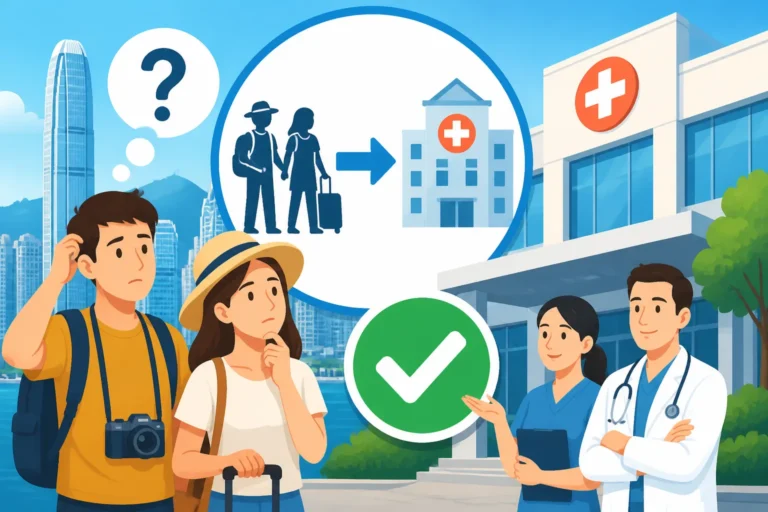
The HA has a very strict definition of who gets the "local" price and who pays the "tourist" price. To be an "Eligible Person" (EP), you must hold a valid Hong Kong Identity Card (HKID). This applies to anyone on a work visa, a dependent visa, or a student visa. Even if you aren't a permanent resident yet, having that card in your wallet drops your costs by about 95%.
If you are a tourist or a visitor without an HKID, you are a "Non-Eligible Person" (NEP). For NEPs, the costs are significantly higher. A night in a public hospital for an NEP can cost thousands of dollars, which is why having travel coverage from a provider like SafetyWing is essential if you are in the city on a visitor's visa. Always carry your original HKID with you; a photo on your phone often won't suffice when you are checking in at the registration desk.
Costs and Fees for Expats in the Public System
The most shocking thing about the HA for someone coming from the US or even parts of Europe is the price—provided you have an HKID. The government heavily subsidizes these services, often covering over 90% of the actual cost. For those of us who have lived through the nightmare of medical debt elsewhere, seeing a bill for a three-day hospital stay that costs less than a fancy brunch in Soho is a surreal experience.
However, "cheap" does not mean "free." There are set fees for every type of interaction, from the emergency room to the specialist clinic. These fees are adjusted periodically, so it is worth checking the latest Hospital Authority Fees: Eligible Persons (EP) vs Non-Eligible Persons (NEP) updates to ensure your budget is accurate. For most expats, these costs are so low they are paid out of pocket without even thinking about an insurance claim.
Standard Subsidized Rates for HKID Holders
If you have your HKID, the rates are incredibly standardized. An attendance at an Accident and Emergency (A&E) department currently costs HK$180. This includes all the consultations, basic scans, and blood tests performed during that visit. If you are admitted to a general ward, the stay costs about HK$120 per day, plus a one-time admission fee of HK$75.
Medication is also subsidized. Usually, it is a flat fee of HK$15 per item. If you are prescribed ten different medications for a chronic condition, you pay HK$150. Compare this to the private sector where a single box of antibiotics can easily set you back HK$400. This is why many expats choose to have their Managing Chronic Conditions: Diabetes and Hypertension in HK handled through the public system even if they see a private doctor for everything else.
Non-Eligible Person (NEP) Fees and Risks
For those without an HKID, the public system is surprisingly expensive. The HA uses "cost-recovery" pricing for visitors. An A&E visit for a tourist isn't HK$180; it's over HK$1,200. If you are admitted to a ward as an NEP, the daily rate can exceed HK$5,000, and that doesn't include procedures, surgeries, or expensive medications.
This is a major pitfall for visiting parents or friends. Expats can be hit with five-figure bills if a visiting relative has a fall and requires a few days of observation. This is exactly where Can I Buy VHIS for My Overseas Dependent Parents? becomes a relevant conversation, or at the very least, ensuring they have robust travel insurance. Without that local ID, the HA ceases to be a budget-friendly option and becomes a financial liability.
Payment Methods and the HA Go App
The HA has modernized significantly in the last few years. While you can still pay with cash or Octopus cards at the windows, the most efficient way is through the "HA Go" app. You can link your credit card or use the Faster Payment System (FPS) to settle bills directly from your phone. This is a godsend when you are being discharged and don't want to stand in another 20-minute line just to pay a hundred dollars.
| Service Type | Eligible Person (HKID) | Non-Eligible Person (Visitor) |
|---|---|---|
| A&E Attendance | HK$180 | HK$1,230 |
| General Outpatient (GOPC) | HK$50 | HK$445 |
| Specialist Outpatient (SOPC) | HK$135 (1st), HK$80 (subsequent) | HK$1,190 |
| General Ward (per day) | HK$120 | HK$5,100 |
| Medication (per item) | HK$15 | Market Price |
Accessing Outpatient Services
The outpatient system is divided into two distinct tiers: General Outpatient Clinics (GOPC) and Specialist Outpatient Clinics (SOPC). Understanding how to move between these—and how they differ from your neighborhood private GP—is the key to getting the most out of the HA. The GOPC is your frontline. These clinics handle minor ailments like the flu, simple infections, and the management of stable chronic conditions.
Getting an appointment at a GOPC can be a bit of a sport. In the old days, elderly residents would line up at 5:00 AM. Today, it’s mostly done through the telephone booking system or the Using the HA Go App for Booking Public Outpatient Clinics feature. Slots open up on a rolling 24-hour basis. If you wake up feeling sick, you need to jump on the app immediately to snag a spot at your nearest clinic. It’s fast-paced, and if you miss the window, you might have to wait another day or visit a private doctor.
The Specialist Referral Pipeline
If your condition is more complex, you need to see a specialist. However, you cannot simply call up a public hospital and book a cardiologist. The HA operates on a strict referral system. You must first see a general doctor—either at a public GOPC or a private clinic—who will then write a referral letter.
Once you have that letter, you take it (or upload it via the app) to the Specialist Outpatient Clinic. This is where the famous Hong Kong "wait times" come into play. The HA triages these referrals into "Urgent," "Semi-urgent," and "Stable." If you are an urgent case, you will see a specialist within a week or two. If you are "Stable," you might be waiting months or even a year. For many expats, this is the point where they pivot back to their Cigna Global coverage to see a private specialist within 48 hours. Knowing How Specialist Referrals Work in the HK Public System can save you a lot of frustration when you realize your "stable" appointment is scheduled for 14 months from now.
Navigating the Specialist Clinics
When your appointment day finally arrives, be prepared for a long stay in the waiting room. Public specialist clinics are incredibly busy. You will be given a time slot, but that is more of a "suggestion" for when you should check in. You will likely wait an hour or two before your name is called.
The consultation itself will be brief. Public doctors are highly efficient; they get straight to the point, review your labs, adjust your meds, and set the next follow-up. If you are looking for a doctor to spend 30 minutes chatting about your lifestyle, the public SOPC is not the place for it. However, if you want a doctor who has seen ten thousand cases exactly like yours and knows the clinical protocols inside and out, you are in the right hands.
Accident and Emergency (A&E) Wards
The A&E is the heartbeat of the public hospital. In Hong Kong, the emergency room is used both for life-threatening trauma and, unfortunately, for people who couldn't get a GP appointment. This leads to significant congestion. If you walk into an A&E with a minor sprain on a Sunday evening, you might be sitting there for eight to ten hours.
The system relies on a five-tier triage process. When you arrive, a nurse will assess your vitals and symptoms before you even register. They categorize you as Category 1 (Critical), 2 (Emergency), 3 (Urgent), 4 (Semi-urgent), or 5 (Non-urgent). Understanding Accident and Emergency (A&E) Triage Categories in Public Hospitals is vital because it manages your expectations. If you are a Category 4, you will watch Category 1 and 2 patients go in ahead of you all night long.
The Triage Reality Check
Category 1 patients are treated immediately. These are the heart attacks, the major strokes, and the severe accidents. Category 2 patients usually wait less than 15 minutes. However, the vast majority of people who "walk in" fall into Categories 4 and 5. For these patients, the wait can be grueling.
Most public hospitals have a digital board in the waiting area showing the estimated wait times. It can hit "Over 8 Hours" at hospitals like Kwong Wah or United Christian during flu season. If you are in pain but it’s not life-threatening, you have to decide if the HK$180 fee is worth the 8-hour wait, or if you’d rather pay HK$1,000 at a private 24-hour clinic to be seen in 30 minutes.
When the A&E is the Only Option
Despite the wait times, there are moments when you must use the public A&E. Hong Kong’s public hospitals are the leaders in trauma care and acute infectious disease. If you are dealing with a potential surgical emergency or something that requires complex imaging in the middle of the night, the A&E is your best bet.
Also, if you are brought in by a 999 ambulance, you are going to a public A&E. There is no choosing a private hospital in a government ambulance. The paramedics will take you to the nearest designated HA emergency department based on your location. Once you are stabilized, you can request a transfer to a private facility if you have the insurance and the receiving doctor accepts you, but the initial "save" happens in the public system.
Inpatient Care and Hospital Stays
If you are admitted to a public hospital, prepare for a bit of culture shock. The standard "General Ward" is a large room with 6 to 10 beds, separated only by curtains. There is very little privacy. You will hear your neighbor’s snoring, their family’s conversations, and the constant beep of medical monitors.
There are no private bathrooms for each bed; you’ll share a communal facility with the rest of the ward. However, don't let the lack of frills fool you. The nursing care is rigorous, and the clinical oversight is constant. In a public ward, you are never more than 10 feet away from a nursing station. For many expats, this is where Private Hospitals in Hong Kong: Admission, Costs, and Insurance starts to look attractive, as private hospitals offer single rooms and much more autonomy.
Visiting Hours and Cultural Etiquette
Public hospitals have very strict visiting hours, usually limited to a couple of hours in the afternoon and evening. They are also quite strict about the number of visitors—usually only two per bed at a time. During flu outbreaks or public health scares, these hours can be restricted even further or canceled entirely.
Culturally, you will notice that local families are very involved. They often bring home-cooked food (if the doctor allows) and basic supplies like tissues and wet wipes. The hospital provides the medical care, but the "comfort" care is often supplemented by the family. As an expat, you might find the environment a bit sterile and loud, but the staff are generally accustomed to English speakers, especially in the larger hospitals.
Discharge and Follow-Up
The discharge process in an HA hospital is a well-oiled machine. Once the doctor clears you, the ward clerk will prepare your discharge summary and your "pink slip" for medication. You then take your papers to the hospital pharmacy, pay your bill at the shroff (payment office), and wait for your meds.
One thing to note is that you will rarely leave with a month’s supply of medicine. Usually, they give you enough to last until your next follow-up appointment at the SOPC. This follow-up is automatically scheduled for you. If you prefer to follow up with a private specialist, you must ask for a copy of your lab results and discharge summary, which you can also access through the How to Request Your Medical Records from the Hospital Authority process or via the HA Go app.
The HA Go App: A Digital Lifesaver
If you are going to live in Hong Kong and use the public health system, the HA Go app is not optional—it is essential. The government has poured resources into making this app a "one-stop-shop" for patients. It has transformed the experience from one of endless phone calls and paper slips to something you can manage from your couch.
To get full access, you have to do a one-time "verification." You download the app, enter your HKID details, and then you must physically go to a registration kiosk at an HA hospital with your HKID to verify your identity. It’s a 5-minute process but a necessary one to ensure your medical data is secure. Once verified, the app becomes incredibly powerful.
Booking and Managing Appointments
The app allows you to see all your upcoming appointments across different hospitals and clinics. You can reschedule or cancel them with a few taps. More importantly, it allows you to book GOPC appointments. The app shows you the available slots in real-time for clinics in your area.
For specialists, you can use the "Book SOPC" feature to upload a photo of your referral letter. No more trekking down to the hospital just to drop off a piece of paper. The hospital will review the scan, triage you, and send you a notification with your appointment date. This is a massive time-saver for busy professionals.
Accessing Your Medical Records
One of the best features of HA Go is the "My Health" section. It stores your dispensed medication history, your laboratory test results (like blood work and radiology reports), and even your allergy records. If you ever find yourself at a private doctor, you can open the app and show them exactly what your last blood test showed at the public hospital.
The app also includes a "Telehealth" feature. For certain follow-up appointments that don't require a physical exam, the doctor can see you via a video call within the app. This has become especially popular during typhoon season or for elderly patients who find it difficult to travel. It’s a level of digital integration that even many private systems haven't fully mastered yet.
Public vs Private: Making the Right Choice
The "million-dollar question" for expats is always whether to go public or private. The answer isn't binary; it depends on the situation. For Maternity and Childbirth in HK: Public Wards vs Private Packages, for instance, the choice is often between a HK$500 public experience and a HK$100,000 private one. Both are clinically safe, but the comfort levels are worlds apart.
For acute, life-threatening issues, the public system is often superior because of its sheer scale and the concentration of experts. For elective surgeries—like a knee replacement or a gallbladder removal—the private system is much better because you can choose your surgeon and your surgery date, rather than waiting on a public list for two years.
The Hybrid Strategy
Many savvy expats maintain a high-quality private insurance policy, like those from Cigna Global, while still keeping their HA Go app updated and their HKID ready. They use the private system for:
- General GP visits and vaccinations.
- Diagnostic scans (MRI/CT) to avoid public wait times.
- Elective surgeries and comfortable inpatient stays.
- English-speaking mental health services.
They rely on the public system for:
- Major trauma and emergency ER visits.
- Extremely expensive, long-term treatments like chemotherapy or dialysis.
- Standardized follow-ups for chronic conditions once stabilized.
Integration with International Insurance
It is important to know that Can I Use My Foreign Health Insurance Card at Queen Mary Hospital? is a common question with a "mostly no" answer. Public hospitals generally do not do "direct billing" with international insurance companies for outpatient services or standard ward stays. You pay the HA directly (remember, it’s cheap!), and then you seek reimbursement from your insurer later.
However, some HA hospitals have "Private Wards." These are more expensive and function more like a private hospital within the public building. For these, and for major inpatient procedures, your insurance might coordinate, but it’s much less seamless than at a place like the Matilda or Adventist. If you are using SafetyWing for a short-term stint, keep all your receipts; the HA shroff will provide a formal receipt that insurers recognize worldwide.
Essential Tips for Navigating the System
Navigating the HA as a foreigner requires a bit of patience and a "local" mindset. First, don't be afraid of the language barrier. While the frontline staff (nurses, clerks) may have varying levels of English, almost all doctors in Hong Kong are trained in English and are highly proficient. All medical records in the HA system are kept in English as well.
If you are struggling to communicate with a clerk, you can request Medical Translation Services: Navigating Local Clinics Without Cantonese, though in reality, most expats find that pointing and using basic phrases gets the job done. The system is used to a diverse population, and as long as you have your HKID and your appointment info on your phone, the process is fairly mechanical.
Packing Your Hospital Bag
If you are admitted to a public ward, you need to bring your own supplies. Unlike private hospitals that provide pajamas, toothbrushes, and towels, the HA provides the bed and the gown, and that’s about it. You should pack:
- A "Power Bank" for your phone (outlets are often scarce or far from the bed).
- Your own towel and toiletries.
- Tissues and wet wipes (essential for the communal bathrooms).
- Earplugs and an eye mask (the wards are never truly dark or quiet).
- Comfortable slip-on shoes or flip-flops.
Navigating During Typhoons
Hong Kong’s weather can shut down the city, but the hospitals never close. However, outpatient clinics (GOPC and SOPC) usually stop operating once a Typhoon Signal No. 8 or a Black Rainstorm Warning is issued. If you have an appointment during a storm, check the HA website or the app. Usually, appointments are automatically rescheduled, or there is a grace period where you can show up the following week. For more details, see Navigating Medical Emergencies During T8 Typhoons or Black Rainstorms.
The A&E departments remain open during storms, but they become even more crowded. If you have a non-emergency during a T8, try to stay home. Taxis often charge a significant illegal surcharge during storms, and public transport may be limited, making the journey to the hospital dangerous in itself.
Summary of Public Healthcare Access
The Hong Kong Hospital Authority is a robust, world-class system that offers incredible value to anyone holding an HKID. While it lacks the luxury of the private sector, its clinical outcomes are among the best in the world. By using the HA Go app, understanding the triage system, and knowing when to bridge the gap with private insurance like Cigna Global or SafetyWing, you can ensure that your health is protected without draining your bank account.
The key to success is preparation. Register for your HKID immediately, verify your HA Go account, and keep a list of your nearest GOPC and A&E locations. Hong Kong is a fast-paced city, and its healthcare system is no different. Once you learn the "rules of the road," you’ll find that the HA is one of the most reliable pillars of expat life in the 852.
Disclaimer
The information provided in this guide is for informational purposes only and does not constitute medical or legal advice. Healthcare policies, fees, and regulations in Hong Kong are subject to change by the Hospital Authority and the Department of Health. Always consult with a qualified medical professional or the official Hospital Authority website for the most up-to-date information regarding your specific health needs.