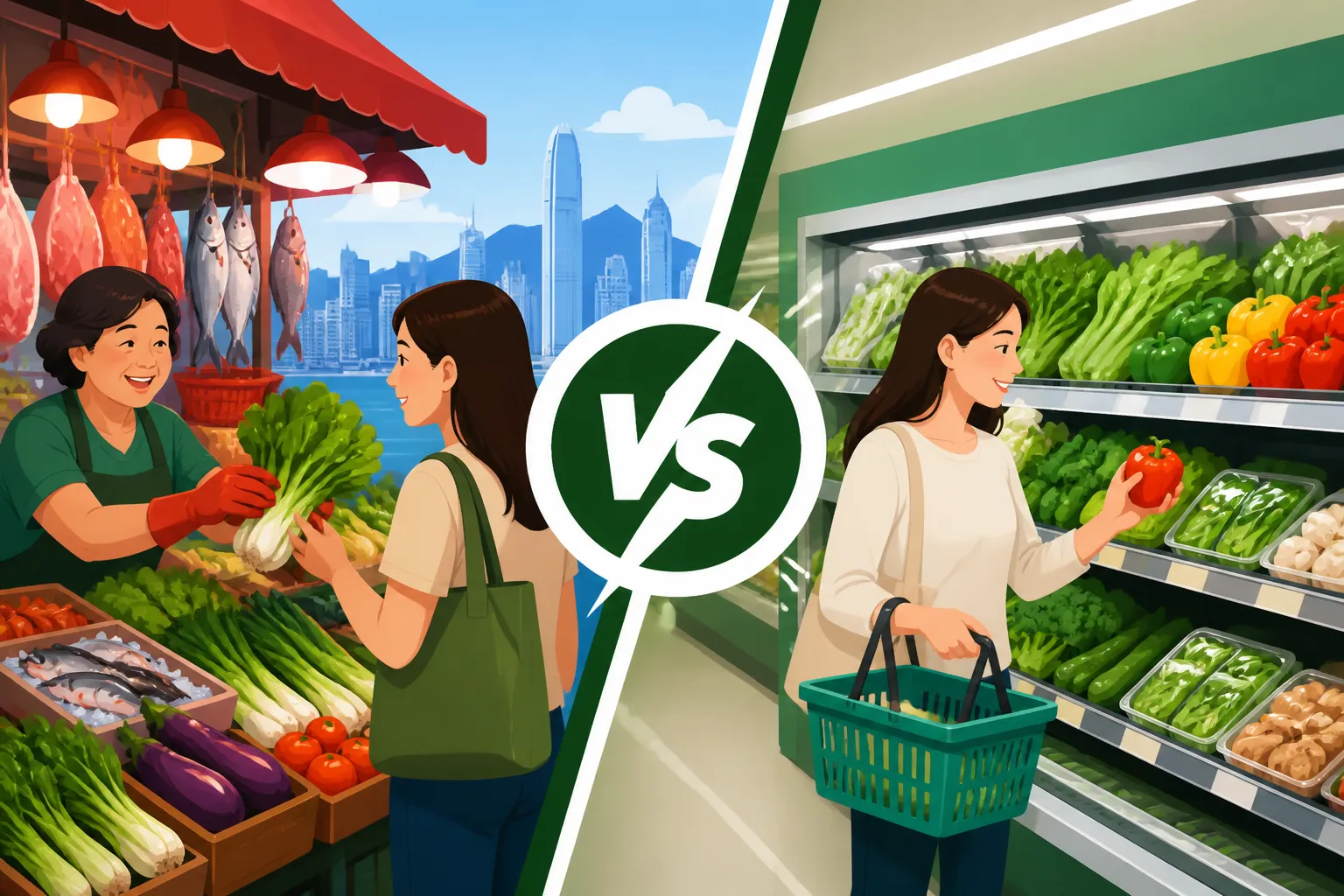
Wet Markets vs Supermarkets: Where to Get Fresh Produce
Standing in front of a $60 punnet of imported strawberries at a high-end supermarket while a bustling wet market two blocks away sells a mountain of oranges for $20 is the ultimate Hong Kong initiation. If you are struggling to balance your grocery budget without sacrificing quality, this guide navigates the chaotic, wonderful world of local markets versus the air-conditioned convenience of supermarkets.
Decoding the Hong Kong Wet Market Experience
When I first arrived in Hong Kong, the "wet market" was a sensory overload that felt both intimidating and slightly hazardous. The floors are literally wet (hence the name) from the constant hosing down of fish stalls, and the air is thick with the scent of fresh coriander, salt water, and roast meats. However, once you get past the initial shock, you realize this is where the soul of the city’s culinary scene resides. It is the only place to get "live" seafood and vegetables that were in the ground just a few hours ago.
The structure of these markets usually falls into two categories: the outdoor street markets, like those found on Graham Street in Central or Fa Yuen Street in Mong Kok, and the indoor Municipal Services Buildings. If you have recently completed your Expat Checklist for the First Week at a New HK Office, you might find the indoor markets more manageable at first. They are managed by the government and are generally cleaner, with dedicated floors for vegetables, meat, and cooked food centers.
One of the biggest hurdles for expats is the unit of measurement. While supermarkets use grams and kilograms, wet markets use the "catty" (gin). One catty is roughly 605 grams. You will often see prices written on cardboard scraps in Chinese numerals, which can be daunting. My advice? Watch what the local "Aunties" are doing. They will pick up a bunch of bok choy, hand it to the vendor, and wait for the price. Don't be afraid to use hand signals or point. Most vendors in expat-heavy areas like Wan Chai or Sai Ying Pun have a basic grasp of English numbers, but having a few Cantonese phrases for "How much?" (Gei do cin?) goes a long way.
The "extra" culture is another reason to love wet markets. If you become a regular at a vegetable stall, don't be surprised if the vendor tosses a handful of spring onions or a piece of ginger into your bag for free. This "ga sung" (adding to the dish) is a sign of rapport that you simply won't find at a self-checkout kiosk. It’s these small interactions that make you feel like a resident rather than a guest. If you are still in the process of moving and using a service like Sirelo to bring your kitchenware over, getting to know your local market is the fastest way to make your new house feel like a home.
The Supermarket Landscape From Budget to Luxury
If the wet market is the heart of Hong Kong, the supermarket is its pragmatic, air-conditioned brain. The market is dominated by a duopoly: Dairy Farm (which owns Wellcome and Market Place) and AS Watson (which owns ParknShop, Fusion, and Taste). For the average expat, these stores represent safety and familiarity. You can find your favorite cereal, imported cheeses, and cleaning supplies without having to dodge a delivery cart or a splashing fish.
However, not all supermarkets are created equal. If you are living in a managed apartment through a provider like Blueground, you are likely located near the "premium" versions of these stores. Fusion and Market Place by Jasons cater specifically to international tastes, stocking everything from Australian Wagyu to British biscuits. If you really want to splurge, City'super and Great Food Hall are the cathedrals of imported goods. Here, you can find $500 melons from Japan and a cheese counter that rivals anything in Paris. But be warned: shopping here exclusively is one of the fastest ways to blow your Everyday Budgeting in HK: Cost of Living Benchmarks (2026).
The convenience factor of supermarkets cannot be overstated. Most stay open late, and they all accept The Octopus Card: Hong Kong's Essential Transport & Payment Tool, which makes the transaction seamless. For those residing in Habyt co-living spaces, where kitchen space might be shared, the pre-washed salad bags and pre-marinated meats found in supermarkets are a lifesaver. You pay a "convenience tax" in the form of higher prices and more plastic packaging, but in a city as fast-paced as Hong Kong, sometimes that 20 minutes saved is worth the extra 20 dollars.
One specific frustration you will face in supermarkets is the "out of stock" phenomenon. Because almost everything is imported, global shipping delays can mean your favorite brand of oat milk or almond butter disappears for three weeks without warning. This is why veteran expats often adopt a "buy it when you see it" mentality for non-perishable essentials.
Price Quality and Sustainability A Side by Side Comparison
The choice between a wet market and a supermarket often comes down to what you are putting on the table tonight. For fresh leafy greens, tropical fruits, and seafood, the wet market wins on both price and quality every single time. The turnover at a busy market stall is so high that nothing sits for long. In contrast, the "fresh" produce in supermarkets is often wrapped in multiple layers of plastic, which not only traps moisture and accelerates rot but also contributes to the city's massive plastic waste problem.
If you are concerned about Food Safety in HK: Preventing Gastroenteritis in Humid Weather, the clinical look of a supermarket might feel more reassuring. However, the Hong Kong government regulates wet markets strictly. The meat you see hanging on hooks is fresh-killed that morning, which is a concept many Westerners find difficult to stomach initially. If you prefer your meat chilled and butchered into neat trays, the supermarket is your best bet. But for those brave enough to ask for a specific cut of pork at the market, the reward is a much more flavorful meal at a fraction of the cost.
Below is a quick reference to help you decide where to shop based on your needs:
| Category | Wet Market | Supermarket | Winner |
|---|---|---|---|
| Leafy Greens | Cheap, seasonal, very fresh | Pricier, often wilted in plastic | Wet Market |
| Seafood | Live in tanks, bespoke cleaning | Frozen or pre-packaged fillets | Wet Market |
| Western Staples | Rarely available (cheese, wine) | Extensive range of imports | Supermarket |
| Payment | Cash or Octopus (mostly) | Credit Cards, Apps, Octopus | Supermarket |
| Environment | Hot, loud, wet, authentic | Cold, quiet, clean, sterile | Tie (Subjective) |
| Pantry Items | Limited to local sauces/spices | Full range of flours, oils, cans | Supermarket |
When it comes to dry goods—think pasta, olive oil, toilet paper, and canned tomatoes—the wet market is virtually useless. For these items, savvy shoppers look for "dry markets" or local pharmacies (like Watsons or Mannings) which often sell household goods cheaper than the big supermarkets. Interestingly, some of the best deals for imported snacks and pantry staples can be found at "parallel import" shops like Best Mart 360 or 759 Store. These shops are a favorite among those trying to manage their Budgeting for Utilities: Electricity, Water, Gas, and Broadband in HK while still enjoying a few treats from home.
Expert Tips for Navigating Both Like a Local
To truly master the Hong Kong grocery game, you need a hybrid strategy. No veteran expat shops exclusively at one or the other. My routine usually involves a big supermarket haul once a week for heavy items and pantry staples, supplemented by 2-3 trips to the wet market for fresh protein and vegetables.
Timing is everything. If you go to the wet market at 8:00 AM, you will be competing with professional chefs and the most intense grandmothers in the city. It is high-pressure and fast-paced. If you go at 6:00 PM, the vendors are looking to clear their stock and will offer "bundle deals" (e.g., three bowls of peppers for $10). However, the selection will be picked over. For a balance of sanity and selection, 10:30 AM is the sweet spot. Supermarkets, on the other hand, are best visited late at night or during the work week to avoid the weekend "family outing" crowds that can make a simple milk run feel like a marathon.
Another tip is to keep an eye on your Dealing with Humidity and Mold in Your Apartment. Fresh produce from the wet market doesn't have the preservatives that some supermarket imports do, and in Hong Kong's 90% humidity, a bag of onions can turn into a science project in three days. Buy smaller quantities more frequently—this is how the locals do it, often because their kitchens have limited storage space anyway.
Finally, don't ignore the "Cooked Food Centres" located above many wet markets. If the heat and the crowds of shopping become too much, you can head upstairs for a cheap, delicious meal. It’s a great way to see the ingredients you just saw downstairs being put to use. Whether you are living in a high-rise in Mid-Levels or a village house in Sai Kung, mastering these two systems is essential for a sustainable lifestyle. While you are at it, make sure you have sorted your Registering Your HKID for Subsidized Public Healthcare Rates because, let's be honest, the first time you try a new chili sauce from the market, your stomach might need a moment to adjust.
Disclaimer
This guide is for informational purposes only. Prices, availability, and specific market conditions in Hong Kong are subject to change based on seasonal fluctuations, government regulations, and economic shifts. Always exercise personal judgment regarding food hygiene and safety when shopping at any retail outlet. The author is a long-term resident sharing personal experiences and does not provide professional financial or legal advice.