Accident and Emergency (A&E) Triage Categories in Public Hospitals
Standing in the middle of a crowded public hospital lobby at 2 AM, clutching a numbered ticket while your feverish child whimpers, is a rite of passage no expat wants but many of us experience. I once spent an entire rainy Tuesday evening at Queen Mary Hospital with what I thought was a broken ankle, only to realize I was at the very bottom of a very long list. This guide breaks down exactly how the Hong Kong Hospital Authority prioritizes patients so you can navigate the A&E without the soul-crushing confusion.
The Logic Behind the Triage System
When you walk into a public Accident and Emergency department in Hong Kong, the first person you see isn't a doctor; it’s a triage nurse. This is a highly trained professional whose sole job is to determine how likely you are to die or suffer permanent damage in the next hour. In a city of over seven million people, the public system is the backbone of Healthcare in Hong Kong: Public vs Private Systems Explained (2027), and it operates on a strictly "medical need" basis rather than a "first-come, first-served" basis.
The Philosophy of Need Over Turn
In many Western countries, we are used to waiting our turn, but the Hong Kong public system is designed to catch the "silent killers." You might see someone walk in after you and get whisked away immediately while you sit for hours. This isn't favoritism; it’s the triage system at work. If that person is experiencing a silent heart attack or a stroke, they are Category 1. If you have a deep gash that is bleeding but controlled, you might be Category 4.
I’ve learned the hard way that complaining to the staff about the wait time doesn't help. They are following a rigorous set of protocols established by the Hospital Authority to ensure that resources are directed where they can save the most lives. Understanding this helps manage the psychological toll of the wait. It’s also why many expats choose to carry Cigna Global coverage, allowing them to bypass these queues by heading to Private Hospitals in Hong Kong: Admission, Costs, and Insurance when the situation isn't a life-threatening emergency.
The Triage Nurse Interview
The moment you arrive, you will be directed to the triage station. The nurse will take your vitals—blood pressure, pulse, oxygen saturation, and temperature. They will ask you a series of targeted questions: "When did the pain start?" "Scale of 1 to 10?" "Any history of heart disease?" Your answers, combined with your vitals, determine your category.
It is crucial to be honest but precise. In the stress of the moment, some people tend to downplay their symptoms to avoid being a "bother," while others exaggerate. Neither helps. If you are a digital nomad or a frequent traveler, having a plan like SafetyWing can give you peace of mind, but in the public A&E, the triage nurse is the final authority on your priority level. They use the Hospital Authority (HA) Guide: Accessing Public Healthcare for Expats standards to ensure every patient is categorized fairly across all 18 public A&E departments in the territory.
The Five Triage Categories Broken Down
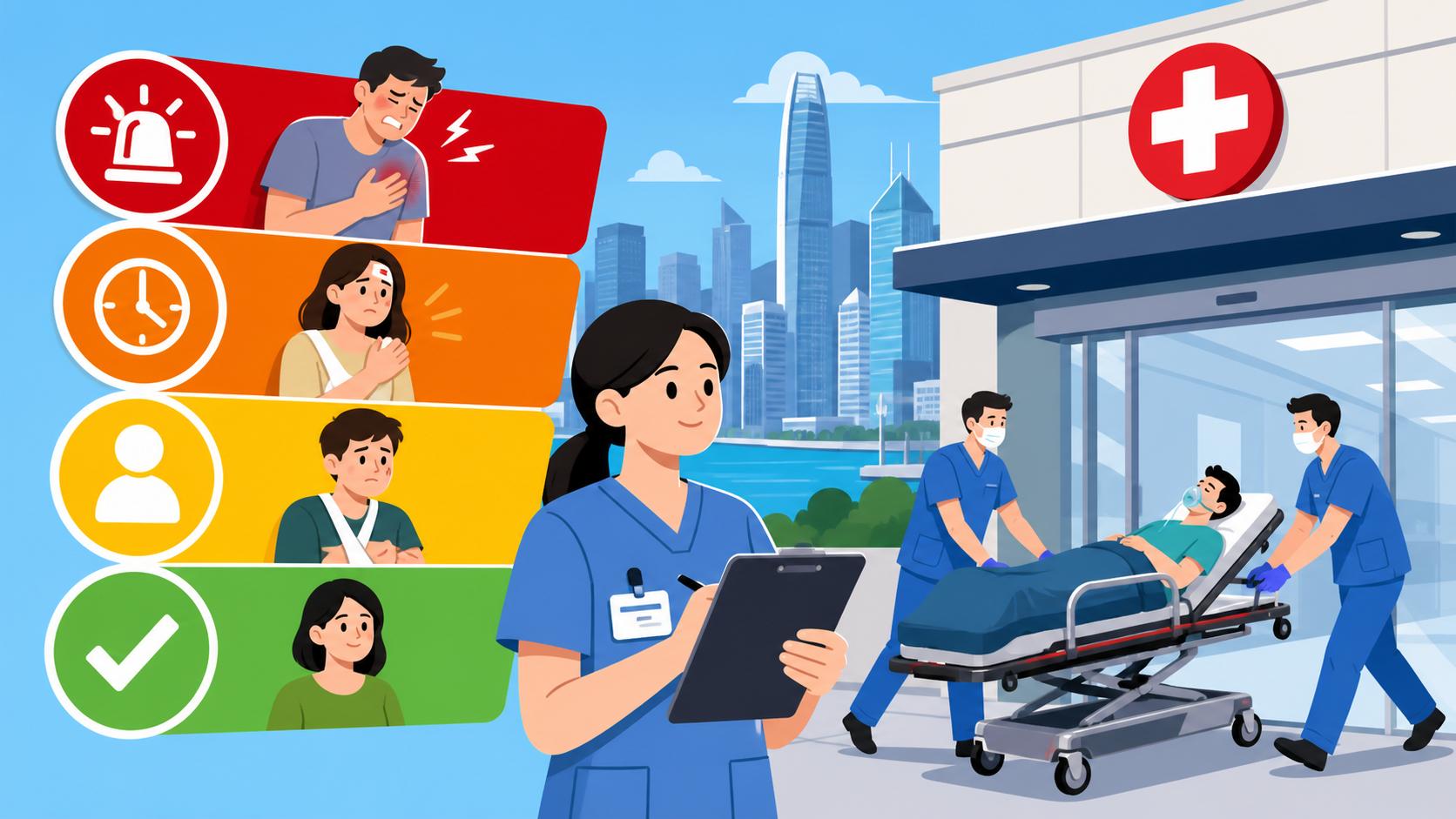
The Hong Kong triage system uses a five-level scale. Knowing where you likely fall can help you decide whether to stay in the public queue or seek private care. The categories are not just labels; they come with specific "pledged" waiting times, though the reality often exceeds these during peak flu seasons or holidays.
Category 1 and 2: Critical and Emergency
Category 1 (Critical) is for patients who are in a life-threatening condition and require immediate resuscitation. Think cardiac arrest, major trauma, or severe airway obstruction. These patients do not wait; they are taken to the "Resus" room immediately. Category 2 (Emergency) is for those with life-threatening conditions who are currently stable but could deteriorate rapidly, such as a major stroke or severe chest pain. The target is to see these patients within 15 minutes.
In these cases, the public system is actually where you want to be. The Emergency Medical Services in HK: Calling 999 and A&E Wards are world-class, and public hospitals often have more specialized trauma equipment on hand than smaller private facilities. If you or a loved one falls into these categories, the doctors will move heaven and earth for you. This is the strength of the public system—it is a literal lifesaver when seconds count.
Category 3: Urgent Cases
Category 3 (Urgent) is the middle ground. These are patients who have stable vitals but are suffering from conditions that could become serious if left untreated for a few hours. Common examples include moderate burns, severe abdominal pain that might be appendicitis, or a high fever in a very young infant. The pledged waiting time for Category 3 is usually 30 minutes, and the Hospital Authority aims to hit this target for 95% of patients.
From my experience, Category 3 is where the "real" waiting begins. While 30 minutes is the goal, if a multi-car pileup happens on the Tolo Highway, all the Category 1 and 2 cases coming in via ambulance will push you back. If you are Category 3 and have a plan from Cigna Global, you might consider if a private hospital's 24-hour outpatient clinic is a faster route, provided you are stable enough for the taxi ride.
Category 4 and 5: Semi-Urgent and Non-Urgent
This is where the vast majority of expat A&E visits end up. Category 4 (Semi-urgent) covers acute but stable conditions like a simple fracture, a sprained ankle, or a minor infection. Category 5 (Non-urgent) is for chronic conditions or minor ailments like a cold, a mild skin rash, or a small cut that needs a few stitches. For these categories, there is no pledged waiting time. You will see the Waiting Times at Public A&E: What Category 4 and 5 Actually Mean on the digital boards often exceeding 360 or 480 minutes.
During my first year in HK, I went to the A&E for a "urgent" ear infection. I was triaged as Category 5. Eight hours later, I was still sitting in the same plastic chair. The reality is that if you are Category 4 or 5, you are the lowest priority. This is why Registering Your HKID for Subsidized Public Healthcare Rates is important for the cost, but it won't buy you speed. For these minor issues, it is almost always better to find a local clinic or use Telemedicine Apps in HK: DoctorNow and Virtual Consultations rather than clogging up the A&E.
Managing Waiting Times and Expectations
The mental game of the A&E is arguably harder than the physical one. When the board says "4 hours," it usually means "at least 4 hours." In Hong Kong, public hospitals are notoriously busy, especially during the humid summer months or the winter flu peak.
Using the HA Go App for Real-Time Data
One of the best tools for any expat is the HA Go app. It provides live updates on waiting times at every public A&E in the city. Before you leave your flat, check the app. Sometimes, taking a 20-minute taxi to a hospital further away—like moving from Queen Mary in Pok Fu Lam to Pam Youde Nethersole Eastern in Chai Wan—can save you four hours of waiting.
The app also allows you to see the Hospital Authority Fees: Eligible Persons (EP) vs Non-Eligible Persons (NEP) so there are no surprises at the payment kiosk. If you are a traveler covered by SafetyWing, keep your receipts, as you will likely be paying the higher "Non-Eligible Person" rate, which is currently over HKD 1,200 per visit, compared to the HKD 180 for residents.
Why Your Wait Might Suddenly Get Longer
It is a frustrating phenomenon: you are "next" on the list, and then suddenly three more people are called before you. This usually happens because of "ambulance bypass" or "inter-hospital transfers." A public hospital's A&E doesn't just serve the people in the lobby; it serves the ambulances in the district.
If you are waiting in a hospital that is a designated trauma center, like Queen Elizabeth in Jordan, you are at the mercy of every major accident in Kowloon. This is why Navigating Medical Emergencies During T8 Typhoons or Black Rainstorms is particularly tricky; transport is limited, and the A&E becomes the only port of call for everyone, leading to massive surges in Category 4 and 5 wait times.
| Triage Category | Description | Target Waiting Time | Typical Reality (Peak) |
|---|---|---|---|
| Category 1 | Critical (Life-threatening) | Immediate | Immediate |
| Category 2 | Emergency (Severe risk) | 15 Minutes | 15–30 Minutes |
| Category 3 | Urgent (Potentially serious) | 30 Minutes | 1–3 Hours |
| Category 4 | Semi-urgent (Acute/Stable) | No Pledge | 4–10 Hours |
| Category 5 | Non-urgent (Minor/Chronic) | No Pledge | 6–12+ Hours |
Costs and Logistics for Expats
Navigating the paperwork while you're in pain is the last thing you want to do. The Hong Kong system is efficient, but it is also bureaucratic. You need to have your documents ready the moment you hit the registration desk.
Registering Your HKID for Subsidized Rates
To get the "Eligible Person" rate, you must present a valid Hong Kong Identity Card. If you’ve just arrived and haven't received your physical card yet, your "Notification of Application" (the paper slip from the Immigration Department) is usually sufficient. Without these, you will be charged the "Non-Eligible Person" (NEP) rate, which is significantly higher.
Even if you have Cigna Global or another private insurer, the public hospital will require payment upfront or a guarantee of payment. Most public hospitals now Do Public Hospitals Accept Credit Cards, Alipay, or WeChat Pay?—and the answer is yes, including Octopus cards for smaller fees. However, always carry a backup credit card just in case the electronic systems are slow.
Eligible Persons vs Non-Eligible Persons Fees
The price gap is staggering. For a resident with an HKID, an A&E visit is a flat HKD 180, which includes basic medications dispensed by the hospital pharmacy. For a tourist or someone on a visitor visa, that same visit starts at HKD 1,230. And that’s just the consultation. If you need X-rays, blood tests, or a bed in the observation ward, the costs for NEPs climb quickly.
For those without an HKID, SafetyWing is an excellent bridge. It covers those unexpected A&E visits that could otherwise cost thousands of dollars if complications arise. Always remember to ask for a formal receipt and a brief medical report before you leave, as Filing a Medical Complaint: The Medical Council of Hong Kong or even just filing an insurance claim requires specific documentation that is much harder to get after you've been discharged.
Alternatives to Public A&E
It is worth telling new arrivals: the A&E is for emergencies, not for convenience. If you can walk, talk, and aren't bleeding profusely, there are often better, faster ways to see a doctor in Hong Kong.
Private Hospitals and 24-Hour Clinics
If your budget or insurance allows, private hospitals like Matilda on the Peak or Gleneagles in Wong Chuk Hang offer 24-hour urgent care clinics. While much more expensive than the public HKD 180 fee, the wait times are usually measured in minutes, not hours. For a Category 4 or 5 issue, a private outpatient clinic will get you in and out in under an hour.
Many expats use their employer-provided insurance for these visits. It’s worth checking if your policy has a "direct billing" arrangement with specific Private Hospitals in Hong Kong: Admission, Costs, and Insurance. If not, you’ll pay out of pocket and claim back later. If you are an entrepreneur or freelancer, having a personal plan with Cigna Global ensures you have access to these premium facilities without worrying about the bill.
Finding English-Speaking General Practitioners (GPs)
For non-urgent issues like the flu, minor infections, or prescription refills, a local GP is your best friend. Areas like Central, Tsim Sha Tsui, and Discovery Bay are packed with high-quality clinics. Finding English-Speaking General Practitioners (GPs) in Central is incredibly easy, and many of these doctors have trained in the UK, Australia, or the US.
These clinics often have their own diagnostic tools for simple tests. If you need something more specific, like Dental Scaling, Polishing, and Orthodontics: Average HK Costs or a specialized check-up, your GP can provide a referral. In the public system, How Specialist Referrals Work in the HK Public System can be a long process, but in the private sector, a GP referral can get you an appointment with a specialist within days.
Practical Tips for Your A&E Visit
If you do find yourself heading to a public A&E, a little preparation goes a long way. The environment is often cold (the AC is always on high), loud, and bustling.
Language Barriers and Translation
While most doctors and triage nurses in Hong Kong speak excellent English, some of the support staff and ward cleaners might only speak Cantonese. This can be stressful when you're trying to find the bathroom or ask for a glass of water. If you don't speak the local language, have a translation app ready on your phone.
In more complex situations, you can request Medical Translation Services: Navigating Local Clinics Without Cantonese. The Hospital Authority has access to over-the-phone interpreters for various languages. Don't be afraid to ask for clarity if you don't understand the instructions the doctor is giving you regarding your Pharmacies and Medication in HK: Prescriptions and OTC Rules.
What to Pack for the Wait
Because you might be there for eight hours, you need a "survival kit." Public hospital waiting rooms aren't known for their comfort.
- A Power Bank: Your phone will die before you see a doctor.
- A Heavy Jacket: Even in 30-degree humidity outside, the A&E is an icebox.
- Water and Snacks: Vending machines are available, but they often only take Octopus or coins.
- Your HKID and Insurance Card: These are non-negotiable.
- A List of Medications: If you are taking anything regularly, have the names ready.
Understanding Public Hospital Visiting Hours: What You Need to Know Before Going is also vital if you have a friend or family member waiting with you. Often, only one person is allowed to stay with the patient in the treatment area, and during busy times, they may ask companions to wait in the main lobby to keep the clinical areas clear.
Disclaimer
The information provided in this guide is for educational and informational purposes only and does not constitute professional medical or legal advice. Hospital Authority policies, waiting times, and fees in Hong Kong are subject to change by the government. Always consult with a qualified healthcare professional or the relevant government department for specific medical concerns or up-to-date administrative requirements. In the event of a life-threatening emergency, dial 999 immediately.