Do Public Hospitals Accept Credit Cards, Alipay, or WeChat Pay?
Standing at the payment counter of a crowded public hospital after a five-hour wait, only to realize you aren't sure if they take your preferred payment method, is a stress nobody needs. I remember my first time at Queen Mary Hospital, clutching a thin paper slip and panicking because I only had a credit card and a half-empty Octopus. This guide will clarify exactly how you can pay your bills at Hong Kong public hospitals so you never face that "Shoroff" counter anxiety again.
Accepted Payment Methods at Hong Kong Public Hospitals
The Hong Kong Hospital Authority (HA) has made significant strides in the last few years to modernize its payment infrastructure. Gone are the days when you had to carry thick wads of cash for every visit, though cash is still technically accepted. Today, the system is designed to be as frictionless as possible, catering to both local residents and the growing number of expats and tourists navigating the Healthcare in Hong Kong: Public vs Private Systems Explained (2027).
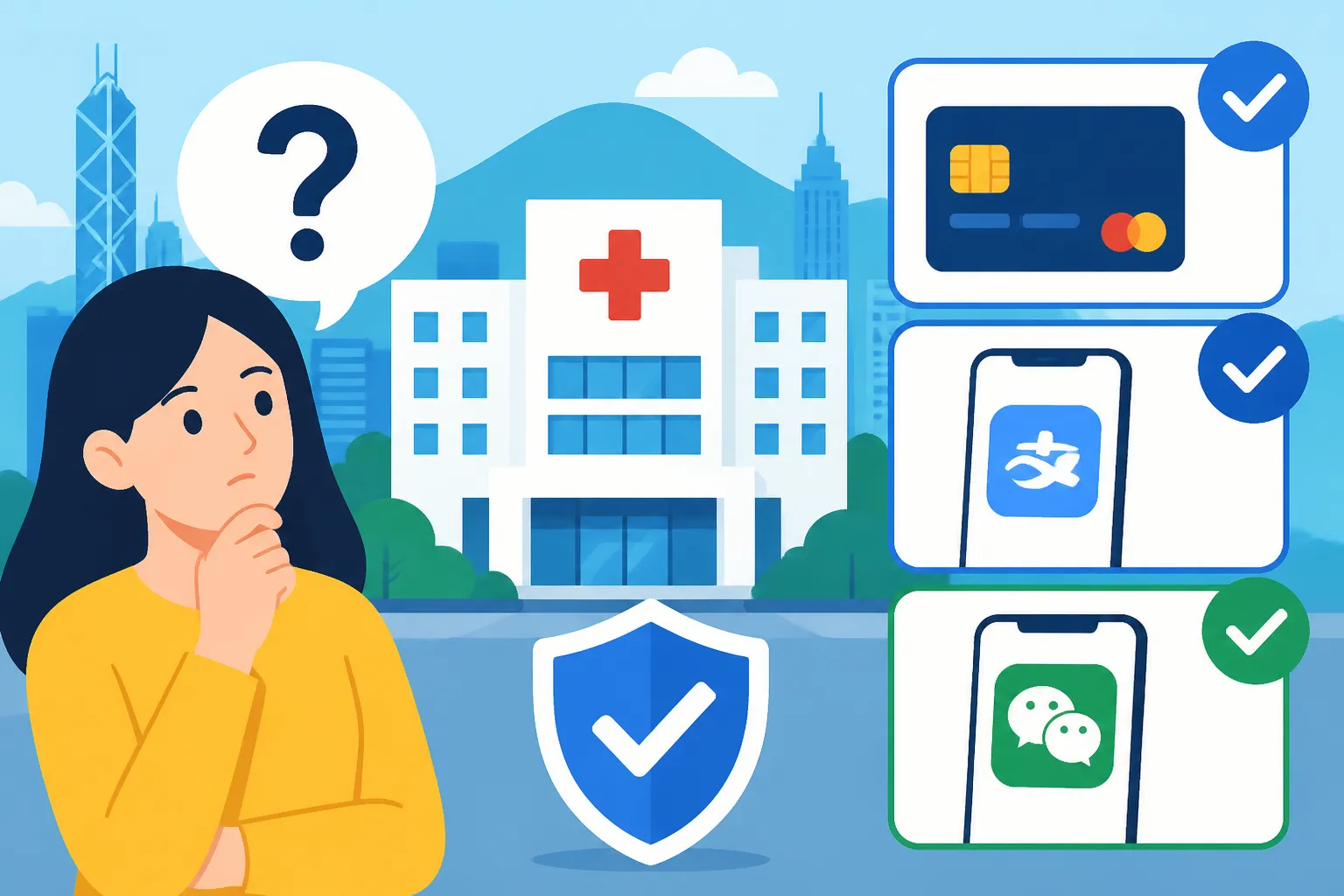
You can generally use major credit cards, including Visa and Mastercard, at almost all public hospital payment counters. This is a relief for many of us who rely on points or simply don't want to carry physical currency. In addition to plastic, the ubiquitous Octopus card remains a primary way to settle smaller outpatient fees. If you have your Octopus linked to an automatic top-up service, it is often the fastest way to breeze through the queue.
Digital wallets have also seen a massive rollout. Both AlipayHK and WeChat Pay HK are widely accepted at the Shroff (payment) counters of all public hospitals and many outpatient clinics. It is important to note that while the "HK" versions of these apps are the standard, the mainland China versions are also increasingly supported to accommodate visitors. If you are a digital nomad or a traveler using SafetyWing for your medical coverage, knowing these digital options are available can save you a trip to an ATM in the middle of a medical emergency.
Using the HA Go App for Seamless Payments
If you truly want to avoid the physical queues at the payment counters, you need to get familiar with the HA Go app. This is the official mobile application of the Hospital Authority, and it has revolutionized how we interact with the public system. After you have finished your consultation, your bill often appears automatically in the app under the "Pay HA" section.
The app supports a variety of payment methods, including credit cards and the Faster Payment System (FPS). I have found that using FPS via the HA Go app is often the most reliable method when the physical counters are backed up with people. You simply scan the QR code displayed on your bill or pay directly through the app's interface. This is especially helpful if you are Using the HA Go App for Booking Public Outpatient Clinics and want to manage everything from your smartphone.
However, a small hurdle for many expats is the registration process. To fully unlock the payment features of HA Go, you typically need to verify your identity in person at a hospital counter with your HKID. It is a one-time inconvenience that pays dividends in saved time later. For those still in their first month, it is worth adding this to your Essential Health Checklist for Your First 30 Days in Hong Kong.
Public Hospital Fees for Eligible vs Non-Eligible Persons
One of the most confusing aspects of the Hong Kong system for newcomers is the massive price gap between "Eligible Persons" and "Non-Eligible Persons." If you hold a valid Hong Kong Identity Card (HKID), you are an Eligible Person (EP) and entitled to highly subsidized rates. Without that card, you are a Non-Eligible Person (NEP), and the costs can skyrocket.
For an EP, an Accident & Emergency (A&E) visit might cost a flat fee of HK$180. For an NEP, that same visit could be over HK$1,200, excluding any specialized tests or ward stays. Because the amounts for NEPs can be quite high, the hospital's ability to accept credit cards becomes even more critical. If you are admitted for several days as a non-resident, the bill can easily reach tens of thousands of dollars.
| Service Category | Eligible Person (HKID Holder) | Non-Eligible Person (Tourist/Visitor) |
|---|---|---|
| A&E Consultation | HK$180 | HK$1,230 |
| General Outpatient | HK$50 | HK$445 |
| Specialist Outpatient (First Visit) | HK$135 | HK$1,190 |
| Acute Ward Stay (Per Day) | HK$120 | HK$5,100 |
| Intensive Care Stay (Per Day) | Subsidized rate | HK$24,400+ |
Understanding these distinctions is vital, especially if you are Registering Your HKID for Subsidized Public Healthcare Rates for the first time. If you find yourself in the NEP category, having robust international coverage from providers like Cigna Global is essential to avoid massive out-of-pocket expenses that your credit card limit might not even cover.
How to Pay Your Hospital Authority Bill Online via FPS
The Faster Payment System (FPS) is perhaps the most "Hong Kong" way to handle money. It is instantaneous and works across different banks. Public hospitals have integrated FPS into their billing slips. When you receive a physical bill, there is often a QR code at the bottom. By opening your banking app and scanning that code, you can settle the bill in seconds.
This is particularly useful for settling "after-the-fact" bills. Sometimes, in the chaos of Emergency Medical Services in HK: Calling 999 and A&E Wards, you might be discharged without settling every small laboratory fee or medication charge. The hospital will mail you a bill, and rather than trekking back to the hospital, you can use the FPS code to pay from your living room.
If you are a frequent user of the system or are Managing Chronic Conditions: Diabetes and Hypertension in HK, mastering How to Pay Your Hospital Authority Bill Online via FPS will save you hours of standing in line over the course of a year. It is one of those small administrative wins that makes expat life in this city much more bearable.
Insurance Reimbursement and the Payment Process
One point of frustration often raised by expats is that public hospitals do not offer "direct billing" for private insurance. Even if you have the most premium plan from Cigna Global, the public hospital will expect you to pay the bill yourself first. You will then need to take the official receipt and file a claim for reimbursement.
This is a stark contrast to Private Hospitals in Hong Kong: Admission, Costs, and Insurance, where the administrative staff often coordinates directly with your insurance provider. At a public hospital like Queen Mary or Queen Elizabeth, the staff at the Shroff are focused on high-volume processing. They will give you a standard receipt, but they won't fill out your specific insurance claim forms for you on the spot.
If you are a traveler using SafetyWing, make sure you keep every single piece of paper the hospital gives you. To get your money back, you will need the itemized breakdown of charges. If you lose that original receipt, getting a duplicate from the Hospital Authority can be a bureaucratic nightmare involving written requests and wait times of several weeks.
Practical Tips for Your Hospital Visit
The layout of Hong Kong public hospitals can be a maze. The "Shroff" or payment office is not always located right next to the doctor's office. In many hospitals, you have to go to a centralized billing area. Always look for the signs that say "Accounts" or "Shroff." If you are at a large facility, there may be different payment windows for inpatient and outpatient services.
Another tip is to check the balance on your Octopus card before you arrive. While you can pay with a credit card, the Octopus is often the only method accepted at some of the smaller, older pharmacy counters within the hospital complex. If you need to buy a specific brace or a small medical device not covered by the general bill, having a loaded Octopus card is a lifesaver.
For those navigating Hospital Authority Fees: Eligible Persons (EP) vs Non-Eligible Persons (NEP), always carry your physical HKID card. While the "e-HKID" on the GovHK app is increasingly accepted, some hospital systems still prefer the physical card for registration to ensure you get the subsidized rate. If you forget your card, you may be charged the full NEP rate and have to return later with the card to seek a refund of the difference, which is a time-consuming process.
Handling Large Bills and Payment Installments
In rare cases where a bill is exceptionally large—perhaps due to a long stay in an intensive care unit for a non-resident—the Hospital Authority does have a medical fee waiving mechanism. However, this is primarily designed for low-income residents and is quite difficult for expats to access.
If you are facing a bill that exceeds your credit card limit, the first step is to speak with the Medical Social Services department within the hospital. They can sometimes help facilitate payment plans or provide guidance on how to handle the debt. However, the best defense is always a comprehensive insurance policy. Whether it is SafetyWing for short-term stays or Cigna Global for long-term residency, having that financial cushion ensures you aren't negotiating payment terms while trying to recover from an illness.
Remember that Public Hospitals in Hong Kong: Public vs Private Systems Explained (2026) provide world-class care, but their administrative systems are built for efficiency and volume. They expect prompt payment at the time of discharge. By ensuring your credit cards are active, your HA Go app is verified, and your insurance paperwork is in order, you can focus on what actually matters: getting better.
Understanding the Difference Between Rx and Hospital Pharmacy Fees
When you are prescribed medication in a public hospital, you will often have to pay a separate fee for the drugs. For Eligible Persons, this is usually a flat fee per drug item (often HK$15). For Non-Eligible Persons, the drugs are charged at the "at cost" price, which can be significantly higher for specialized medications.
These pharmacy fees are usually paid at the same Shroff counter where you pay for your consultation. You will get a receipt with a "collection number." You then take this receipt to the pharmacy window and wait for your number to be called. It is a two-step process: pay first, then collect.
If you are looking for more flexibility, you might want to read about Pharmacies and Medication in HK: Prescriptions and OTC Rules. Sometimes, it is easier to take a prescription to a private pharmacy, although it will almost certainly be more expensive than the subsidized public hospital price. Knowing The Difference Between Registered Pharmacies (Rx) and Drug Stores will help you identify where you can actually get your prescriptions filled if you choose to go the private route.
Disclaimer
This guide is for informational purposes only and reflects the payment policies of the Hong Kong Hospital Authority as of 2026. Hospital policies and fee structures are subject to change by the Hong Kong government. Always verify current payment methods and costs directly with the hospital staff or the official Hospital Authority website before seeking treatment. Medical insurance coverage depends on your individual policy terms.