Sleep Clinics and Sleep Apnea Testing Facilities in Hong Kong
Waking up exhausted despite eight hours of rest is a common Hong Kong refrain, usually blamed on the city's relentless pace or the hum of a neighbor's air conditioner. I spent my first two years here thinking my chronic fatigue was just "part of the hustle" until a sleep study revealed I was stopping breathing thirty times an hour. This guide maps out the specialized sleep clinics and testing facilities across the territory to help you reclaim your energy.
The Landscape of Sleep Medicine in Hong Kong
The struggle for quality rest is magnified by the unique environment of Hong Kong. High-density living, significant light pollution, and the ubiquitous "OT" (overtime) culture mean that sleep disorders often go undiagnosed or are dismissed as lifestyle-related stress. However, Obstructive Sleep Apnea (OSA) is a clinical condition that requires professional intervention. When navigating the medical landscape, the first hurdle is deciding between the public and private sectors.
In the public system, managed by the Hospital Authority, you will find world-class respiratory and ENT (Ear, Nose, and Throat) specialists who handle sleep disorders. The primary challenge here is the timeline. For a non-emergency sleep study, wait times at public clusters can stretch from eighteen months to over two years. If you are noticing symptoms like loud snoring, morning headaches, or sudden gasping for air at night, a two-year wait can feel like an eternity.
Conversely, the private sector offers immediate access but at a premium. Private hospitals and dedicated sleep centers can often book a diagnostic study within a week. For many expats, the choice depends heavily on their insurance coverage. Brands like Cigna Global are frequently used by long-term residents to bypass these public queues, providing coverage for both the diagnostic phase and the subsequent treatment, such as CPAP (Continuous Positive Airway Pressure) machines.
Recognizing the Symptoms in a High-Stress Environment
Before booking a clinic, it is vital to distinguish between general insomnia and sleep apnea. Insomnia is often linked to the "always-on" nature of Hong Kong life, where Mental Health in Hong Kong: Counseling and Expat Support Services can be more effective. However, if your partner complains about your snoring or if you find yourself nodding off during an afternoon MTR ride, you likely need a physiological assessment.
Common indicators of sleep apnea in the local context include:
- Extreme daytime somnolence, even after a "full" night of sleep.
- Waking up with an extremely dry throat or a heavy headache.
- Observation of breathing pauses by a partner.
- Difficulty concentrating during high-pressure work meetings.
If you suspect OSA, your first step should be Finding English-Speaking General Practitioners (GPs) in Central or your local neighborhood. A GP will conduct a preliminary screening, often using the Epworth Sleepiness Scale, and then refer you to a specialist or a sleep lab for a formal study.
Leading Sleep Clinics and Testing Facilities
Hong Kong is home to several prestigious facilities equipped with the latest polysomnography (PSG) technology. These labs are designed to monitor your brain waves, blood oxygen levels, heart rate, and breathing during sleep.
Private Hospital Sleep Labs
The most comprehensive testing is found within the major private hospitals. These facilities offer "Level 1" sleep studies, which are the gold standard for diagnosis. You typically check in during the evening and spend the night in a private room that looks more like a hotel suite than a clinical ward.
- Matilda International Hospital: Located on The Peak, Matilda is a favorite for the expat community due to its high level of privacy and English-speaking staff. Their sleep assessment packages are comprehensive, often bundled with ENT consultations.
- Hong Kong Sanatorium & Hospital: Situated in Happy Valley, this is arguably the most advanced private hospital in the city. Their Sleep Center utilizes sophisticated diagnostic equipment and has a team of dedicated respiratory physicians.
- Hong Kong Adventist Hospital: With locations in both Stubbs Road and Tsuen Wan, Adventist offers specialized sleep diagnostic services. They are well-versed in handling international insurance claims, making the process smoother for those with Private Health Insurance Plans Beyond VHIS for Expat Families.
Specialized Sleep Centers
Outside of the large hospital settings, there are dedicated clinics that focus solely on sleep hygiene and respiratory health. These are often more "boutique" in their approach and can be slightly more cost-effective than a full hospital admission.
Centers like the Hong Kong Sleep Medicine Centre provide both in-lab testing and the increasingly popular Home Sleep Apnea Testing (HSAT). For digital nomads or those on shorter assignments who might be using SafetyWing for their medical needs, these specialized centers offer a streamlined path to diagnosis without the overhead of a major hospital stay.
| Facility Type | Average Cost (HKD) | Wait Time | Diagnostic Level |
|---|---|---|---|
| Public Hospital (HA) | Subsidized (HKD 100-200) | 18 – 24 Months | Level 1 (PSG) |
| Private Hospital | HKD 12,000 – 22,000 | 3 – 7 Days | Level 1 (PSG) |
| Dedicated Sleep Clinic | HKD 8,000 – 15,000 | 5 – 10 Days | Level 1 or 2 |
| Home Sleep Test (HSAT) | HKD 3,500 – 6,000 | 1 – 3 Days | Level 3 (Portable) |
The Diagnostic Process: From Wires to Results
Understanding what happens during a sleep study can alleviate the anxiety of spending a night in a clinic. If you are referred for a full polysomnography, you will arrive at the facility around 8:00 PM or 9:00 PM.
In-Lab Polysomnography (PSG)
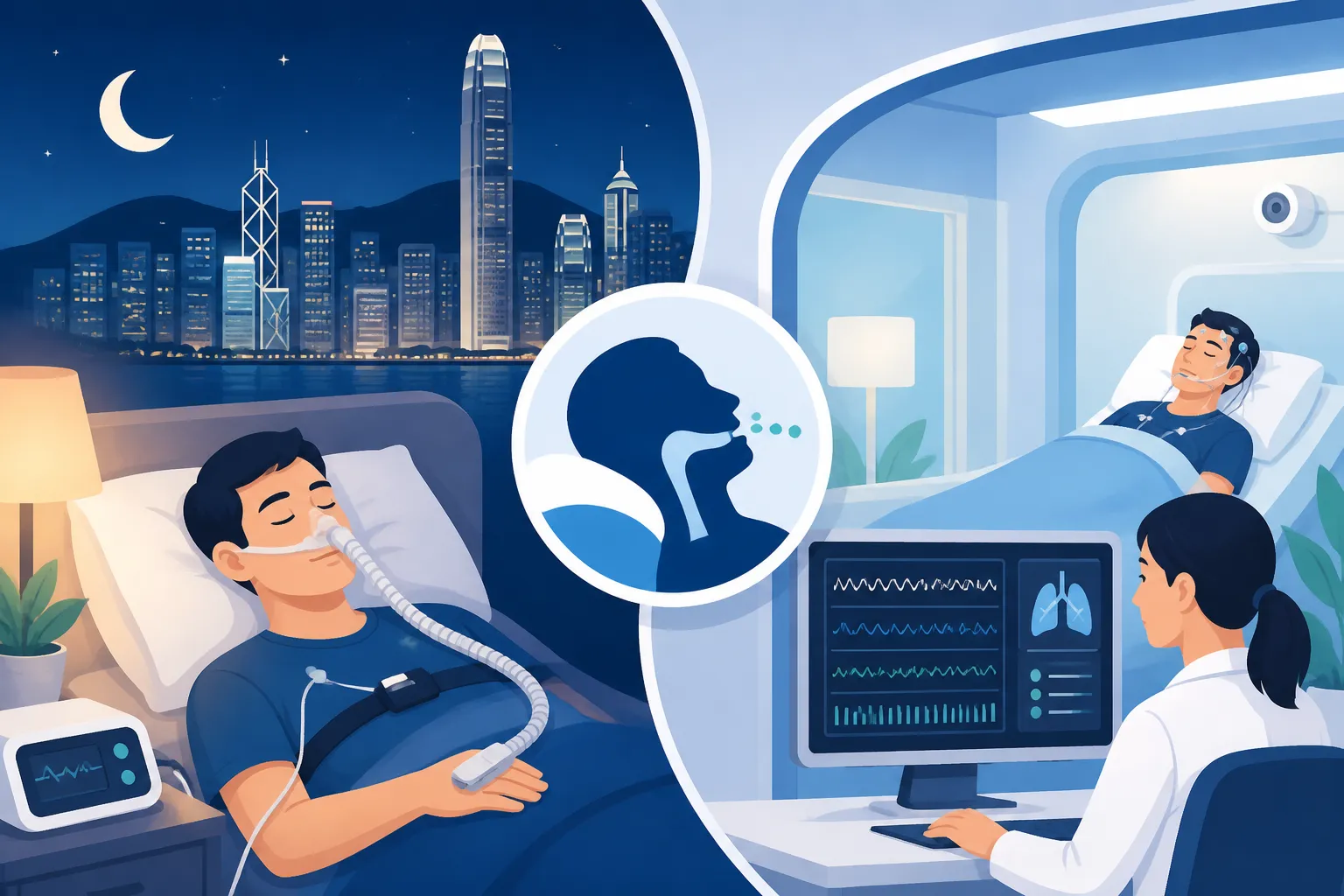
The PSG is an intensive monitoring process. A technician will apply various sensors to your body: EEG electrodes on your scalp to track sleep stages, EOG sensors near your eyes to monitor REM sleep, and EMG sensors on your chin and legs to detect muscle movements or restless leg syndrome. Additionally, belts are placed around your chest and abdomen to measure breathing effort, and a pulse oximeter is attached to your finger to monitor oxygen saturation.
While it sounds invasive, most people find they can sleep relatively well after the initial "wired up" feeling fades. The goal is to capture at least six hours of data. In Hong Kong's private hospitals, these rooms are soundproofed and climate-controlled, which is a welcome relief if you are used to the noise of a typical Kowloon street. For more on how these facilities operate, see Private Hospitals in Hong Kong: Admission, Costs, and Insurance.
Home Sleep Apnea Testing (HSAT)
For those with a high probability of moderate-to-severe OSA and no other significant comorbidities (like heart failure or advanced lung disease), a Home Sleep Apnea Test might be recommended. This is a significantly more convenient and cheaper option.
The clinic will provide you with a portable device—usually a small kit including a nasal cannula, a chest belt, and a finger sensor. You set this up yourself before going to bed in your own home. While it collects less data than a full PSG (it doesn't track brain waves, for instance), it is highly effective at identifying breathing pauses and oxygen drops. This is often the preferred route for busy professionals who cannot spare a night away from home or for those whose Essential Health Checklist for Your First 30 Days in Hong Kong includes addressing sleep issues immediately upon arrival.
Costs, Insurance, and Post-Diagnosis Treatment
The financial aspect of sleep medicine in Hong Kong can be complex. Unlike a standard GP visit, sleep studies are considered "specialized diagnostics" and often require pre-authorization from your insurance provider.
Navigating Insurance and Direct Billing
Most international insurance plans, including Cigna Global, will cover sleep apnea testing if it is deemed medically necessary by a specialist. It is crucial to obtain a referral letter from a GP or a specialist before booking your study.
Many of the top-tier private hospitals have direct-billing arrangements with major insurers. If your plan is eligible, you can walk into a facility like Matilda or the Sanatorium and only pay your deductible or co-pay. If you are unsure about your coverage, it is worth Finding a Direct-Billing Clinic for International Expat Insurance to see which providers are currently in-network for sleep diagnostics.
For those without comprehensive coverage, perhaps traveling on a plan like SafetyWing, you should expect to pay the full cost upfront and then attempt to claim it back. In such cases, the Home Sleep Test is often the most pragmatic financial choice.
Treatment and CPAP Titration
If the results of your study indicate sleep apnea, the most common treatment is CPAP therapy. This involves wearing a mask connected to a machine that provides a continuous stream of air to keep your airway open.
The "titration" process—finding the right air pressure for you—sometimes requires a second night in the sleep lab. However, modern "Auto-CPAP" machines can often be set up at home. In Hong Kong, you can purchase these machines from specialized distributors like Celki Medical or HomeCare Medical. Be prepared for the cost of the machine itself, which typically ranges from HKD 7,000 to 15,000.
Managing sleep apnea is a long-term commitment, much like Managing Chronic Conditions: Diabetes and Hypertension in HK. Regular follow-ups with your respiratory physician are necessary to ensure the pressure settings remain optimal and to monitor your compliance with the therapy.
Accessing the Public System for Sleep Disorders
If you are a holder of a Hong Kong Identity Card, you are entitled to use the public healthcare system at heavily subsidized rates. This is an excellent option for those on a budget, provided the condition is not immediately life-threatening.
The Referral Pathway
To enter the public system, you must first visit a General Outpatient Clinic (GOPC). You can use the Using the HA Go App for Booking Public Outpatient Clinics system to secure an appointment. Present your symptoms to the doctor, who will then issue a referral to the Specialist Outpatient Clinic (SOPC), usually under the Department of Medicine (Respiratory) or ENT.
Once at the SOPC, you will be "triaged." If your symptoms are severe—for example, if you have fallen asleep while driving or have significant cardiac issues—you may be moved up the list. Otherwise, you will be placed in the stable queue. For a deep dive into how these rates and categories work, refer to the Hospital Authority (HA) Guide: Accessing Public Healthcare for Expats.
Public Hospital Facilities
Major teaching hospitals such as Queen Mary Hospital (HK Island), Prince of Wales Hospital (Sha Tin), and Queen Elizabeth Hospital (Kowloon) have dedicated sleep laboratories. These labs are staffed by leading academic experts in sleep medicine.
While the wait is long, the quality of care is exceptional. For some, the strategy is to pay for a private diagnostic study to get an immediate answer and then transfer to the public system for long-term management and CPAP supplies. This hybrid approach is a common way to navigate Public vs Private Psychiatric Care: Waiting Times and Costs and other specialized medical services in the city.
Strategic Tips for Better Sleep in Hong Kong
While waiting for your appointment or adjusting to a CPAP machine, there are local-specific adjustments you can make to improve your sleep hygiene. Hong Kong's humidity and noise are significant factors that can exacerbate sleep disorders.
- Humidity Control: High humidity can make breathing feel more labored and encourage the growth of mold, which triggers allergies. Investing in a high-quality dehumidifier is essential.
- Blackout Solutions: The "city that never sleeps" is bright. Even at 3:00 AM, streetlights and signage can bleed into your bedroom. Use heavy blackout curtains or a high-quality eye mask.
- Noise Management: If you live near a construction site or a busy road, white noise machines or high-fidelity earplugs are worth the investment.
- Consulting TCM: Some residents find that integrating Western diagnostics with traditional methods helps manage the stress components of sleep. You can explore this further in our guide to Traditional Chinese Medicine (TCM) in HK: A Guide for Foreigners.
Taking the step to visit a sleep clinic is often the turning point for many expats who have struggled with "unexplained" fatigue for years. Whether you choose the efficiency of a private hospital like the Sanatorium or the subsidized route of the Hospital Authority, addressing sleep apnea is one of the most impactful things you can do for your long-term health in Hong Kong.
Disclaimer
This article is for informational purposes only and does not constitute professional medical advice, diagnosis, or treatment. Always seek the advice of your physician or other qualified health provider with any questions you may have regarding a medical condition. The Hong Kong healthcare landscape and insurance policies are subject to change; please verify all costs and waiting times directly with the facilities mentioned.